Saturday, January 28, 2017

The Truth About Hemorrhoids

webmd logo Daily
Saturday, January 28, 2017
Missing Images
The Truth About Hemorrhoids

They're more common than you think. They're painful. And nobody wants to talk about them. Here's what you need to know.
View Slideshow

What Do You Give Up?

Dieting takes work -- and sacrifice. What food do you give up to lose weight?
Tell Us Your Story
Trending Videos
What Is Sepsis?
ABCs of a Pregnancy Test
Learn What Vertigo Feels Like
Things to Know About Cholera
Flu Symptoms and Remedies
From the WebMD Network
UTIs in Adults
Physical Growth of Newborns
Hematomas and Bruises
Featured
What May Replace Affordable Care Act?
How to Handle Hair Loss From Chemo
Famous Faces of Schizophrenia
Foods to Help Erectile Dysfunction
Nerve Pain Explained
ADVERTISEMENT
 
ADVERTISEMENT
 
 
From Our Sponsor
Track Healthy Habits With Walgreens
 
ADVERTISEMENT
Allergy App  
ADVERTISEMENT


BREAKING: Trump says immigration ban 'working out very nicely' as protests, dozens of detainments hit airports

Having trouble viewing this email? | View it in your browser

FB TW g+ Ins

  The fallout from President Trump's temporary ban on refugees to the U.S. struck with full force Saturday, blocking some travelers from boarding their planes overseas, forcing others to turn around upon arrival in the U.S., and prompting customs agents at New York's JFK Airport to detain at least a dozen people. About 50 people were detained at Dallas-Fort Worth International Airport and some families were left waiting for hours for relatives stuck in the process. The growing chaos also sparked legal challenges, airport protests, condemnations from politicians and denunciations from advocacy groups. In his first remarks on the order since he signed it, Trump said: "It's not a Muslim ban but it's working out very nicely. We're going to have a strict ban, and we're going to have extreme vetting, which we should have had in this country for many years."

FOR MORE ON THIS STORY, GO TO:
  USATODAY.COM  
 

Help | Advertise | Home Delivery | Privacy Policy - Your California Privacy Rights  
  © 2017 USA TODAY, a division of Gannett Satellite Information Network, LLC.
7950 Jones Branch Drive, McLean, VA 22108


BREAKING: Kremlin: Trump, Putin agree to coordinate on fighting Islamic State

Having trouble viewing this email? | View it in your browser

FB TW g+ Ins

  President Trump and Russian counterpart Vladimir Putin spoke by phone Saturday and agreed to establish "real coordination" to "crush ISIS and other terrorist groups in Syria," the Kremlin said, referring to the Islamic State. Cooperation with Russia in Syria would represent a break with current policy and a rift among Republican foreign policy leaders. Sen. John McCain, R.-Ariz., on Friday warned Trump against cooperating too closely with Putin, whom he accused of propping up a "murderous regime" in Syria. The White House has not yet issued a statement on the call.

FOR MORE ON THIS STORY, GO TO:
  USATODAY.COM  
 

Help | Advertise | Home Delivery | Privacy Policy - Your California Privacy Rights  
  © 2017 USA TODAY, a division of Gannett Satellite Information Network, LLC.
7950 Jones Branch Drive, McLean, VA 22108


Four Planet System Directly Imaged In Motion

New post on Universe Today

Four Planet System Directly Imaged In Motion

by Matt Williams

Located about 129 light years from Earth in the direction of the Pegasus constellation is the relatively young star system of HR 8799. Beginning in 2008, four orbiting exoplanets were discovered in this system which - alongside the exoplanet Formalhaut b - were the very first to be confirmed using the direct imaging technique. And over time, astronomer have come to believe that these four planets are in resonance with each other.

In this case, the four planets orbit their star with a 1:2:4:8 resonance, meaning that each planet's orbital period is in a nearly precise ratio with the others in the system. This is a relatively unique phenomena, one which inspired a Jason Wang - a graduate student from the Berkeley arm of the NASA-sponsored Nexus for Exoplanet System Science (NExSS) - to produce a video that illustrates their orbital dance.

Using images obtained by the W.M. Keck Observatory over a seven year period, Wang's video provides a glimpse of these four exoplanets in motion. As you can see below, the central star is blacked out so that the light reflecting off of its planets can be seen. And while it does not show the planets completing a full orbital period (which would take decades and even centuries) it beautifully illustrates the resonance that exists between the star's four planets.

As Jason Wang told Universe Today via email:

"The data was obtained over 7 years from one of the 10 meter Keck telescopes by a team of astronomers (Christian Marois, Quinn Konopacky, Bruce Macintosh, Travis Barman, and Ben Zuckerman). Christian reduced each of the 7 epochs of data, to make 7 frames of data. I then made a movie by using a motion interpolation to interpolate those 7 frames into 100 frames to get a smooth video so that it's not choppy (as if we could observe them every month from Earth)."

The images of the four exoplanets were originally captured by Dr. Christian Marois of the National Research Council of Canada's Herzberg Institute of Astrophysics. It was in 2008 that Marois and his colleagues discovered the first three of HR 8799's planets - HR 8799 b, c and d - using direct imaging technique. At around the same time, a team from UC Berkeley announced the discovery of Fomalhaut b, also using direct imaging.

These planets were all determined to be gas giants of similar size and mass, with between 1.2 and 1.3 times the size of Jupiter, and 7 to 10 times its mass. At the time of their discovery, HR 8799 d was believed to be the closest planet to its star, at a distance of about 27 Astronomical Units (AUs) - while the other two orbit at distances of about 42 and 68 AUs, respectively.
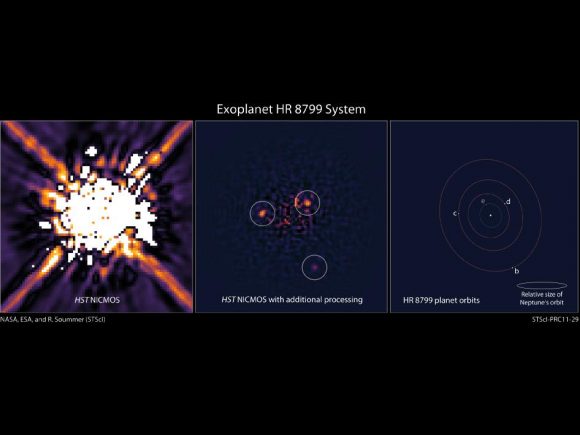
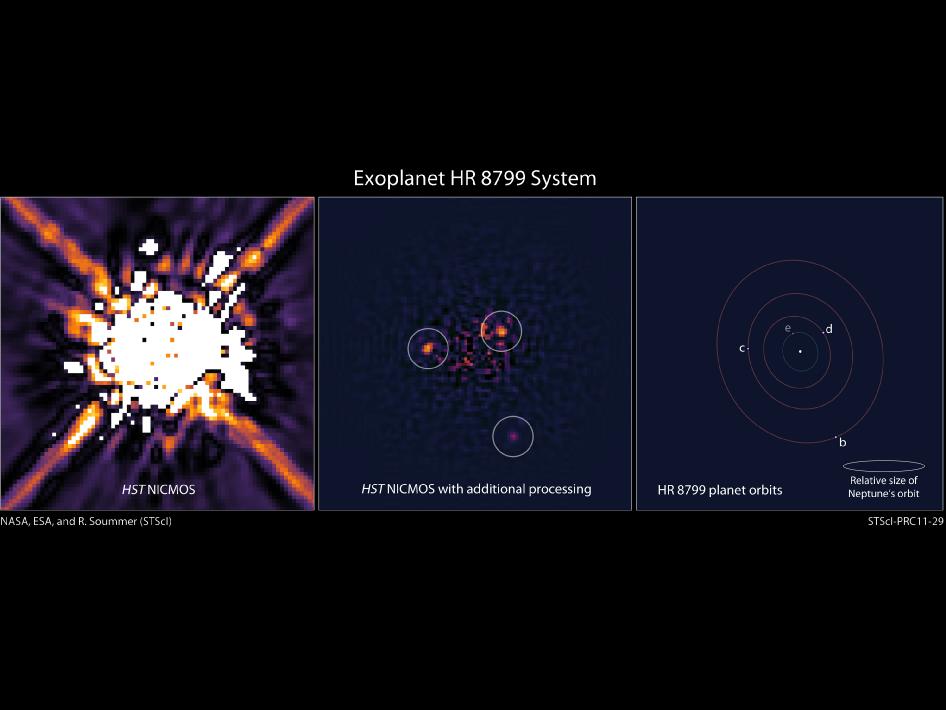
Image of HR 8799 (left) taken by the HST in 1998, image processed to remove scattered starlight (center), and illustration of the planetary system (right). Credit: NASA/ESA/STScI/R. Soummer

It was only afterwards that the team realized the planets had already been observed in 1998. Back then, the Hubble Space Telescope's Near Infrared Camera and Multi-Object Spectrometer (NICMOS) had obtained light from the system that indicated the presence of planets. However, this was not made clear until after a newly-developed image-processing technique had been installed. Hence, the "pre-discovery" went unnoticed.

Further observations in 2009 and 2010 revealed the existence of fourth planet - HR 8799 e - which had an orbit placing it inside the other three. Even so, this planet is fifteen times farther from its star than the Earth is from the Sun, which results in an orbital period of about 18,000 days (49 years). The others take around 112, 225, and 450 years (respectively) to complete an orbit of HR 8799.

Ultimately, Wang decided to produce the video (which was not his first), to illustrate how exciting the search for exoplanets can be. As he put it:

"I had written this motion interpolation algorithm for another exoplanet system, Beta Pictoris b, where we see one planet on an edge-on orbit looking like it's diving into its star (it's actually just circling in front of it). We wanted to do the same thing for HR 8799 to bring this system to life and share our excitement in directly imaging exoplanets. I think it's quite amazing that we have the technology to watch other worlds orbit other stars."

In addition, the video draws attention to a star system that presents some unique opportunities for exoplanet research. Since HR 8799 was the first multi-planetary system to be directly-imaged means that astronomers can directly observe the orbits of the four planets, observe their dynamical interactions, and determine how they came to their present-day configuration.

Astronomers will also be able to take spectra of these planet's atmospheres to study their composition, and compare this to our own Solar System's gas giants. And since the system is really quite young (just 40 million years old), it can tell us much about the planet-formation process. Last, but not least, their wide orbits (a necessity given their size) could mean the system is less than stable.

In the future, according to Wang, astronomers will be watching to see if any planets get ejected from the system. I don't know about you, but I would consider a video that illustrates one of HR 8799's gas giants getting booted out of its system would be pretty inspiring too!

Further Reading: NASA

Matt Williams | January 28, 2017 at 3:34 pm | Tags: Featured | URL: http://wp.me/p1CHIY-yCz
Comment    See all comments

Trouble clicking? Copy and paste this URL into your browser: 

http://www.universetoday.com/133087/four-planet-system-directly-imaged-motion/


BREAKING: From New York to Arizona, U.S. immigrants react to ban: 'Our president is trying to divide us'

Having trouble viewing this email? | View it in your browser

FB TW g+ Ins

  Some of the nation's immigrants watched in trepidation as President Trump's immigration ban went into effect with abrupt results Saturday. The executive order temporarily banning all refugees - as well as more specific restrictions on predominantly Muslim countries - drew lawsuits, protests and outrage on social media as travelers were stopped from boarding U.S.-bound planes and detained at international airports. In parts of Arizona, New York and Kentucky, some immigrants already in the country were enveloped in feelings of fear and uncertainty. The USA TODAY Network wrote about their stories.

FOR MORE ON THIS STORY, GO TO:
  USATODAY.COM  
 

Help | Advertise | Home Delivery | Privacy Policy - Your California Privacy Rights  
  © 2017 USA TODAY, a division of Gannett Satellite Information Network, LLC.
7950 Jones Branch Drive, McLean, VA 22108


BREAKING: Trump immigration ban creates 'complete chaos,' 1,000 calls to advocacy group as criticism and reaction mount

Having trouble viewing this email? | View it in your browser

FB TW g+ Ins

  Donald Trump's first week in office was a dizzying one and there was no letting up on the action Saturday, which turned into a full working day at the White House, as refugees were stopped from boarding U.S.-bound planes and criticism over the president's latest executive order blossomed. People flooded social media with tales of stranded family, two-time Oscar nominee Asghar Farhad won't be able to enter the USA for the Academy Awards and the fallout began hitting U.S. cities from New York to Arizona even as civil liberties group pledged to file lawsuits.

FOR MORE ON THIS STORY, GO TO:
  USATODAY.COM  
 

Help | Advertise | Home Delivery | Privacy Policy - Your California Privacy Rights  
  © 2017 USA TODAY, a division of Gannett Satellite Information Network, LLC.
7950 Jones Branch Drive, McLean, VA 22108