Monday, November 28, 2016

Malaysia: Babies for Sale


November 28, 2016

Battle for Mosul: ISIL's innocent victims

Iraqi medics on Mosul frontline say growing proportion of the patients they treat are non-combatants.

A brief history of war and drugs: From Vikings to Nazis

From World War II to Vietnam and Syria, drugs are often as much a part of conflict as bombs and bullets.


OPINION

In Gaza, we aren't mourning Clinton's loss


Bill Clinton, George Bush, Barack Obama, none of them tried to allay Palestine's misery. Hillary wouldn't have either.


OPINION

Fidel Castro in context


The revolutionary's achievements in the face of US meddling made him a powerful symbol of resistance against hegemony.


Egypt-Israel relations 'at highest level' in history


On the 39th anniversary of Sadat's speech in Jerusalem, the two countries have never been closer, analysts say.


The Britannic and the Titanic: A story of two ships


Sunken giant at the bottom of the Aegean: The Britannic, a diver's paradise, provides clues to mysteries of the Titanic.


OPINION

Canada at risk of sinking in Trump's political tsunami


Neighbouring nations Canada and the US head into an economic storm caused by the US election.


OPINION

The Oromo protests have changed Ethiopia


The struggle of the Oromo people has finally come to the attention of the global public conscience.

 
PROGRAMMES HIGHLIGHTS


Cuba's Unfinished Spaces


Castro's dream for Cuba's artists and the three architects who tried to make it a reality.


Malaysia: Babies for Sale


101 East investigates the sinister world of baby selling in Malaysia, where infants are sold to the highest bidder.

 
Forward this email to a friend
If you no longer wish to receive emails please unsubscribe
Trouble viewing the email? View in browser


This email was sent to mantiskhiralla@gmail.com
why did I get this?    unsubscribe from this list    update subscription preferences
Al Jazeera English · P.O. Box 23127 · TV Roundabout · Doha - · Qatar


NASA Digest, Vol 42, Issue 13


  November 28, 2016 
RELEASE 16-110
NASA's ISS-RapidScat Earth Science Mission Ends
ISS-RapidScat wind speed data from a North Atlantic storm in October 2014
ISS-RapidScat wind speed data from a North Atlantic storm in October 2014, as seen by the National Centers for Environmental Prediction Advanced Weather Interactive Processing System used by weather forecasters at NOAA's Ocean Prediction Center.
Credits: NASA/JPL-Caltech/NOAA

NASA's International Space Station Rapid Scatterometer (ISS-RapidScat) Earth science instrument has ended operations following a successful two-year mission aboard the space station. The mission launched Sept. 21, 2014, and had recently passed its original decommissioning date.

ISS-ISS-RapidScat used the unique vantage point of the space station to provide near-real-time monitoring of ocean winds, which are critical in determining regional weather patterns. Its measurements of wind speed and direction over the ocean surface have been used by agencies worldwide for weather and marine forecasting and tropical cyclone monitoring. Its location on the space station made it the first space-borne scatterometer that could observe how winds evolve throughout the course of a day.

"As a first-of-its-kind mission, ISS-RapidScat proved successful in providing researchers and forecasters with a low-cost eye on winds over remote areas of Earth's oceans," said Michael Freilich, director of NASA's Earth Science Division. "The data from ISS-RapidScat will help researchers contribute to an improved understanding of fundamental weather and climate processes, such as how tropical weather systems form and evolve."

The agencies that routinely used ISS-RapidScat's data for forecasting and monitoring operations include the National Oceanic and Atmospheric Administration (NOAA) and the U.S. Navy, along with European and Indian weather agencies. It provided more complete coverage of wind patterns far out to sea that could build into dangerous storms. Even if these storms never reach land, they can bring devastating wave impacts to coastal areas far away. 

"The unique coverage of ISS-RapidScat allowed us to see the rate of change or evolution in key wind features along mid-latitude storm tracks, which happen to intersect major shipping routes," said Paul Chang, Ocean Surface Winds Science team lead at NOAA's Center for Satellite Applications and Research. "ISS-RapidScat observations improved situational awareness of marine weather conditions, which aid optimal ship routing and hazard avoidance, and marine forecasts and warnings."

During its mission, ISS-RapidScat also provided new insights into research questions such as how changing winds over the Pacific drove changes in sea surface temperature during the 2015-2016 El Niño event. Due to its unique ability to sample winds at different times of day, its data will be useful to scientists for years to come.

ISS-RapidScat was born out of ingenuity, expertise and a need for speed. It was constructed in less than two years to replace its widely valued predecessor, NASA's decade-old QuikScat scatterometer satellite, at a fraction of the cost of the original – largely by adapting spare parts from QuikScat.

On Aug. 19, a power distribution unit for the space station's Columbus module failed, resulting in a power loss to ISS-RapidScat. Later that day, as the mission operations team from NASA's Jet Propulsion Laboratory (JPL) in Pasadena, California, attempted to reactivate the instrument, one of the outlets on the power distribution unit experienced an electrical overload. In the following weeks, multiple attempts to restore ISS-RapidScat to normal operations were not successful, including a final attempt on Oct. 17.

NASA currently does not plan to launch another scatterometer mission. However, the loss of ISS-RapidScat data will be partially mitigated by the newly launched ScatSat ocean wind sensor, a mission of the Indian Space Research Organization.

ISS-RapidScat was the first continuous Earth-observing instrument specifically designed and developed to operate on the International Space Station exterior, but it's no longer the only one. The Cloud-Aerosol Transport System (CATS) joined the space station in January 2015 to provide cost-effective measurements of atmospheric aerosols and clouds in Earth's atmosphere. Two more instruments are scheduled to launch to the space station in 2017 – one that will allow scientists to monitor the ozone layer's gradually improving health, and another to observe lightning over Earth's tropics and mid-latitudes. Following that, two additional Earth science instruments are scheduled for launch in 2018 and 2019.

ISS-RapidScat was a partnership between JPL and the International Space Station Program Office at NASA's Johnson Space Center in Houston, with support from the Earth Science Division of NASA's Science Mission Directorate in Washington. Other mission partners include the agency's Kennedy Space Center in Florida and its Marshall Space Flight Center in Huntsville, Alabama; the European Space Agency; and SpaceX.

NASA collects data from space, air, land and sea to increase our understanding of our home planet, improve lives and safeguard our future. NASA develops new ways to observe and study Earth's interconnected natural systems with long-term data records. The agency freely shares this unique knowledge and works with institutions around the world to gain new insights into how our planet is changing.

To access ISS-RapidScat data, or for more information, visit:

http://winds.jpl.nasa.gov/missions/RapidScat


Press Contacts

Sean Potter
Headquarters, Washington
202-358-1536
sean.potter@nasa.gov

Alan Buis
Jet Propulsion Laboratory, Pasadena, Calif.
818-354-0474
alan.buis@jpl.nasa.gov


Sentinel-1 Satellites Confirm San Francisco’s Millenium Tower Is Sinking


Evan Gough posted: "The Millennium Tower is a luxury skyscraper in San Francisco. It has been sinking and tilting since it's construction 8 years ago. In fact, the 58 story building has sunk 8 inches, and tilted at least 2 inches. San Francisco is experiencing a building boo"

New post on Universe Today

Sentinel-1 Satellites Confirm San Francisco's Millenium Tower Is Sinking

by Evan Gough

The Millennium Tower is a luxury skyscraper in San Francisco. It has been sinking and tilting since it's construction 8 years ago. In fact, the 58 story building has sunk 8 inches, and tilted at least 2 inches. San Francisco is experiencing a building boom, and planners and politicians want to know why the Millennium Tower is having these problems.

Now they're getting a little help from space.

The European Space Agency's (ESA) Copernicus Sentinel-1 satellites have trained their radar on San Francisco. They've found that the Millennium Tower is sinking, or subsiding, at the alarming rate of almost 50 mm per year. Although the exact cause is not yet known for sure, it's suspected that the building's supporting piles are not resting on solid bedrock.

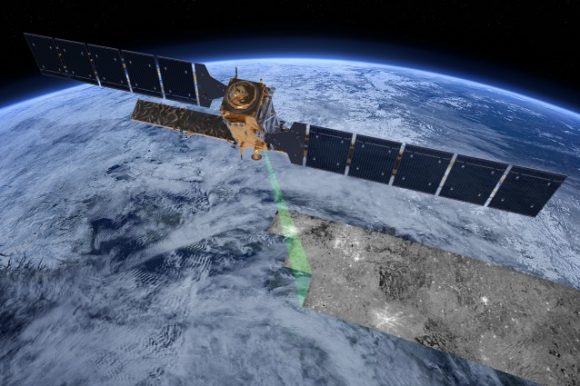
An artist's illustration of the Sentinel-1. Image: ESA/ATG Medialab

An artist's illustration of the Sentinel-1. Image: ESA/ATG Medialab

The Sentinel-1 satellites are part of the ESA's Copernicus Program. There are two of the satellites in operation, and two more are on the way. They employ Synthetic Aperture Radar to provide continuous imagery during the day, during the night, and through any kind of weather.

The satellites have several applications:

  • Monitoring sea ice in the arctic
  • Monitoring the arctic environment and other marine environments
  • Monitoring land surface motion
  • Mapping land surfaces, including forest, water, and soil
  • Mapping in support of humanitarian aid in crisis situations

Though the Sentinels were not specifically designed to monitor buildings, they're actually pretty good at it. Buildings like the Millennium Tower are especially good at reflecting radar. When multiple passes are made with the satellites, they provide a very accurate measurement of ground subsidence.

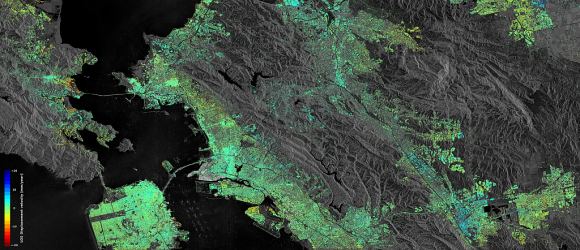
Radar data from Sentinel-1 shows the displacement in San Francisco's Bay Area. Yellow-red areas are sinking, while blue areas are rising. Green areas are not moving. Image: ESA SEOM INSARAP study / PPO.labs / Norut / NGU

Radar data from Sentinel-1 shows the displacement in San Francisco's Bay Area. Yellow-red areas are sinking, while blue areas are rising. Green areas are not moving. Image: ESA SEOM INSARAP study / PPO.labs / Norut / NGU

The Millennium Tower is not the only thing in San Francisco Bay Area that Sentinel-1 can see moving. It's also spotted movement in buildings along the Hayward Fault, an area prone to earthquakes, and the sinking of reclaimed land in San Rafael Bay. It's also spotted some rising land near the city of Pleasanton. The recent replenishing of groundwater is thought to be the cause of the rising land.

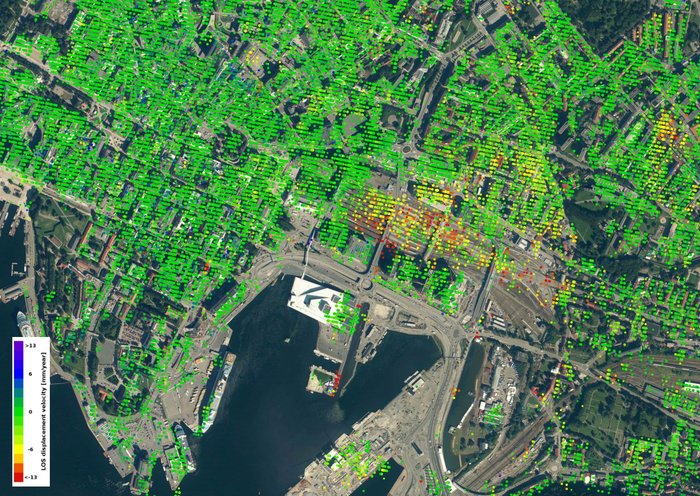
Now other parts of the world, especially in Europe, are poised to benefit from Sentinel-1's newfound prowess at reading the ground. In Oslo, Norway, the train station is built on reclaimed land. Newer buildings have proper foundations right on solid bedrock, but the older parts of the station are experiencing severe subsidence.

Sentinel-1 data shows that the Oslo train station, the red/yellow area in the center of the image, is sinking at the rate of 12-18mm per year. Image:  Copernicus Sentinel data (2014–16) / ESA SEOM INSARAP study / InSAR Norway project / NGU / Norut / PPO.labs

Sentinel-1 data shows that the Oslo train station, the red/yellow area in the center of the image, is sinking at the rate of 12-18mm per year. Image: Copernicus Sentinel data (2014–16) / ESA SEOM INSARAP study / InSAR Norway project / NGU / Norut / PPO.labs

John Dehls is from the Geological Survey of Norway. He had this to say about Sentinel: "Experience and knowledge gained within the ESA's Scientific Exploitation of Operational Missions programme give us strong confidence that Sentinel-1 will be a highly versatile and reliable platform for operational deformation monitoring in Norway, and worldwide."

As for the Millennium Tower in San Francisco, the problems continue. The developer of the building is blaming the problems on the construction of a new transit center for the city. But the agency in charge of that, the Transbay Joint Powers Authority, denies that they are at fault. They blame the developer's poor structural design, saying that it's not properly built on bedrock.

Now, the whole thing is before the courts. A $500 million class-action lawsuit has been filed on behalf of the residents, against the developer, the transit authority, and other parties.

It's a good bet that data from the Sentinel satellites will be part of the evidence in that lawsuit.

Evan Gough | November 28, 2016 at 4:32 pm | Tags: Featured | URL: http://wp.me/p1CHIY-yng

Unsubscribe to no longer receive posts from Universe Today.
Change your email settings at Manage Subscriptions.

Trouble clicking? Copy and paste this URL into your browser:
http://www.universetoday.com/132138/sentinel-1-satellites-confirm-san-franciscos-millenium-tower-sinking/


What is a Supermassive Black Hole?


Matt Williams posted: "In 1971, English astronomers Donald Lynden-Bell and Martin Rees hypothesized that a supermassive black hole (SMBH) resides at the center of our Milky Way Galaxy. This was based on their work with radio galaxies, which showed that the massive amounts of en"

New post on Universe Today

What is a Supermassive Black Hole?

by Matt Williams

In 1971, English astronomers Donald Lynden-Bell and Martin Rees hypothesized that a supermassive black hole (SMBH) resides at the center of our Milky Way Galaxy. This was based on their work with radio galaxies, which showed that the massive amounts of energy radiated by these objects was due to gas and matter being accreted onto a black hole at their center.

By 1974, the first evidence for this SMBH was found when astronomers detected a massive radio source coming from the center of our galaxy. This region, which they named Sagittarius A*, is over 10 million times as massive as our own Sun. Since its discovery, astronomers have found evidence that there are supermassive black holes at the centers of most spiral and elliptical galaxies in the observable Universe.

Description:

Supermassive black holes (SMBH) are distinct from lower-mass black holes in a number of ways. For starters, since SMBH have a much higher mass than smaller black holes, they also have a lower average density. This is due to the fact that with all spherical objects, volume is directly proportional to the cube of the radius, while the minimum density of a black hole is inversely proportional to the square of the mass.

In addition, the tidal forces in the vicinity of the event horizon are significantly weaker for massive black holes. As with density, the tidal force on a body at the event horizon is inversely proportional to the square of the mass. As such, an object would not experience significant tidal force until it was very deep into the black hole.

Formation:

How SMBHs are formed remains the subject of much scholarly debate. Astrophysicists largely believe that they are the result of black hole mergers and the accretion of matter. But where the "seeds" (i.e. progenitors) of these black holes came from is where disagreement occurs. Currently, the most obvious hypothesis is that they are the remnants of several massive stars that exploded, which were formed by the accretion of matter in the galactic center.

Another theory is that before the first stars formed in our galaxy, a large gas cloud collapsed into a "qausi-star" that became unstable to radial perturbations. It then turned into a black hole of about 20 Solar Masses without the need for a supernova explosion. Over time, it rapidly accreted mass in order to become an intermediate, and then supermassive, black hole.

In yet another model, a dense stellar cluster experienced core-collapse as the as a result of velocity dispersion in its core, which happened at relativistic speeds due to negative heat capacity. Last, there is the theory that primordial black holes may have been produced directly by external pressure immediately after the Big Bang. These and other theories remain theoretical for the time being.

Sagittarius A*:

Multiple lines of evidence point towards the existence of a SMBH at the center of our galaxy. While no direct observations have been made of Sagittarius A*, its presence has been inferred from the influence it has on surrounding objects. The most notable of these is S2, a star that flows an elliptical orbit around the Sagittarius A* radio source.

S2 has an orbital period of 15.2 years and reaches a minimal distance of 18 billion km (11.18 billion mi, 120 AU) from the center of the central object. Only a supermassive object could account for this, since no other cause can be discerned. And from the orbital parameters of S2, astronomers have been able to produce estimates on the size and mass of the object.

For instance, S2s motions have led astronomers to calculated that the object at the center of its orbit must have no less than 4.1 million Solar Masses (8.2 × 10³³ metric tons; 9.04 × 10³³ US tons). Furthermore, the radius of this object would have to be less than 120 AU, otherwise S2 would collide with it.

However, the best evidence to date was provided in 2008 by the Max Planck Institute for Extraterrestrial Physics and UCLAs Galactic Center Group. Using data obtained over a 16 year period by the ESO's Very Large Telescope and Keck Telescope, they were able to not only accurately estimate the distance to the center of our galaxy (27,000 light years from Earth), but also track the orbits of the stars there with immense precision.

As Reinhard Genzel, the team leader from the Max-Planck-Institute for Extraterrestrial Physics said:

"Undoubtedly the most spectacular aspect of our long term study is that it has delivered what is now considered to be the best empirical evidence that supermassive black holes do really exist. The stellar orbits in the Galactic Centre show that the central mass concentration of four million solar masses must be a black hole, beyond any reasonable doubt."

Another indication of Sagittarius A*s presence came on January 5th, 2015, when NASA reported a record-breaking X-ray flare coming from the center of our galaxy. Based on readings from the Chandra X-ray Observatory, they reported emissions that were 400 times brighter than usual. These were thought to be the result of an asteroid falling into the black hole, or by the entanglement of magnetic field lines within the gas flowing into it.

Other Galaxies:

Astronomers have also found evidence of SMBHs at the center of other galaxies within the Local Group and beyond. These include the nearby Andromeda Galaxy (M31) and elliptical galaxy M32, and the distant spiral galaxy NGC 4395. This is based on the fact that stars and gas clouds near the center of these galaxies show an observable increase in velocity.

Another indication is Active Galactic Nuclei (AGN), where massive bursts of radio, microwave, infrared, optical, ultra-violet (UV), X-ray and gamma ray wavebands are periodically detected coming from the regions of cold matter (gas and dust) at the center of larger galaxies. While the radiation is not coming from the black holes themselves, the influence such a massive object would have on surrounding matter is believed to be the cause.

In short, gas and dust form accretion disks at the center of galaxies that orbit supermassive black holes, gradually feeding them matter. The incredible force of gravity in this region compresses the disk's material until it reaches millions of degrees kelvin, generating bright radiation and electromagnetic energy. A corona of hot material forms above the accretion disc as well, and can scatter photons up to X-ray energies.

The interaction between the SMBH rotating magnetic field and the accretion disk also creates powerful magnetic jets that fire material above and below the black hole at relativistic speeds (i.e. at a significant fraction of the speed of light). These jets can extend for hundreds of thousands of light-years, and are a second potential source of observed radiation.

When the Andromeda Galaxy merges with our own in a few billion years, the supermassive black hole that is at its center will merge with our own, producing a much more massive and powerful one. This interaction is likely to kick several stars out of our combined galaxy (producing rogue stars), and is also likely to cause our galactic nucleus (which is currently inactive) to become active one again.

The study of black holes is still in its infancy. And what we have learned over the past few decades alone has been both exciting and awe-inspiring. Whether they are lower-mass or supermassive, black holes are an integral part of our Universe and play an active role in its evolution.

Who knows what we will find as we peer deeper into the Universe? Perhaps some day we the technology, and sheer audacity, will exist so that we might attempt to peak beneath the veil of an event horizon. Can you imagine that happening?

We have written many interesting articles about black holes here at Universe Today. Here's Beyond Any Reasonable Doubt: A Supermassive Black Hole Lives in Centre of Our Galaxy, X-Ray Flare Echo Reveals Supermassive Black Hole Torus, How Do You Weigh a Supermassive Black Hole? Take its Temperature, and What Happens When Supermassive Black Holes Collide?

Astronomy Cast also some relevant episodes on the subject. Here's Episode 18: Black Holes Big and Small, and Episode 98: Quasars.

More to explore: Astronomy Cast's episodes Quasars, and Black Holes Big and Small.

Sources:

Matt Williams | November 28, 2016 at 4:02 pm | Tags: Environment, Featured | URL: http://wp.me/p1CHIY-y9H
Comment    See all comments

Unsubscribe to no longer receive posts from Universe Today.
Change your email settings at Manage Subscriptions.

Trouble clicking? Copy and paste this URL into your browser:
http://www.universetoday.com/131297/supermassive-black-hole-2/


Carnival of Space #485


Susie Murph posted: "This week's Carnival of Space is hosted by Allen Versfeld at his Urban Astronomer blog. Click here to read Carnival of Space #485. And if you're interested in looking back, here's an archive to all the past Carnivals of Space. If you've got a spac"

New post on Universe Today

Carnival of Space #485

by Susie Murph

This week's Carnival of Space is hosted by Allen Versfeld at his Urban Astronomer blog.

Click here to read Carnival of Space #485.
Read more of this post

Susie Murph | November 28, 2016 at 3:52 pm | URL: http://wp.me/p1CHIY-ynq
Comment    See all comments

Unsubscribe to no longer receive posts from Universe Today.
Change your email settings at Manage Subscriptions.

Trouble clicking? Copy and paste this URL into your browser:
http://www.universetoday.com/132148/carnival-space-485/