Back in November, a team of researchers from the Swinburne University of Technology and the University of Cambridge published some very interesting findings about a galaxy located about 8 billion light years away. Using the La Silla Observatory's Very Large Telescope (VLT), they examined the light coming from the supermassive black hole (SMBH) at its center.
In so doing, they were able to determine that the electromagnetic energy coming from this distant galaxy was the same as what we observe here in the Milky Way. This showed that a fundamental force of the Universe (electromagnetism) is constant over time. And on Monday, Dec. 4th, the ESO followed-up on this historic find by releasing the color spectrum readings of this distant galaxy - known as HE 0940-1050.
To recap, most large galaxies in the Universe have SMBHs at their center. These huge black holes are known for consuming the matter that orbits all around them, expelling tremendous amounts of radio, microwave, infrared, optical, ultra-violet (UV), X-ray and gamma ray energy in the process. Because of this, they are some of the brightest objects in the known Universe, and are visible even from billions of light years away.

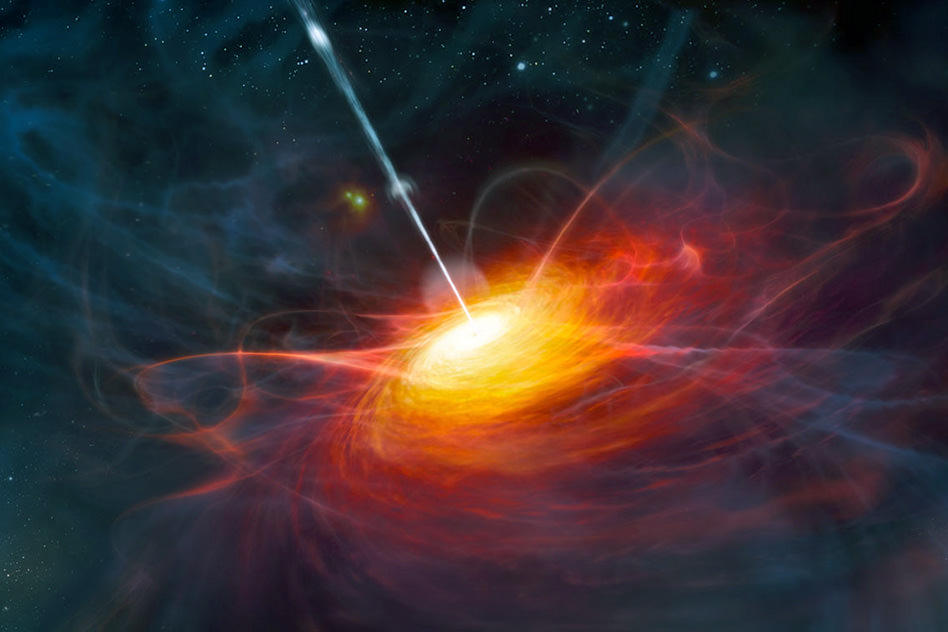
Artist's interpretation of ULAS J1120+0641, a very distant quasar.
Credit: ESO/M. Kornmesser
But because of their distance, the energy which they emit has to pass through the intergalactic medium, where it comes into contact with incredible amount of matter. While most of this consists of hydrogen and helium, there are trace amounts of other elements as well. These absorb much of the light that travels between distant galaxies and us, and the absorption lines this creates can tell us of lot about the kinds of elements that are out there.
At the same time, studying the absorption lines produced by light passing through space can tell us how much light was removed from the original quasar spectrum. Using the Ultraviolet and Visual Echelle Spectrograph (UVES) instrument aboard the VLT, the Swinburg and Cambridge team were able to do just that, thus sneaking a peak at the "fingerprints of the early Universe".
What they found was that the energy coming from HE 0940-1050 was very similar to that observed in the Milky Way galaxy. Basically, they obtained proof that electromagnetic energy is consistent over time, something which was previously a mystery to scientists. As they state in their study, which was published in the Monthly Notices of the Royal Astronomical Society:
"The Standard Model of particle physics is incomplete because it cannot explain the values of fundamental constants, or predict their dependence on parameters such as time and space. Therefore, without a theory that is able to properly explain these numbers, their constancy can only be probed by measuring them in different places, times and conditions. Furthermore, many theories which attempt to unify gravity with the other three forces of nature invoke fundamental constants that are varying."
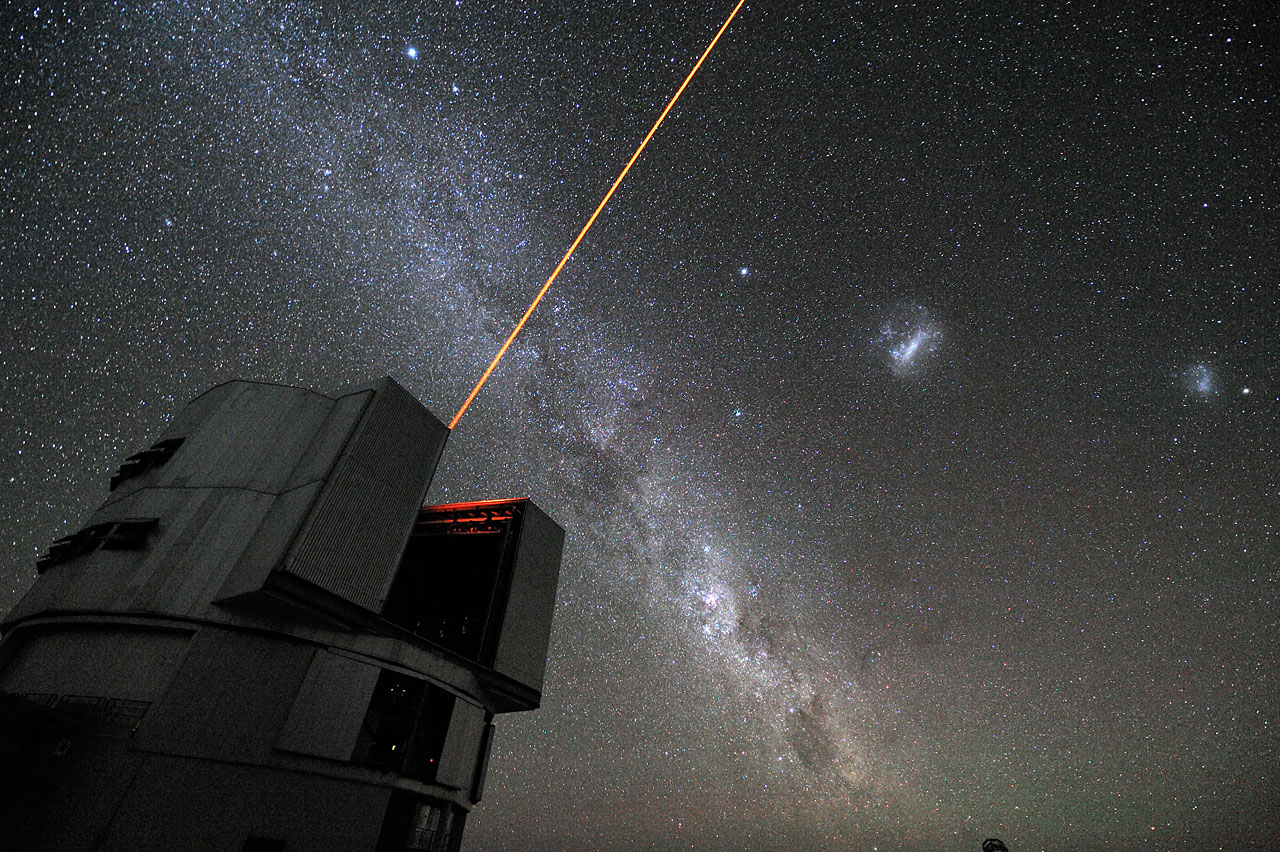
A laser beam launched from the Very Large Telescope (VLT) at the ESO's La Silla Observatory in Chile. Credit: ESO
Since it is 8 billion light years away, and its strong intervening metal-absorption-line system, probing the electromagnetic spectrum being put out by HE 0940-1050 central quasar - not to mention the ability to correct for all the light that was absorbed by the intervening intergalactic medium - provided a unique opportunity to precisely measure how this fundamental force can vary over a very long period of time.
On top of that, the spectral information they obtained happened to be of the highest quality ever observed from a quasar. As they further indicated in their study:
"The largest systematic error in all (but one) previous similar measurements, including the large samples, was long-range distortions in the wavelength calibration. These would add a ?2 ppm systematic error to our measurement and up to ?10 ppm to other measurements using Mg and Fe transitions."
However, the team corrected for this by comparing the UVES spectra to well-calibrated spectra obtained from the High Accuracy Radial velocity Planet Searcher (HARPS) - which is also located at the at the La Silla Observatory. By combining these readings, they were left with a residual systematic uncertainty of just 0.59 ppm, the lowest margin of error from any spectrographic survey to date.
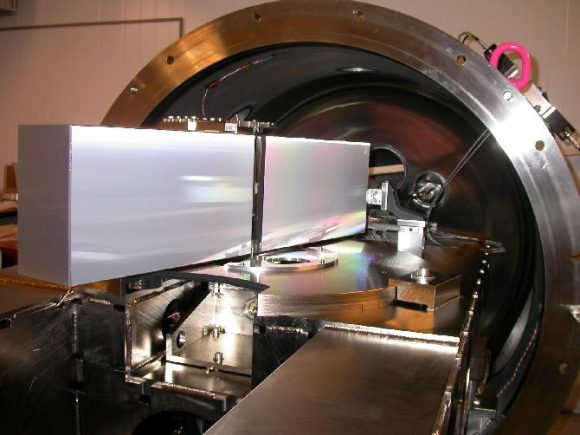
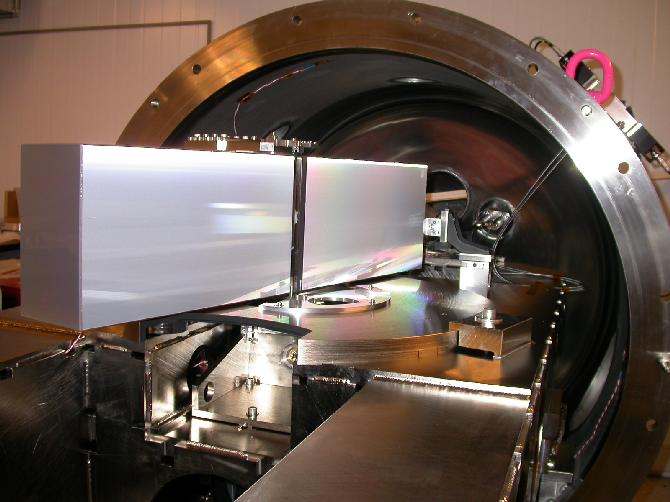
High Accuracy Radial velocity Planet Searcher at the ESO La Silla 3.6m telescope. Credit: ESO
This is exciting news, and for more reasons that one. On the one hand, precise measurements of distant galaxies allow us to test some of the most tricky aspects of our current cosmological models. On the other, determining that electromagnetism behaves in a consistent way over time is a major find, largely because it is responsible for such much of what goes on in our daily lives.
But perhaps most importantly of all, understanding how a fundamental force like electromagnetism behaves across time and space is intrinsic to finding out how it - as well as weak and strong nuclear force - unifies with gravity. This too has been a preoccupation of scientists, who are still at a loss when it comes to explaining how the laws governing particles interactions (i.e. quantum theory) unify with explanations of how gravity works (i.e general relativity).
By finding measurements of how these forces operate that are not varying could help in creating a working Grand Unifying Theory (GUT). One step closer to truly understanding how the Universe works!
Further Reading: ESO


 Posts
Posts