On July 4th, 2016, the Juno mission established orbit around Jupiter, becoming the second spacecraft in history to do so (after the Galileo probe). Since then, the probe has been in a regular 53.4-day orbit (known as perijove), moving between the poles to avoid the worst of its radiation belts. Originally, Juno's mission scientists had been hoping to reduce its orbit to a 14-day cycle so the probe could make more passes to gather more data.
To do this, Juno was scheduled for an engine burn on Oct. 19th, 2016, during its second perijovian maneuver. Unfortunately, a technical error prevented this from happening. Ever since, the mission team has been pouring over mission data to determine what went wrong and if they could conduct an engine burn at a later date. However, the mission team has now concluded that this won't be possible.
The technical glitch which prevented the firing took place weeks before the engine burn was scheduled to take place, and was traced to two of the engines helium check valves. After the propulsion system was pressurized, the valves took several minutes to open - whereas they took only seconds during previous engine burns. Because of this, the mission leaders chose to postpone the firing until they could get a better understanding of why the glitch happened.
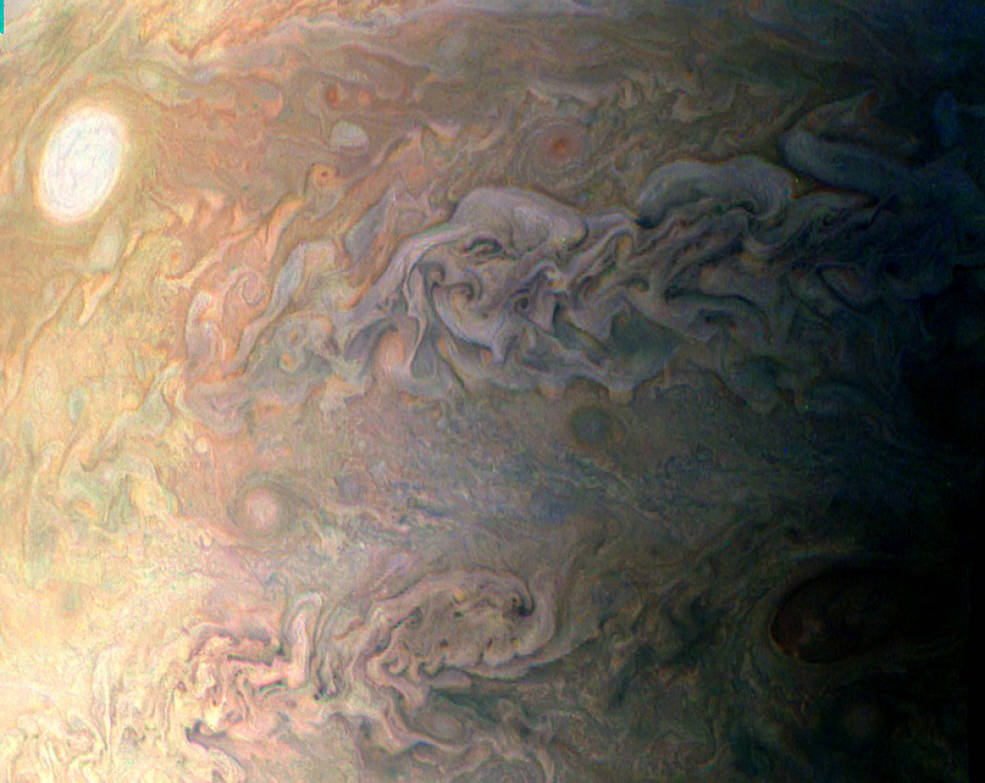
This amateur-processed image was taken on Dec. 11th, 2016, at 9:27 a.m. PST (12:27 p.m. EST), as NASA's Juno spacecraft performed its third close flyby of Jupiter. Credits: NASA/JPL-Caltech/SwRI/MSSS/Eric Jorgensen
And after pouring over mission data from the past few months and performing calculations on possible maneuvers, Juno's science team came to the conclusion that an engine burn might be counter-productive at this point. As Rick Nybakken, the Juno project manager at NASA's Jet Propulsion Laboratory (JPL), explained in a recent NASA press release:
"During a thorough review, we looked at multiple scenarios that would place Juno in a shorter-period orbit, but there was concern that another main engine burn could result in a less-than-desirable orbit. The bottom line is a burn represented a risk to completion of Juno's science objectives."
However, this is not exactly bad news for the mission. It's current perijove orbit takes it from one pole to the other, allowing it to pass over the cloud tops at a distance of around 4,100 km (2,600 mi) at its closest. At its farthest, the spacecraft reaches a distance of 8.1 million km (5.0 million mi) from the gas giant, which places it far beyond the orbit of Callisto.
During each pass, the probe is able to peak beneath the thick clouds to learn more about the planet's atmosphere, internal structure, magnetosphere, and formation. And while a 14-day orbital period would allow for it to conduct 37 orbits before its mission is scheduled to wrap up, its current 53.4-day period will allow for more information to be collected on each pass.
And as Thomas Zurbuchen, the associate administrator for NASA's Science Mission Directorate in Washington, declared:
"Juno is healthy, its science instruments are fully operational, and the data and images we've received are nothing short of amazing. The decision to forego the burn is the right thing to do – preserving a valuable asset so that Juno can continue its exciting journey of discovery."
In the meantime, the Juno science team is still analyzing the returns from Juno's four previous flybys - which took place on August 27th, October 19th, December 11th, and February 2nd, 2017, respectively. With each pass, more information is revealed about the planet's magnetic fields, aurorae, and banded appearance. The next perijovian maneuver will take place on March 27th, 2017, and will result in more images and data being collected.
Before the mission concludes, the Juno spacecraft will also explore Jupiter's far magnetotail, its southern magnetosphere, and its magnetopause. The mission is also conducting an outreach program with its JunoCam, which is being guided with assistance of the public. Not only can people vote on which features they want imaged with every flyby, but these images are accessible to "citizen scientists" and amateur astronomers.
Under its current budget plan, Juno will continue to operate through to July 2018, conducting a total of 12 science orbits. At this point, barring a mission extension, the probe will be de-orbited and burn up in Jupiter's outer atmosphere. As with the Galileo spacecraft, this will be as to avoid any possibility of impact and biological contamination with one of Jupiter's moons.
Further Reading: NASA


 Posts
Posts