Saturday, February 25, 2017

NASA Studies Whether to Add Crew to 1st SLS Megarocket Moon Launch in 2019

New post on Universe Today

NASA Studies Whether to Add Crew to 1st SLS Megarocket Moon Launch in 2019

by Ken Kremer

NASA's Space Launch System rocket will be the most powerful rocket in the world and, with the agency's Orion spacecraft, will launch America into a new era of exploration to destinations beyond Earth's orbit. Their first integrated mission is planned as uncrewed, but NASA now is assessing the feasibility of adding crew. Credits: NASA/MSFC

KENNEDY SPACE CENTER, FL - At the request of the new Trump Administration, NASA has initiated a month long study to determine the feasibility of converting the first integrated unmanned launch of the agency's new Space Launch System (SLS) megarocket and Orion capsule into a crewed mission that would propel two astronauts to the Moon and back by 2019 - 50 years after the first human lunar landing.

Top NASA officials outlined the details of the study at a hastily arranged media teleconference briefing on Friday, Feb 24. It will examine the feasibility of what it would take to add a crew of 2 astronauts to significantly modified maiden SLS/Orion mission hardware and whether a launch could be accomplished technically and safely by the end of 2019.

On Feb. 15, Acting Administrator Robert Lightfoot announced that he had asked Bill Gerstenmaier, associate administrator for NASA's Human Exploration and Operations Mission Directorate in Washington, to start detailed studies of what it would take to host astronauts inside the Orion capsule on what the agency calls Exploration Mission-1, or EM-1.

Gerstenmaier, joined by Bill Hill, deputy associate administrator for Exploration Systems Development in Washington, at the briefing said a team was quickly assembled and the study is already underway.

They expect the study to be completed in early spring, possibly by late March and it will focus on assessing the possibilities - but not making a conclusion on whether to actually implement changes to the current uncrewed EM-1 flight profile targeted for blastoff later in 2018.

"I want to stress to you this is a feasibility study. So when we get done with this we won't come out with a hard recommendation, one way or the other," Gerstenmaier stated.

"We're going to talk about essentially the advantages and disadvantages of adding crew to EM-1."

"We were given this task a week ago, appointed a team and have held one telecon."

"Our priority is to ensure the safe and effective execution of all our planned exploration missions with the Orion spacecraft and Space Launch System rocket," said Gerstenmaier.

"This is an assessment and not a decision as the primary mission for EM-1 remains an uncrewed flight test."
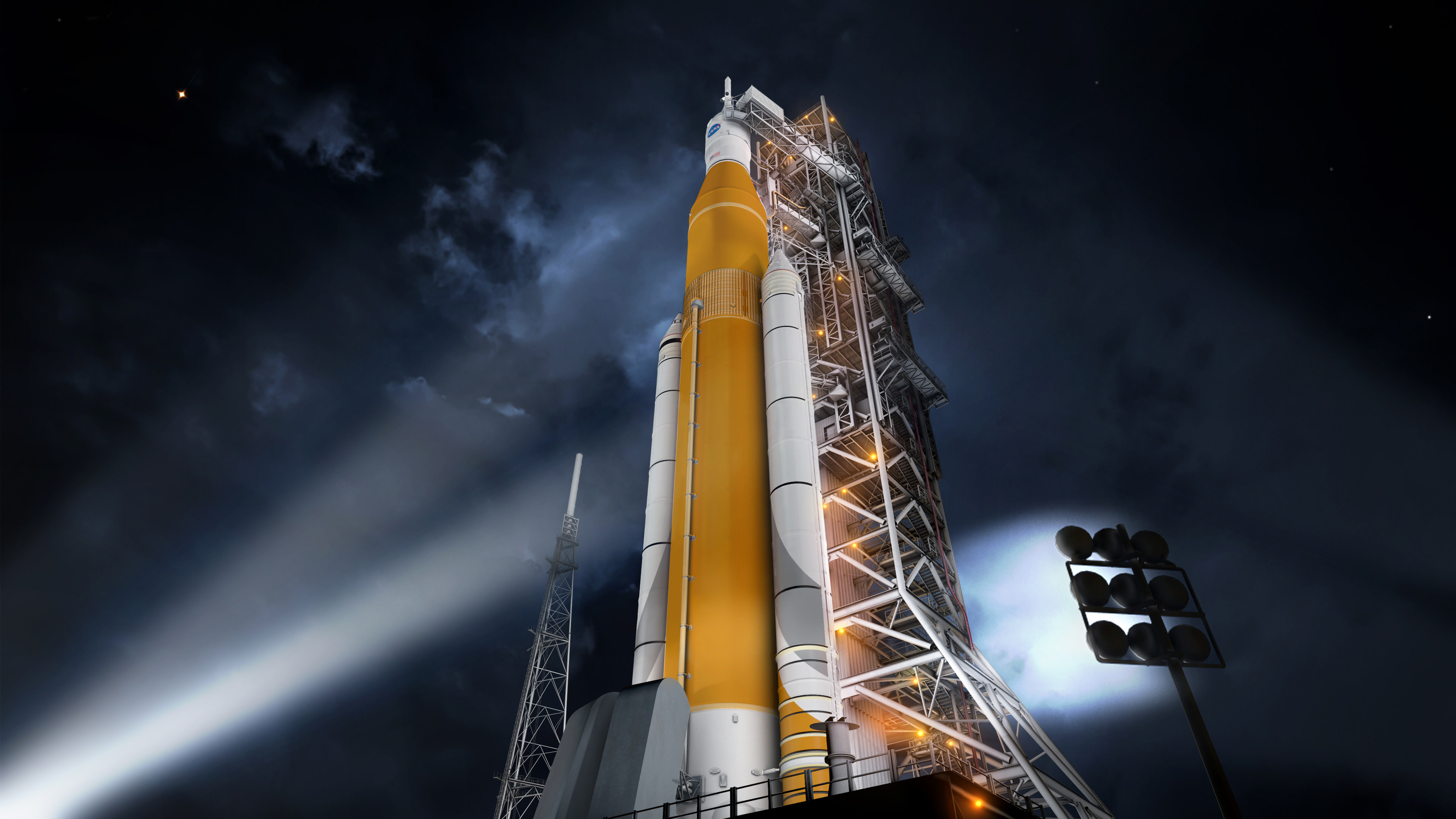
Artist concept of the SLS Block 1 configuration on the Mobile Launcher at KSC. Credit: NASA/MSFC

Gerstenmaier also set a stipulation that the study should focus on determining if a crewed EM-1 could liftoff by the end of 2019. The study team includes one astronaut.

If a change resulted in a maiden SLS/Orion launch date stretching beyond 2019 it has little value - and NASA is best to stick to the current EM-1 flight plan.

The first SLS/Orion crewed flight is slated for Exploration Mission-1 (EM-2) launching in 2021.

"I felt that if we went much beyond 2019, then we might as well fly EM-2 and actually do the plan we're on," Gerstenmaier said.

NASA's current plans call for the unmanned blastoff of Orion EM-1 on the SLS-1 rocket later next year on its first test flight on a 3 week long mission to a distant lunar retrograde orbit. It is slated to occur roughly in the September to November timeframe from Launch Complex 39B at the Kennedy Space Center.

Lightfoot initially revealed the study in a speech to the Space Launch System/Orion Suppliers Conference in Washington, D.C. and an agency wide memo circulated to NASA employees on Feb. 15 - as I reported here.

The Orion EM-1 capsule is currently being manufactured at the Neil Armstrong Operations and Checkout Building at the Kennedy Space Center by prime contractor Lockheed Martin.
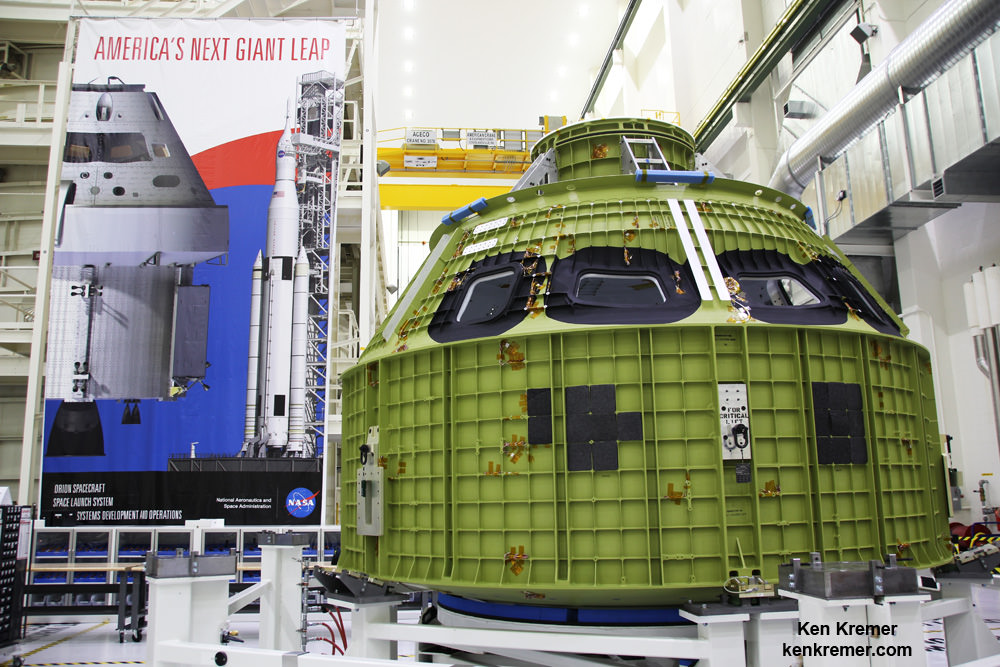
Orion crew module pressure vessel for NASA's Exploration Mission-1 (EM-1) is unveiled for the first time on Feb. 3, 2016 after arrival at the agency's Kennedy Space Center (KSC) in Florida. It is secured for processing in a test stand called the birdcage in the high bay inside the Neil Armstrong Operations and Checkout (O&C) Building at KSC. Launch to the Moon is slated in 2018 atop the SLS rocket. Credit: Ken Kremer/kenkremer.com

To launch astronauts, Orion EM-1 would require very significant upgrades since it will not have the life support systems, display panels, abort systems and more needed to safely support humans on board.

"We know there are certain systems that needed to be added to EM-1 to add crew," Gerstenmaier elaborated. "So we have a good, crisp list of all the things we would physically have to change from a hardware standpoint.

In fact since EM-1 assembly is already well underway, some hardware already installed would have to be pulled out to in order to allow access behind to add the life support hardware and other systems, Hill explained.

The EM-1 pressure shell arrived last February as I witnessed and reported here.

Thus adding crew at this latter date in the manufacturing cycle is no easy task and would absolutely require additional time and additional funding to the NASA budget - which as everyone knows is difficult in these tough fiscal times.

"Then we asked the team to take a look at what additional tests would be needed to add crew, what the additional risk would be, and then we also wanted the teams to talk about the benefits of having crew on the first flight," Gerstenmaier explained.

"It's going to take a significant amount of money, and money that will be required fairly quickly to implement what we need to do," Hill stated. "So it's a question of how we refine the funding levels and the phasing of the funding for the next three years and see where it comes out."

Hill also stated that NASA would maintain the Interim Cryogenic Propulsion stage for the first flight, and not switch to the more advanced and powerful Exploration Upper Stage (EUS) planned for first use on EM-2.

Furthermore NASA would most move up the AA-2 ascent abort test for Orion to take place before crewed EM-1 mission.

Components of the SLS-1 rocket are being manufactured at NASA's Michoud Assembly Facility and elsewhere around the country by numerous suppliers.

Michoud is building the huge fuel liquid oxygen/liquid hydrogen SLS core stage fuel tank, derived from the Space Shuttle External Tank (ET) - as I detailed here.

Gerstenmaier noted that Michoud did suffer some damage during the recent tornado strike which will necessitate several months worth of repairs.
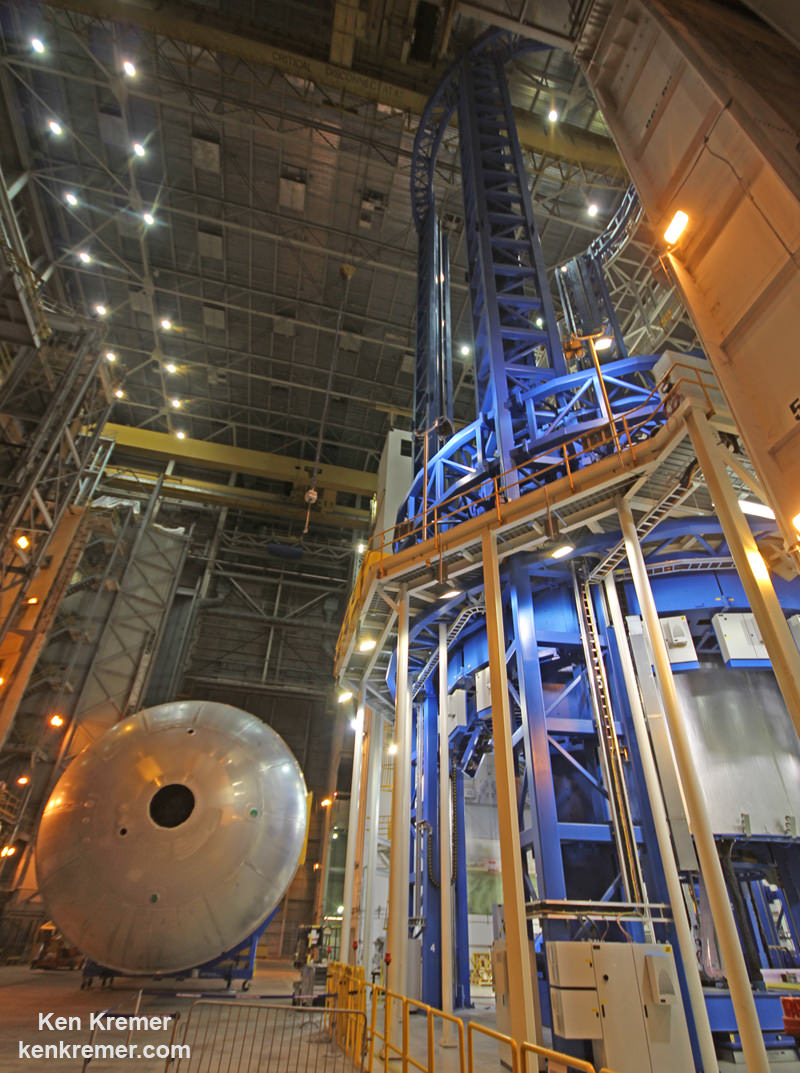
The newly assembled first liquid hydrogen tank, also called the qualification test article, for NASA's new Space Launch System (SLS) heavy lift rocket lies horizontally beside the Vertical Assembly Center robotic weld machine (blue) on July 22, 2016. It was lifted out of the welder (top) after final welding was just completed at NASA's Michoud Assembly Facility in New Orleans. Credit: Ken Kremer/kenkremer.com

The 2018 launch of NASA's Orion on the unpiloted EM-1 mission counts as the first joint flight of SLS and Orion, and the first flight of a human rated spacecraft to deep space since the Apollo Moon landing era ended more than 4 decades ago.

If NASA can pull off a 2019 EM-1 human launch it will coincide with the 50th anniversary of Apollo 11 - NASA's first lunar landing mission manned by Neil Armstrong and Buzz Aldrin, along with Michael Collins.

If crew are added to EM-1 it would essentially adopt the mission profile currently planned for Orion EM-2.

"If the agency decides to put crew on the first flight, the mission profile for Exploration Mission-2 would likely replace it, which is an approximately eight-day mission with a multi-translunar injection with a free return trajectory," said NASA. It would be similar to Apollo 8 and Apollo 13.
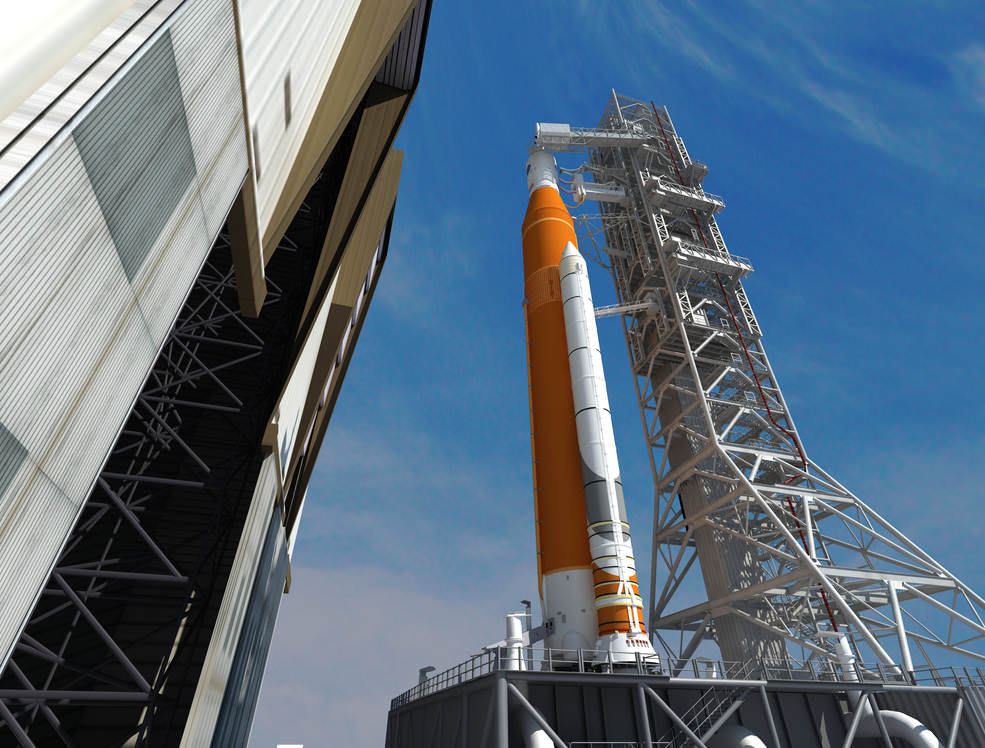
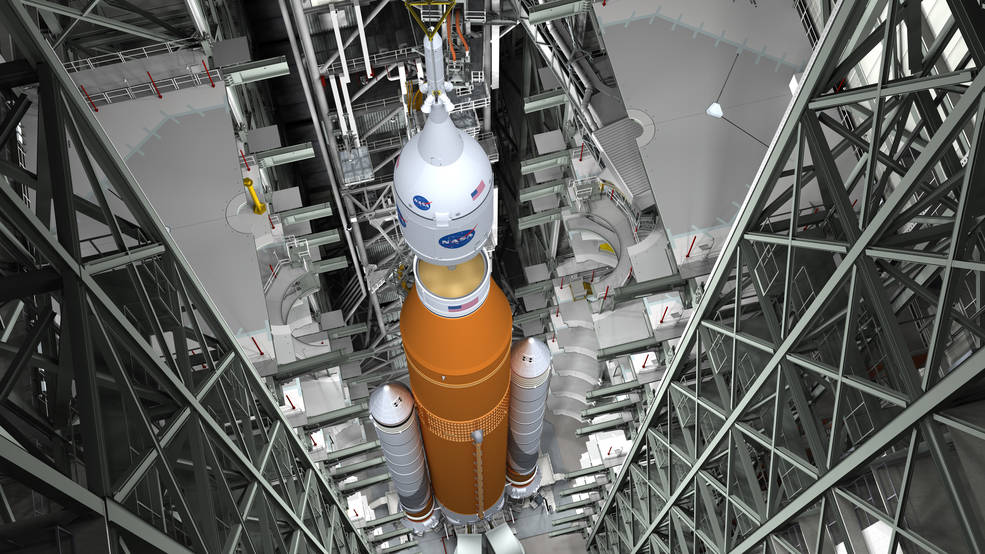
This artist concept depicts the Space Launch System rocket rolling out of the Vehicle Assembly Building at NASA's Kennedy Space Center. SLS will be the most powerful rocket ever built and will launch the agency's Orion spacecraft into a new era of exploration to destinations beyond low-Earth orbit. Credits: NASA/Marshall Space Flight Center

Orion is designed to send astronauts deeper into space than ever before, including missions to the Moon, asteroids and the Red Planet.

NASA is developing SLS and Orion for sending humans on a 'Journey to Mars' in the 2030s.

They are but the first hardware elements required to carry out such an ambitious initiative.
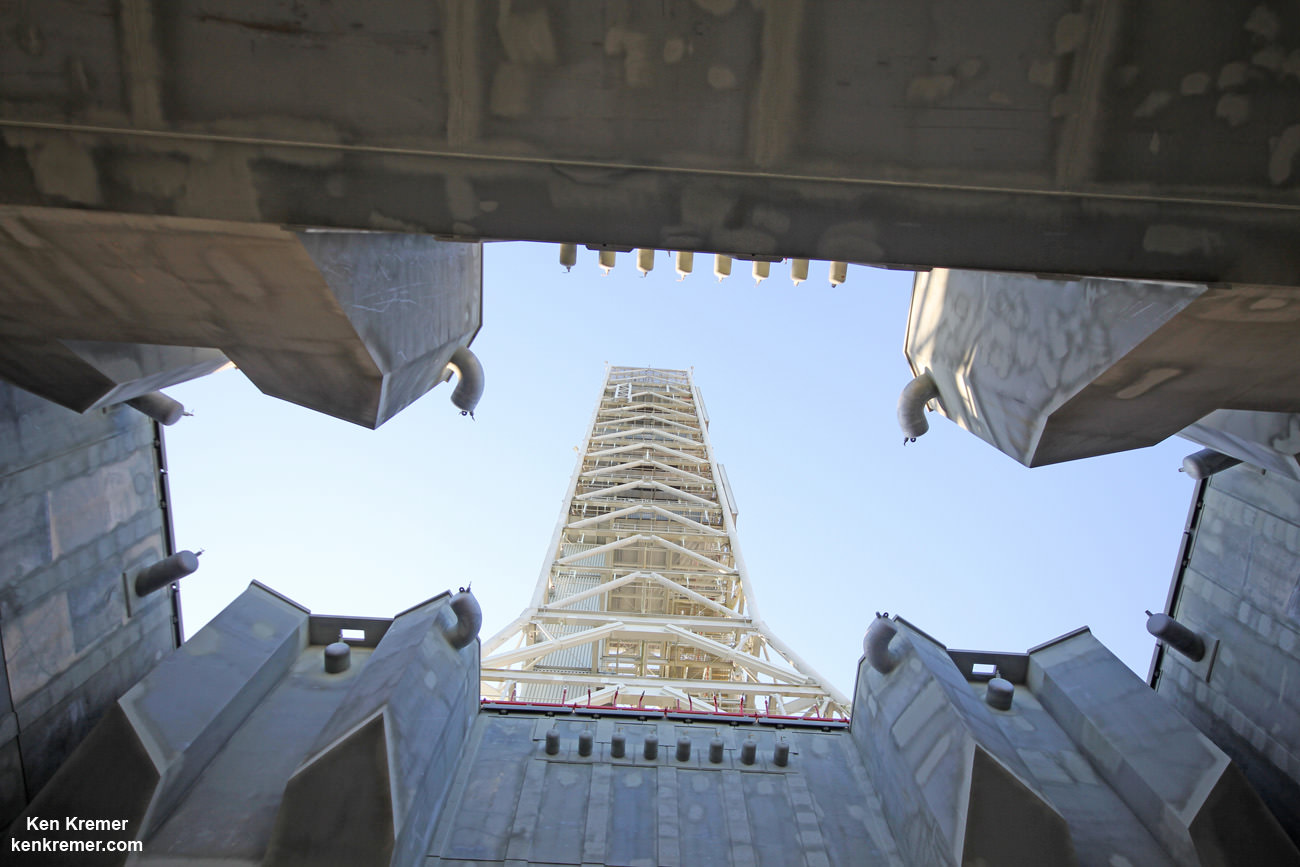
Looking up from beneath the enlarged exhaust hole of the Mobile Launcher to the 380 foot-tall tower astronauts will ascend as their gateway for missions to the Moon, Asteroids and Mars. The ML will support NASA's Space Launch System (SLS) and Orion spacecraft during Exploration Mission-1 at NASA's Kennedy Space Center in Florida. Credit: Ken Kremer/kenkremer.com

Stay tuned here for Ken's continuing Earth and Planetary science and human spaceflight news.

Ken Kremer
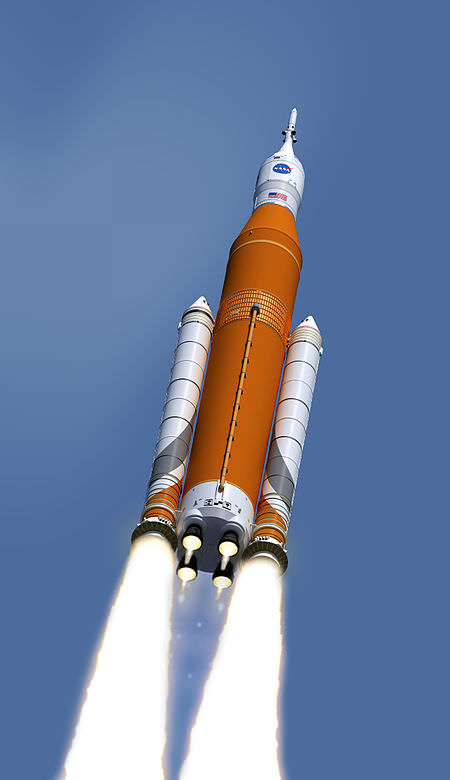
An artist's interpretation of NASA's Space Launch System Block 1 configuration with an Orion vehicle. Image: NASA

Ken Kremer | February 25, 2017 at 4:51 pm | Tags: Orion EM-1, Orion EM-2 | URL: http://wp.me/p1CHIY-yMQ
Comment    See all comments

Trouble clicking? Copy and paste this URL into your browser: 

http://www.universetoday.com/133724/snasa-studies-whether-to-add-2-astronauts-to-1st-slsorion-launch-to-moon-in-2019/


SETI Has Already Tried Listening to TRAPPIST-1 for Aliens

New post on Universe Today

SETI Has Already Tried Listening to TRAPPIST-1 for Aliens

by Matt Williams

The Trappist-1 system has been featured in the news quite a bit lately. In May of 2016, it appeared in the headlines after researchers announced the discovery of three exoplanets orbiting around the red dwarf star. And then there was the news earlier this week of how follow-up examinations from ground-based telescopes and the Spitzer Space Telescope revealed that there were actually seven planets in this system.

And now it seems that there is more news to be had from this star system. As it turns out, the Search for Extraterrestrial Intelligence (SETI) Institute was already monitoring this system with their Allen Telescope Array (ATA), looking for signs of life even before the multi-planet system was announced. And while the survey did not detect any telltale signs of radio traffic, further surveys are expected.

Given its proximity to our own Solar System, and the fact that this system contains seven planets that are similar in size and mass to Earth, it is both tempting and plausible to think that life could be flourishing in the TRAPPIST-1 system. As Seth Shostak, a Senior Astronomer at SETI, explained:

"[T]he opportunities for life in the Trappist 1 system make our own solar system look fourth-rate.  And if even a single planet eventually produced technically competent beings, that species could quickly disperse its kind to all the rest... Typical travel time between worlds in the Trappist 1 system, even assuming rockets no speedier than those built by NASA, would be pleasantly short.  Our best spacecraft could take you to Mars in 6 months.  To shuttle between neighboring Trappist planets would be a weekend junket."

Illustration showing the possible surface of TRAPPIST-1f, one of the newly discovered planets in the TRAPPIST-1 system. Credits: NASA/JPL-Caltech

Little wonder then why SETI has been using their Allen Telescope Array to monitor the system ever since exoplanets were first announced there. Located at the Hat Creek Radio Observatory in northern California (northeast of San Francisco), the ATA is what is known as a "Large Number of Small Dishes" (LNSD) array - which is a new trend in radio astronomy.

Like other LNSD arrays - such as the proposed Square Kilometer Array currently being built in Australia and South Africa - the concept calls for the deployment of many smaller dishes over a large surface area, rather than a single large dish. Plans for the array began back in 1997, when the SETI Institute convened a workshop to discuss the future of the Institute and its search strategies.

The final report of the workshop, titled "SETI 2020", laid out a plan for the creation of a new telescope array. This array was referred to as the One Hectare Telescope at the time, since the plan called for a LNSD encompassing an area measuring 10,000 m² (one hectare). The SETI Institute began developing the project in conjunction with the Radio Astronomy Laboratory (RAL) at the UC Berkeley.

In 2001, they secured a $11.5 million donation from the Paul G. Allen Family Foundation, which was established by Microsoft co-founder Paul Allen. In 2007, the first phase of construction was completed and the ATA finally became operational on October 11th, 2007, with 42 antennas (ATA-42). Since that time, Allen has committed to an additional $13.5 million in funding for a second phase of expansion (hence why it bears his name).

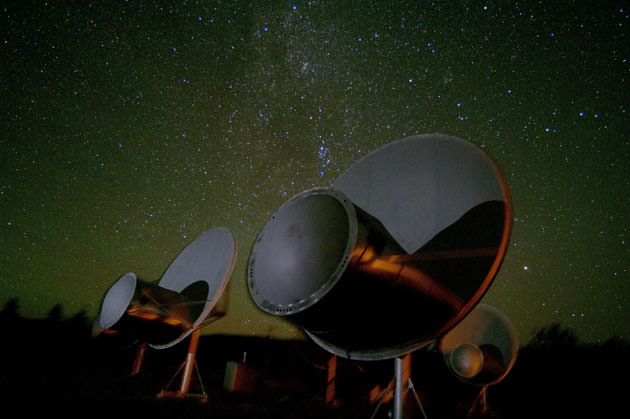
A portion of the Allen Telescope Array. (Credit: Seth Shostak/The SETI Institute. Used with permission)

Compared to large, single dish-arrays, smaller dish-arrays are more cost-effective because they can be upgraded simply by adding more dishes. The ATA is also less expensive since it relies on commercial technology originally developed for the television market, as well as receiver and cryogenic technologies developed for radio communication and cell phones.

It also uses programmable chips and software for signal processing, which allows for rapid integration whenever new technology becomes available. As such, the array is well suited to running simultaneous surveys at centimeter wavelengths. As of 2016, the SETI Institute has performed observations with the ATA for 12 hour periods (from 6 pm and 6 am), seven days a week.

And last year, the array was aimed towards TRAPPIST-1, where it conducted a survey scanning ten billion radio channels in search of signals. Naturally, the idea that a radio signal would be emanating from this system, and one which the ATA could pick up, might seem like a bit of a longshot. But in fact, both the infrastructure and energy requirements would not be beyond a species who's technical advancement is commensurate with our own.

"Assuming that the putative inhabitants of this solar system can use a transmitting antenna as large as the 500 meter FAST radio telescope in China to beam their messages our way, then the Allen Array could have found a signal if the aliens use a transmitter with 100 kilowatts of power or more," said Shostak. "This is only about ten times as energetic as the radar down at your local airport."

A plot of diameter versus the amount of sunlight hitting the planets in the TRAPPIST-1 system, scaled by the size of the Earth and the amount of sunlight hitting the Earth. Credit: F. Marchis/H. Marchis

So far, nothing has been picked up from this crowded system. But the SETI Institute is not finished and future surveys are already in the works. If there is a thriving, technologically-advanced civilization in this system (and they know their way around a radio antenna), surely there will be signs soon enough.

And regardless, the discovery of seven planets in the TRAPPIST-1 system is very exciting because it demonstrates just how plentiful systems that could support life are in our Universe. Not only does this system have three planets orbiting within its habitable zone (all of which are similar in size and mass to Earth), but the fact that they orbit a red dwarf star is very encouraging.

These stars are the most common in our Universe, making up 70% of stars in our galaxy, and up to 90% in elliptical galaxies. They are also very stable, remaining in their Main Sequence phase for up to 10 trillion years. Last, but not least, astronomers believe that 20 out of 30 nearest stars to our Solar System are red dwarfs. Lots of opportunities to find life within a few dozen light years!

"[W]hether or not Trappist 1 has inhabitants, its discovery has underlined the growing conviction that the Universe is replete with real estate on which biology could both arise and flourish,' says Shostak. "If you still think the rest of the universe is sterile, you are surely singular, and probably wrong."

Further Reading: SETI

Matt Williams | February 25, 2017 at 3:33 pm | Tags: Camping, Featured, TRAPPIST-1 | URL: http://wp.me/p1CHIY-yNM
Comment    See all comments

Trouble clicking? Copy and paste this URL into your browser: 

http://www.universetoday.com/133782/seti-already-tried-listening-trappist-1-aliens/


BREAKING: Democrats elect Tom Perez, Obama's former Labor secretary, as new party leader

Having trouble viewing this email? | View it in your browser

FB TW g+ Ins

  Democrats chose Perez as the person to lead them out of a political wilderness of heavy losses at every level of government over the past eight years and amid tensions between moderates and progressives about how to rebuild the party after Hillary Clinton's unexpected loss to Donald Trump. A former Department of Justice civil rights lawyers, Perez emphasized fighting against former Sheriff Joe Arpaio in Arizona on immigration issues, stopping voter ID laws, and taking on Wall Street in the aftermath of the foreclosure crisis.

FOR MORE ON THIS STORY, GO TO:
  USATODAY.COM  
 

Help | Advertise | Home Delivery | Privacy Policy - Your California Privacy Rights  
  © 2017 USA TODAY, a division of Gannett Satellite Information Network, LLC.
7950 Jones Branch Drive, McLean, VA 22108


"Ring of Fire" Solar Eclipse on Feb. 26th

Space Weather News for Feb 25, 2017
http://spaceweather.com
https://www.facebook.com/spaceweatherdotcom

"RING OF FIRE" SOLAR ECLIPSE: Something strange is about to happen to sunbeams in the southern hemisphere. On Sunday, Feb. 26th, the Moon will pass directly in front of the sun, covering as much as 99% of the solar disk.  This will turn the sun into a "ring of fire" over parts of South America and Africa. Crescent-shaped sunbeams and thin rings of light will dance across the ground of more than a dozen countries.  Visit Spaceweather.com for more information and photos.

Remember, SpaceWeather.com is on Facebook!
Above: Click on the image to view an animation of the annular eclipse, created by Larry Koehn of ShadowandSubstance.com
Share
Tweet
Forward
Copyright © 2017 Spaceweather.com, All rights reserved.

Trump's national security adviser wants to avoid term 'radical Islamic terrorism'

The Guardian Today US

headlines

spotlight

opinion

sports

Guardian News & Media Limited - a member of Guardian Media Group PLC. Registered Office: Kings Place, 90 York Way, London, N1 9GU. Registered in England No. 908396