Tuesday, February 28, 2017

The Guardian today: Presidential address: Trump claims 'new chapter in American greatness' – live

View in browser
the guardian today
Wednesday 01 Mar 2017
The Guardian logo
Headlines More »
President to declare 'the time for trivial fights is behind us' in an attempt to offer an optimistic vision to all Americans
Most viewed in last 24 hours More »
Immersed in life online like the followers of 4chan or PewDiePie, we start to imagine that nothing matters – even racism, misogyny and resurgent fascism
Sport More »
Comment is free More »
Culture More »
Business More »
Technology More »
Travel More »
Life and style More »
The Guardian
Football Comment is free Environment
Guardian News & Media Limited - a member of Guardian Media Group PLC. Registered Office: Kings Place, 90 York Way, London, N1 9GU. Registered in England No. 908396

So it Begins, Red Dragon Delayed 2 Years to 2020

New post on Universe Today

So it Begins, Red Dragon Delayed 2 Years to 2020

by Ken Kremer

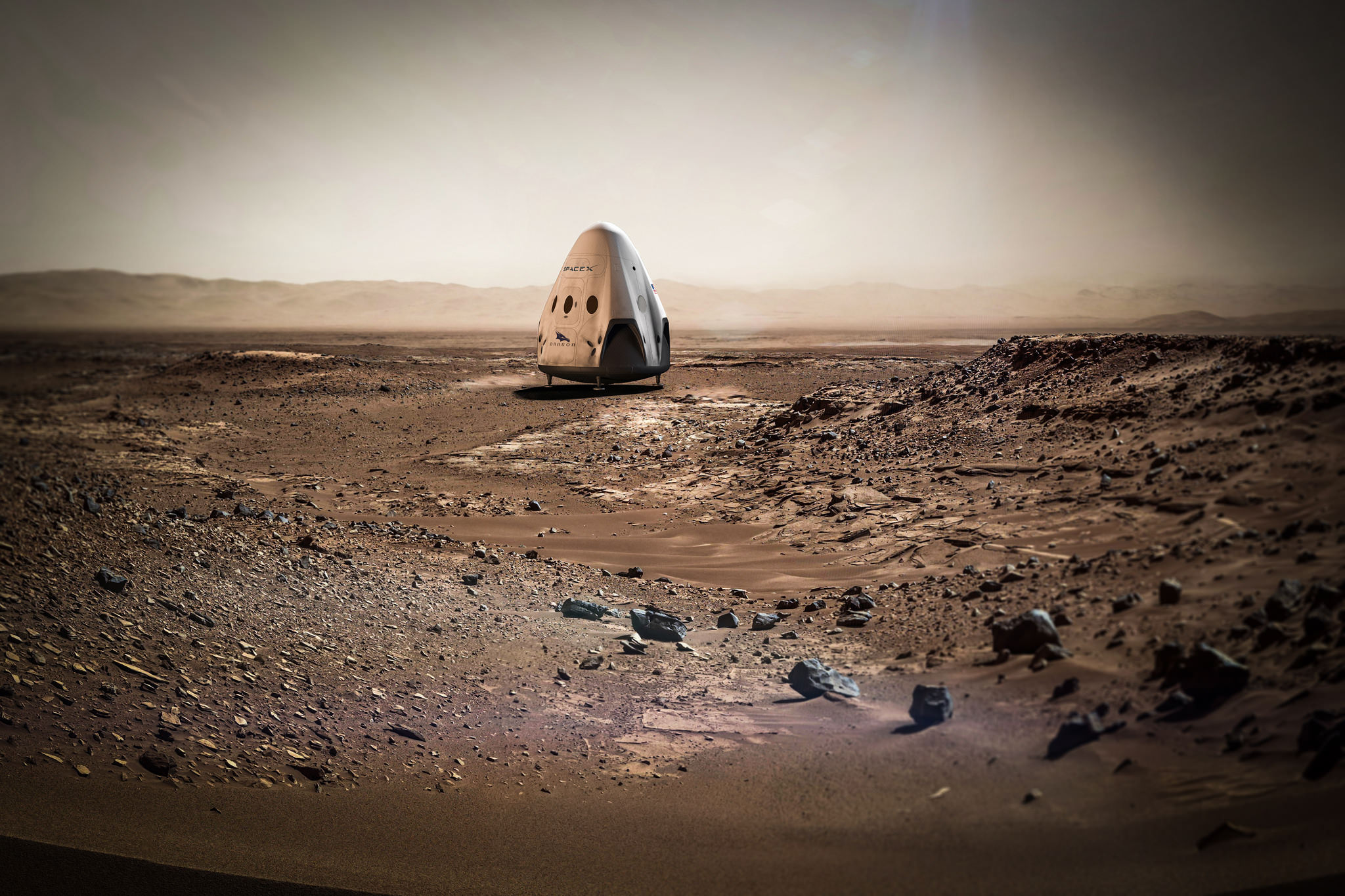
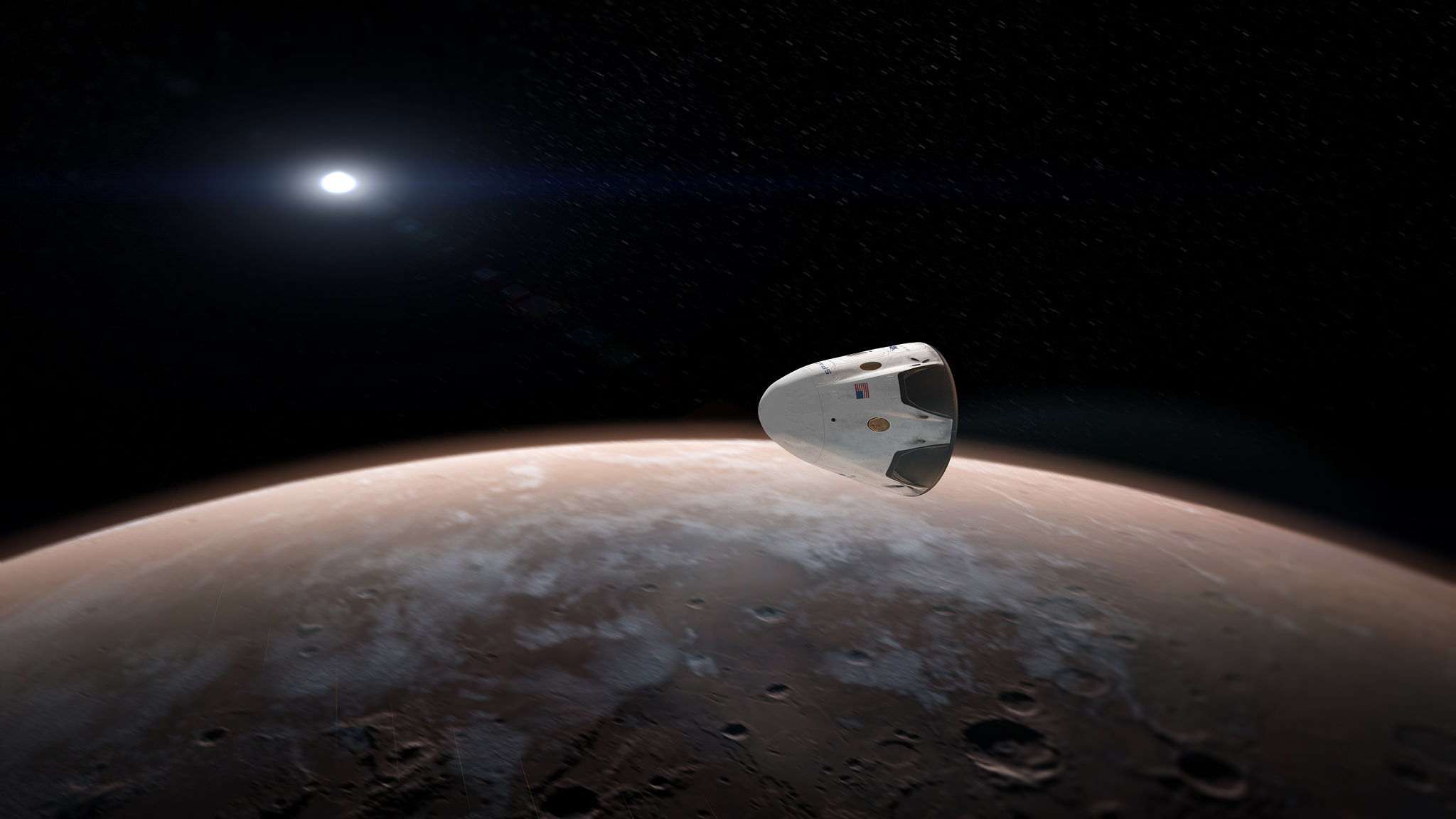
Artists concept for sending SpaceX Red Dragon spacecraft to land propulsively on Mars as early as 2020. Credit: SpaceX

KENNEDY SPACE CENTER, FL - With so many exciting projects competing for the finite time of SpaceX's super talented engineers, something important had to give. And that something comes in the form of slipping the blastoff of SpaceX's ambitious Red Dragon initiative to land the first commercial spacecraft on Mars by 2 years - to 2020.

The Red Dragon launch postponement from 2018 to 2020 was announced by SpaceX president Gwynne Shotwell during a prelaunch press conference at historic pad 39A at NASA's Kennedy Space Center in Florida.

"We were focused on 2018, but we felt like we needed to put more resources and focus more heavily on our crew program and our Falcon Heavy program, said SpaceX Gwynne Shotwell at the pad 39a briefing.

"So we're looking more in the 2020 time frame for that."

And whenever Red Dragon does liftoff, it will carry a significant "science payload" to the Martian surface, Shotwell told me at the pad 39A briefing.

Another factor potentially at play is yesterdays (Feb 27) announcement by SpaceX CEO Elon Musk that he has two hefty, revenue generating paying customers for a manned Moonshot around the Moon that could blastoff on a commercial crew Dragon as soon as next year atop a Falcon Heavy from pad 39A - as I reported here.

Pad 39A is the same pad from which the Red Dragon mission will eventually blastoff atop a heavy lift SpaceX Falcon Heavy rocket - and which just reopened for launch business last week on Feb. 19 after lying dormant for more than 6 years since the retirement of NASA's Space Shuttle Program in July 2011.

So at least the high hurdle of reopening pad 39A has been checked off!
SpaceX continues to dream big - setting its extraterrestrial sights on the Moon and Mars.

Musk founded SpaceX with the dream of transporting Humans to the Red Planet and establishing a 'City on Mars'.

Artists concept for sending SpaceX Red Dragon spacecraft to Mars as early as 2020. Credit: SpaceX

Since launch windows to Mars are only available every two years due to the laws of physics and planetary alignments, the minimum Red Dragon launch delay automatically amounts to 2 years.

Furthermore the oft delayed Falcon Heavy has yet to launch on its maiden mission.

Shotwell said the maiden Falcon Heavy launch from pad 39A would occur around mid year or so.

And the commercial crew Dragon 2 spacecraft being built under contract to NASA to launch American astronauts to the International Space Station (ISS) has also seen its maiden launch postponed more than six months over the past calendar year.

And launching the commercial crew Dragon is absolutely critical to NASA for launching US astronauts to the ISS from US - in order to end our total dependence on Russia and the Soyuz capsule at a cost in excess of $80 million per seat.

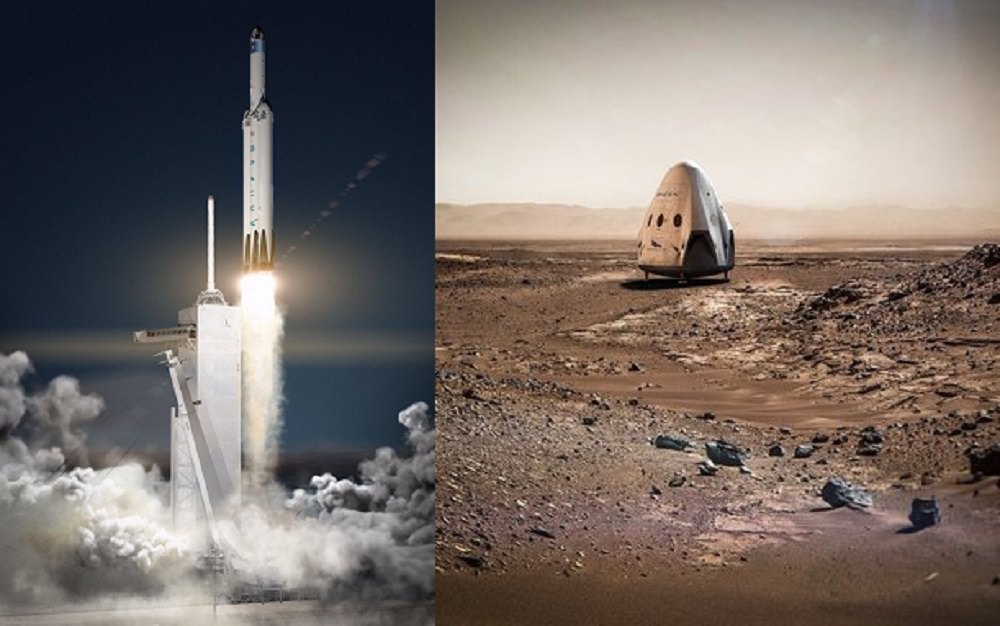
Artistic concepts of the Falcon Heavy rocket (left) and the Dragon capsule deployed on the surface of Mars (right). Credit: SpaceX

The bold Red Dragon endeavor which involved launching an uncrewed version of the firms Dragon cargo spacecraft to carry out a propulsive soft landing on Mars as soon as 2018, was initially announced with great fanfare by SpaceX less than a year ago in April 2016.

But given the magnitude of the work required for this extremely ambitious Mars landing mission, the two year postponement was pretty much expected from the beginning by this author.

The main goal is to propulsively land the heaviest payload ever on Mars - something 5-10 times the size of anything landed before.

"These missions will help demonstrate the technologies needed to land large payloads propulsively on Mars," SpaceX noted last April.

Whenever it does fly, SpaceX will utilize a recycled cargo Dragon from one of the space station resupply missions for NASA, said Jessica Jensen, SpaceX Dragon Mission manager at a KSC media briefing.

NASA's still operating 1 ton Curiosity rover is the heaviest spaceship to touchdown on the Red Planet to date.

NASA's agency wide goal is to send human on a 'Journey to Mars' by the 2030s utilizing the SLS rocket and Orion deep space capsule - slated for their uncrewed maiden launch in late 2018.

Although NASA has just initiated a feasibility study to launch alter the mission and add 2 astronauts with a revised liftoff date of 2019.

Of course it all depends on whether the new Trump Administration bolsters NASA or slashes NASA funding.

Stay tuned here for Ken's continuing Earth and Planetary science and human spaceflight news.

Ken Kremer

Comment    See all comments

Trouble clicking? Copy and paste this URL into your browser: 

http://www.universetoday.com/133549/begins-red-dragon-delayed-2-years-2020/


BREAKING: President Trump uses a sunnier tone to complete his takeover of the Republican Party

Having trouble viewing this email? | View it in your browser

FB TW g+ Ins

  The hour-long speech was in many ways a conventional presidential address, with a laundry list of proposals, allusions to American history and tributes to American heroes. That's notable in part because so much about Trump's presidency has been unconventional - and because many of his populist, nationalist prescriptions that defy Republican orthodoxy are becoming part of the GOP mainstream. "My job is not to represent the world," he said as he discussed the U.S. role around the globe. "My job is to represent the United States of America."

FOR MORE ON THIS STORY, GO TO:
  USATODAY.COM  
 

Help | Advertise | Home Delivery | Privacy Policy - Your California Privacy Rights  
  © 2017 USA TODAY, a division of Gannett Satellite Information Network, LLC.
7950 Jones Branch Drive, McLean, VA 22108


UFO Visualizations Show the Trends in Alien Spotting. Saucers Are Down, Lights Are Up

New post on Universe Today

UFO Visualizations Show the Trends in Alien Spotting. Saucers Are Down, Lights Are Up

by Matt Williams

When it comes to conspiracy theories and modern preoccupations, few things are more popular than unidentified flying objects (UFOs) and alien abductions. For over half a century, there have been rumors, reports, and urban legends about aliens coming to Earth, dabbling with our genetics, and conducting weird (and often invasive) experiments on our citizens.

And while opinions on what drives this popular phenomenon tend to differ (some say hysteria, others that it is media-driven), a few things are clear. For one, sightings appear to take place far more in the United States than anywhere else in the world. And in recent years, these sightings have been on the rise!

Such are the conclusions of a series of visualizations based on the National UFO Reporting Center (NUFORC). Established in 1974 (and located in Davenport, Washington), the National UFO Reporting Center is "dedicated to the collection and dissemination of objective UFO data". Since that time, they have been monitoring UFO sightings worldwide and have maintained careful logs about the 104,947 sightings that have taken place since 1905.
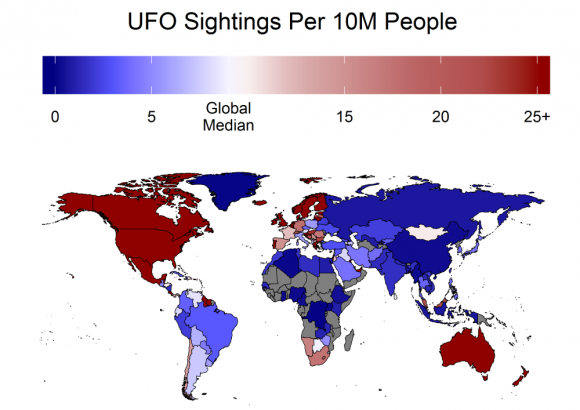
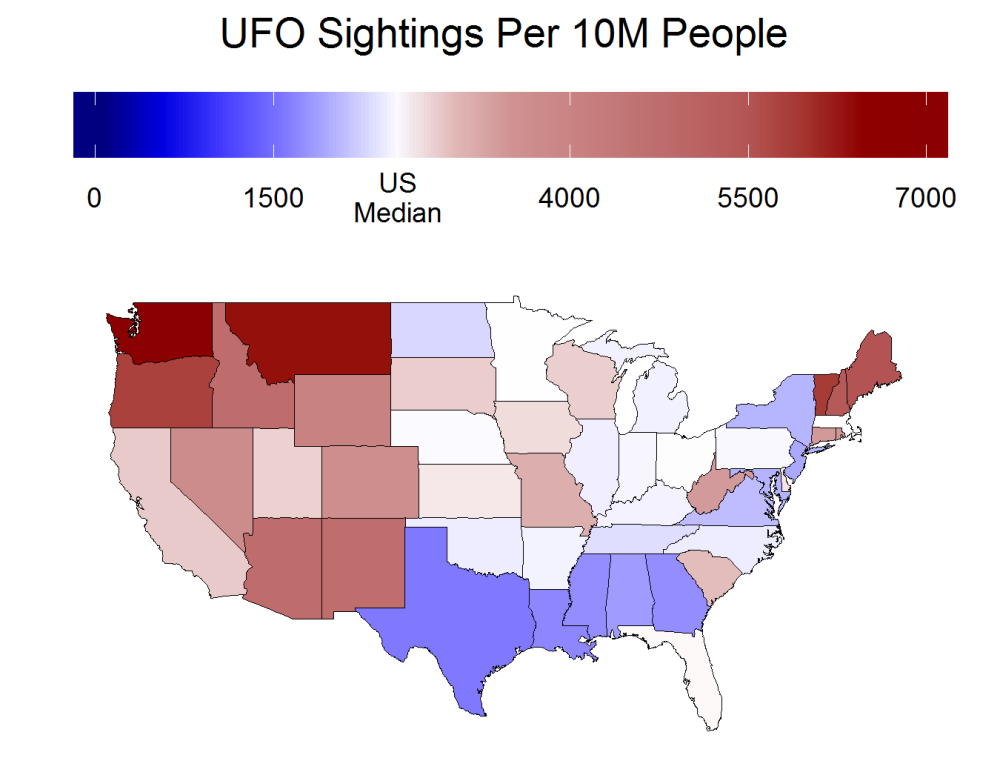
The geographic distribution of UFO sightings. Credit: sammonfort3

Using this data, Sam Monfort - a Doctoral Candidate from the department of Human Factors & Applied Cognition at George Mason University - produced a series of visuals that illustrate the history of UFO sightings. And based on the visualized trends, some rather interesting conclusions can be drawn. The most obvious is that the geographical distribution of sightings is hardly even. For starters, reports in the USA were equal to about 2500 sightings per 10 million people.

This is almost 300 times higher than the global average. Based on individual states, the concentration of sightings was also quite interesting. Apparently, more sightings happen (per 10 million people) in the West and Northwest, with the highest numbers coming from Washington and Montana. Oregon, Idaho, Arizona and New Mexico also made strong showings, while the Great Lakes and Midwestern states were all consistent with the national median.

On the opposite coast, Maine, Vermont, and New Hampshire all had a good number of sightings per capita, though the state of New York even as New York was beneath the national median. Texas actually ranked the lowest, and was followed by the Southern states of Louisiana, Mississippi, Alabama and Georgia. But as Monfort told Universe Today via email, this may be slightly skewed because of who is collecting the information:

"[I]t's worth mentioning that the NUFORC is an American agency ("N" stands for "National"). They make an effort to record international sightings (phone banks staffed 24/7), but I'd guess that sightings in the USA are still over-represented. Honestly, I'd bet that the NUFORC being based in Seattle is the main reason we see so many more sightings in the States. A more thorough analysis might cross-reference sightings from other agencies, like MUFON."
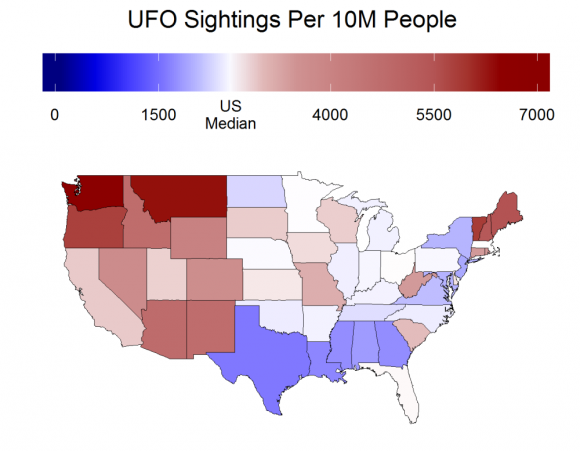
The geographic breakdown of annual UFO sightings (per 10 million people) in the US. Credit: sammonfort3

Canadians did not do much better, coming at second place after the United States with 1000 sightings per 10 million people. And according to a recent article by Allan Maki of The Globe and Mail, its becoming more common - with a record 1982 sightings reported in 2012. He also suggests that this could be due to a combination of growing interest in the subject and reduced stigma.

Iceland, the UK, Australia, the Virgin Islands and Cyprus all ranked a distant third, with between 250 and 500 sightings per 100 million people per year. New Zealand, Mexico, Israel and the Gulf States also produced considerable returns, as did the United Kingdom, Ireland, Portugal, Belgium, Danemark, Finland, Sweden and Norway.

From this distribution, one might make the generalization that more developed nations are more likely to report UFOs (i.e. better record-keeping and all that). And this is a possibility which Monfort explored. In another visualization, he cross-referenced the number of sightings in a respective country with amount of internet access it has (per 100 people), and a limited correlation was shown.

Nations like Israel and the Gulf States have a higher number of sightings than neighboring countries like Syria, Saudi Arabia and Iraq, while South Africa has more reported sightings than several North African and Sub-Saharan African nations surveyed. However, fast-developing nations like Russia, China and India showed a lower than average level of sightings, while Guyana and Suriname showed a higher than average level.
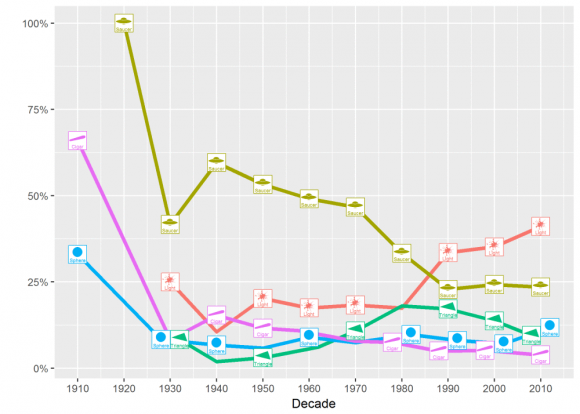
The number of UFO sightings per year, subdivided based on the type of object reported. Credit: sammonfort3

France, Italy and the Czech Republic also lagged behind many of their European counterparts, and Germany and Spain were only slightly higher than the average. So much like distribution by state within the US, internet access does not seem to be a consistent determining factor. Another interesting visualization was the one which broke down the sightings per decade based on the nature of the sighting.

As you can see from the table above, when UFO sightings first began in the early 20th century, they reportedly took the form of either a sphere or a cigar-shaped object. This differs from the 1920s, when "flying saucers" began to appear, and remained the dominant trend throughout World War II and the Cold War era. And ever since the 1990s - what Monfort refers to as "post-internet" era - the most common UFO sightings took the form of bright lights.

"If I had to guess, I'd say it was a combination of factors," said Monfort. "Like I mentioned in the blog, it seems a lot more plausible that someone would see strange lights in the sky than a flying object with a concrete shape (like a saucer). Seeing a shape implies that the object is pretty close to you, "and if it's that close why didn't you take a video of it?"

As for other factors, Monfort considers the possibility of fireworks and (as one comment on his blog suggested) Chinese lanterns. "Those are the little paper balloons you light a candle in and let fly. Some of the bright light sightings could be those, especially since I'd bet most Chinese lanterns are released in groups, with several people going out in groups to release them together. (Often people report formations of lights.)"

Naturally, the data does not support any ironclad conclusions, and plenty can be said about its reliability and methodology. After all, while UFO sightings are documented, they are famous for being routinely debunked. Nevertheless, visuals like these are interesting in illustrated the patterns of sightings, and can allow for some insightful speculation as to why they take place.

Further Reading: Visualize This

Matt Williams | February 28, 2017 at 10:53 pm | Tags: Featured | Categories: News, UFO | URL: http://wp.me/p1CHIY-yNW
Comment    See all comments

Trouble clicking? Copy and paste this URL into your browser: 

http://www.universetoday.com/133792/ufo-visualizations-show-trends-alien-spotting-saucers-lights/


BREAKING: Lady Gaga confirms she will replace Beyoncé as Coachella headliner

Having trouble viewing this email? | View it in your browser

FB TW g+ Ins

  Beyoncé dropped out of her headlining set, due to pregnancy concerns.

FOR MORE ON THIS STORY, GO TO:
  USATODAY.COM  
 

Help | Advertise | Home Delivery | Privacy Policy - Your California Privacy Rights  
  © 2017 USA TODAY, a division of Gannett Satellite Information Network, LLC.
7950 Jones Branch Drive, McLean, VA 22108