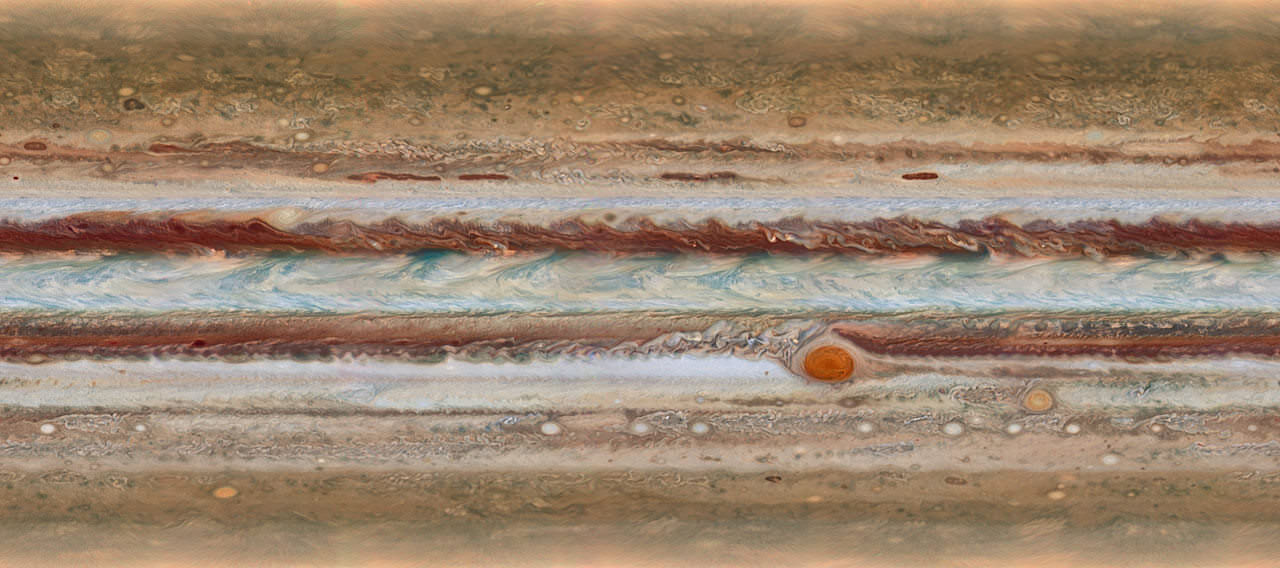
On April, 7th, 2017, Jupiter will come into opposition with Earth. This means that Earth and Jupiter will be at points in their orbit where the Sun, Earth and Jupiter will all line up. Not only will this mean that Jupiter will be making its closest approach to Earth - reaching a distance of about 670 million km (416 million mi) - but the hemisphere that faces towards us will be fully illuminated by the Sun.
Because of its proximity and its position, Jupiter will be brighter in the night sky than at any other time during the year. Little wonder then why NASA and the ESA are taking advantage of this favorable alignment to capture images of the planet with the Hubble Space Telescope. Already, on April 3rd, Hubble took the wonderful color image (shown above) of Jupiter, which has now been released.
Using its Wide Field Camera 3 (WFC3), Hubble was able to observe Jupiter in the visible, ultraviolet and infrared spectrum. From these observations, members of the Hubble science team produced a final composite image that allowed features in its atmosphere - some as small as 130 km across - to be discernible. These included Jupiter's colorful bands, as well as its massive anticyclonic storms.

Image of Jupiter's Great Red Spot, taken by the Voyager 1 space probe during its flyby on March 5, 1979, and re-processed on November 6, 1998. Credit: NASA/JPL
The largest of these - the Great Red Spot - is believed to have been raging on the surface ever since it was first observed in the 1600s. In addition, it is estimated that the wind speeds can reach up to 120 m/s (430 km/h; 267 mph) at its outer edges. And given its dimensions - between 24-40,000 km from west to east and 12-14,000 km from south to north - it is large enough to swallow the Earth whole.
Astronomers have noticed how the storm appears to have been shrinking and expanding throughout its recorded history. And as the latest images taken by Hubble (and by ground-based telescopes) have confirmed, the storm continues to shrink. Back in 2012, it was even suggested that the Giant Red Spot might eventually disappear, and this latest evidence seems to confirm that.
No one is entirely sure why the storm is slowly collapsing; but thanks to images like these, researchers are gaining a better understanding of what mechanisms power Jupiter's atmosphere. Aside from the Great Red Spot, the similar but smaller anticyclonic storm in the farther southern latitudes - aka. Oval BA or "Red Spot Junior" - was also captured in this latest image.
Located in the region known as the South Temperate Belt, this storm was first noticed in 2000 after three small white storms collided. Since then, the storm has increased in size, intensity and changed color (becoming red like its "big brother"). It is currently estimated that wind speeds have reached 618 km/h (384 mph), and that it has become as large as Earth itself (over 12,000 km, 7450 mi in diameter).
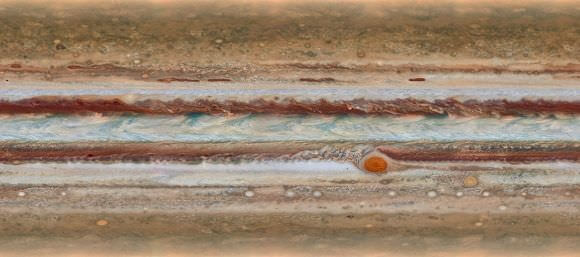
Image of Jupiter, made during the Outer Planet Atmospheres Legacy (OPAL) programme on January 19th, 2015. Credit: NASA/ESA/A. Simon (GSFC)/M. Wong (UC Berkeley)/G. Orton (JPL-Caltech)
And then there are the color bands that make up Jupiter's surface and give it its distinct appearance. These bands are essentially different types of clouds that run parallel to the equator and differ in color based on their chemical compositions. Whereas the whiter bands have higher concentrations of ammonia crystals, the darker (red, orange and yellow) have lower concentrations.
Similarly, these color patterns are also affected by the upwelling of compounds that change color when they are exposed to ultraviolet light from the Sun. Known as chromophores, these colorful compounds are likely made up of sulfur, phosphorous and hydrocarbons. The planet's intense wind speeds of up to 650 km/h (~400 mph) also ensure that the bands are kept separate.
These and other observations of Jupiter are part of the Outer Planet Atmospheres Legacy (OPAL) progamme. Dedicated to ensuring that Hubble gets as much information as it can before it is retired - sometime in the 2030s or 2040s - this program ensures that time is dedicated each year to observing Jupiter and the other gas giants. From the images obtained, OPAL hopes to create maps that planetary scientists can study long after Hubble is decommissioned.
The project will ultimately observe all of the giant planets in the Solar System in a wide range of filters. The research that this enables will not only help scientists to study the atmospheres of the giant planets, but also to gain a better understanding of Earth's atmosphere and those of extrasolar planets. The programme began in 2014 with the study of Uranus and has been studying Jupiter and Neptune since 2015. In 2018, it will begin viewing Saturn.
Further Reading: Hubble Space Telescope


 Posts
Posts