Tuesday, April 11, 2017

U.S. National Library of Medicine NLM Technical Bulletin Update

04/11/2017 04:06 PM EDT

The Annual Meeting of the Medical Library Association will be held May 26-31, 2017, at the Washington State Convention Center, Seattle, Washington. Attendees are invited to visit the NLM exhibit booth 309 (May 28-30) to meet NLM staff and see NLM Web products and services. The NLM Theater at the booth will feature demonstrations and tutorials on a wide variety of topics.
04/11/2017 04:04 PM EDT

On May 2, 2017, NLM will present the Webinar: Insider's Guide to Accessing NLM Data: Welcome to E-utilities for PubMed. Registration is open now.
This email was sent using GovDelivery, on behalf of: U.S. National Library of Medicine · 8600 Rockville Pike · Bethesda, MD 20894 Powered by GovDelivery

BREAKING: J. Geils of 1980s J. Geils Band found dead in his Groton, Mass., home at age 71

Having trouble viewing this email? | View it in your browser

FB TW g+ Ins

  Police in Groton have not yet provided further details.

FOR THE LATEST NEWS VISIT:
  USATODAY.COM  
 
Help | Advertise | Home Delivery | Privacy Policy - Your California Privacy Rights  
  © 2017 USA TODAY, a division of Gannett Satellite Information Network, LLC.
7950 Jones Branch Drive, McLean, VA 22108

Check out our lastest story: "Path to Safety"

Having trouble viewing this email? View it as a Web page.Bookmark and Share

Check out our latest story:

Path to Safety: Man-made wildlife crossings cut animal-vehicle collisions nearly 80 percent

Thousands of motorists are involved in collisions involving animals each year. Looking to address the problem, federal and state wildlife and transportation partners recently built and monitored the effectiveness of Nevada's first wildlife overpass project (shown above) along Highway 93, in Elko County. Credit: Photo courtesy of  Nevada Department of Wildlife (NDOW)
Thousands of motorists are involved in collisions involving animals each year. Looking to address the problem, federal and state wildlife and transportation partners recently built and monitored the effectiveness of Nevada's first wildlife overpass project (shown above) along Highway 93, in Elko County. Credit: Photo courtesy of  Nevada Department of Wildlife (NDOW)

By John Heil
April 11, 2017

Each year, thousands of animals are killed by motorists on interstate highways and roads that intersect critical wildlife habitats, greatly increasing the risk to human safety.

Looking to address this issue, the Nevada Department of Wildlife (NDOW), with grant funding from the U.S. Fish and Wildlife Service (FWS) and in collaboration with the Nevada Department of Transportation (DOT) have recently built and monitored the effectiveness of the first-ever wildlife overpass project in Nevada along Highway 93, in Elko County.

Continue to full story....


This email was sent using GovDelivery, on behalf of: U.S. Fish & Wildlife Service Pacific Southwest Region · 2800 Cottage Way · Suite W-2606 · Sacramento, CA 95825 Powered by GovDelivery

BREAKING: White House Press Secretary Sean Spicer apologizes for Hitler comment, calling it 'insensitive'

Having trouble viewing this email? | View it in your browser

FB TW g+ Ins

  Spicer apologized for his comments likening Syrian President Bashar Assad to Holocaust architect Adolf Hitler, The Associated Press and CNN reported. "We didn't use chemical weapons in World War II. You had a ... someone as despicable as Hitler who didn't even sink ...  to using chemical weapons," Spicer said during Tuesday's press briefing. President Trump's spokesman said he meant to say that Hitler had not used chemical weapons in battlefield situations as Assad did last week.

FOR MORE ON THIS STORY, GO TO:
  USATODAY.COM  
 
Help | Advertise | Home Delivery | Privacy Policy - Your California Privacy Rights  
  © 2017 USA TODAY, a division of Gannett Satellite Information Network, LLC.
7950 Jones Branch Drive, McLean, VA 22108

[eo-announce] Earth Observatory: What's New Week of 11 April 2017

The latest from NASA's Earth Observatory (11 April 2017)
------------------------------------------------------------------------

Latest Images:
http://earthobservatory.nasa.gov/IOTD/

* Meltwater Channels on Ellesmere Island
  http://earthobservatory.nasa.gov/IOTD/view.php?id=90004&src=eoa-iotd

* Fresh Water for Shanghai
  http://earthobservatory.nasa.gov/IOTD/view.php?id=89996&src=eoa-iotd

* Lake Neusiedl and Lake Ferto
  http://earthobservatory.nasa.gov/IOTD/view.php?id=89989&src=eoa-iotd

* Russia's Bay of Whales
  http://earthobservatory.nasa.gov/IOTD/view.php?id=89981&src=eoa-iotd

* 'Ungovernable Fury'
  http://earthobservatory.nasa.gov/IOTD/view.php?id=89984&src=eoa-iotd

* Finding Fires Before They Rage
  http://earthobservatory.nasa.gov/IOTD/view.php?id=89974&src=eoa-iotd

* Overlooked Landslides
  http://earthobservatory.nasa.gov/IOTD/view.php?id=89969&src=eoa-iotd

* The Oil Fires in Qayyarah Are Out
  http://earthobservatory.nasa.gov/IOTD/view.php?id=89964&src=eoa-iotd

--------------------

Recent Blog Posts:
http://earthobservatory.nasa.gov/blogs/

Earth Matters
* On This Date: The Bingham Canyon Landslide
  https://earthobservatory.nasa.gov/blogs/earthmatters/?p=7279&src=eoa-blogs

* April Puzzler
  Your challenge for the April puzzler is to tell us what part of the world we are looking at, what the image shows, and why the scene is interesting.
  https://earthobservatory.nasa.gov/blogs/earthmatters/?p=7285&src=eoa-blogs

* SMAP! Goes The Memory
  https://earthobservatory.nasa.gov/blogs/earthmatters/?p=7268&src=eoa-blogs

* A Climate Model for the History Books
  Early modeling work by Syukura Manabe and Richard Wetherald has proven to be remarkable prescient decades later.
  https://earthobservatory.nasa.gov/blogs/earthmatters/?p=7220&src=eoa-blogs

--------------------


---------------------------------------------------------------------
NASA's Earth Observatory
Where every day is Earth day.
http://earthobservatory.nasa.gov/

These Foods Have More Sugar Than You Think


Juno Sees Overlapping Colliding Clouds on Jupiter

New post on Universe Today

Juno Sees Overlapping Colliding Clouds on Jupiter

by Matt Williams

The Juno mission has made some remarkable finds since it reached Jupiter in July of 2016. During the many orbits it has made around Jupiter's poles - which occur every 53 days - some stunning imagery has resulted. Not only have these pictures revealed things about Jupiter's atmosphere, they have also been an opportunity for the public to participate in the exploration of this giant planet.

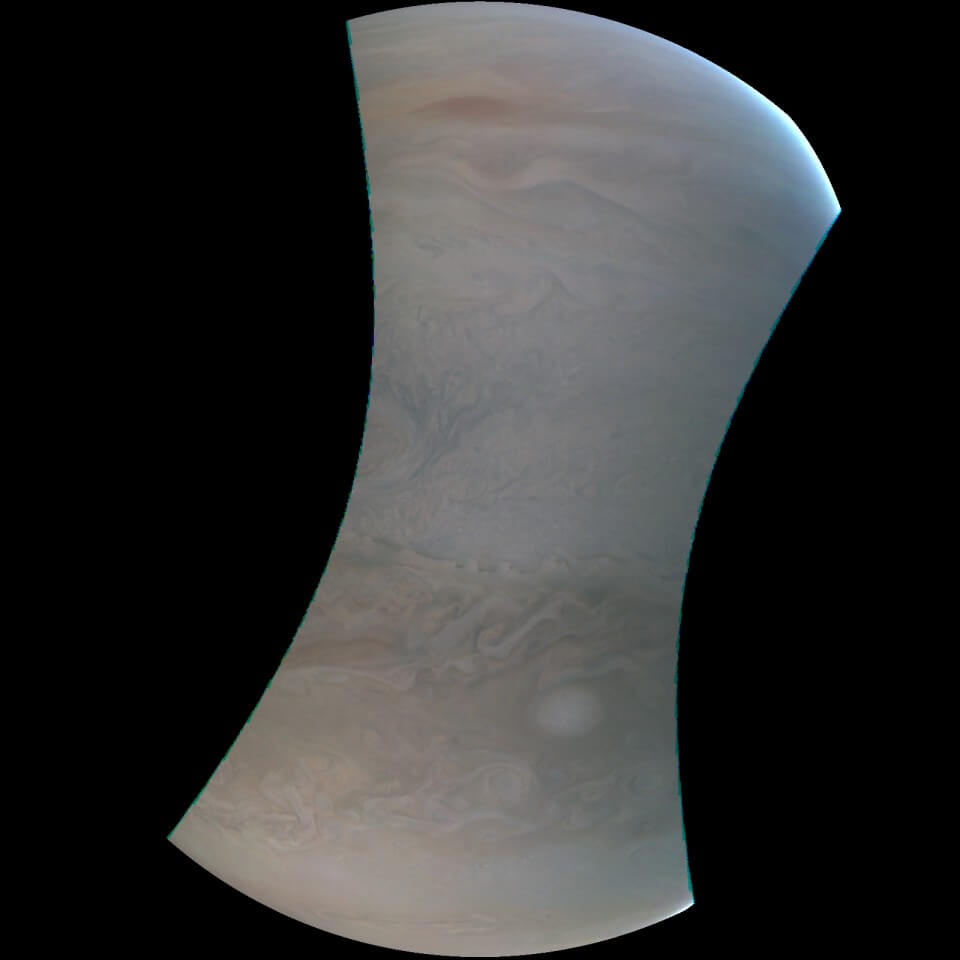
The latest feature that was publicly selected to be photographed is known as "STB Spectre". This feature  was photographed on March 27th, 2017, at 2:06 a.m. PDT (5:06 a.m. EDT), when Juno was 12,700 km from the planet. During this pass, the JunoCam captured a series of light and dark clouds coming together in Jupiter's South Tropical Region (STR).

The left side of the photograph corresponds to the South Temperate Belt (STB), a prominent belt in Jupiter's Southern Hemisphere which is typically darker. It is here that "the Spectre" - the wide bluish streaks on the upper right side of the photograph - can be seen, and which represent a long-lived storm that was taking place when the area was photographed.
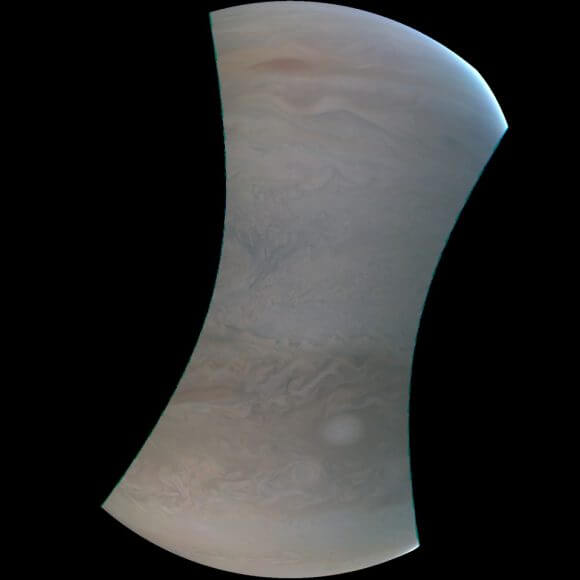
Unprocessed JunoCam image showing the points of interest (POIs) known as "STB Spectre" and "The White Solid". Credit: NASA/SwRI/MSSS

On the right side of the image, we see the neighboring Southern Tropical Zone (STropZ), one of the most prominent zones on the planet. Here, we see another atmospheric condition colliding with the Spectre, one which is characterized by a series of anticyclonic storms (the small white ovals). Not surprisingly, it is within these two bands that part of the large anticyclonic storms known as the "Great Red Spot" and "Red Spot Junior" also exist.

Like all images snapped by the JunoCam since the probe began orbiting Jupiter, this image was made available to the public. In this case, the image was processed by Roman Tkachenko, an amateur astronomer, image processor, and 3D artist who's body of work includes images and visualizations for the New Horizons mission. The description was produced by John Rogers, the citizen scientist who identified the point of interest.

As Tkachenko Universe Today via email, working with these missions pictures is all about bringing raw images to life:

"This image is based on a raw image. Working with raw data you can get a higher resolution than we can see in already constructed, and map-projected official versions. I worked with colors, sharpness and dynamic range to show more details and variety."

This is something new for a space mission, where the public has a direct say in what features will be photographed for study, and can help process them as well. "The participation of amateur astronomers and citizen scientists in this mission is an opportunity to be involved in something gorgeous," said Tkachenko. "They can also show their skills to the public and help the Juno team look at all these data from different angles.
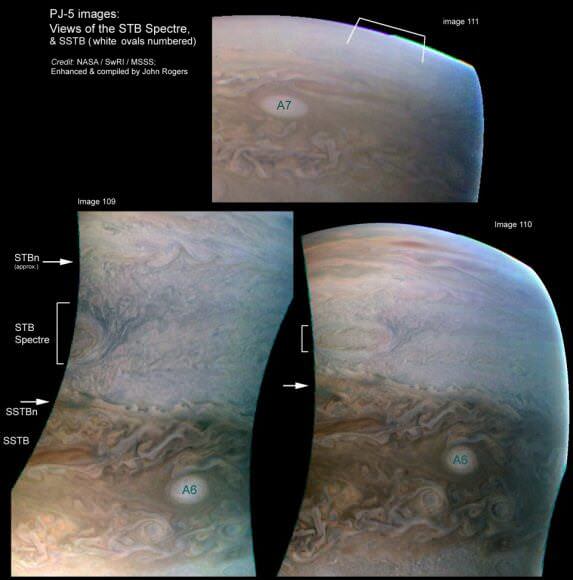
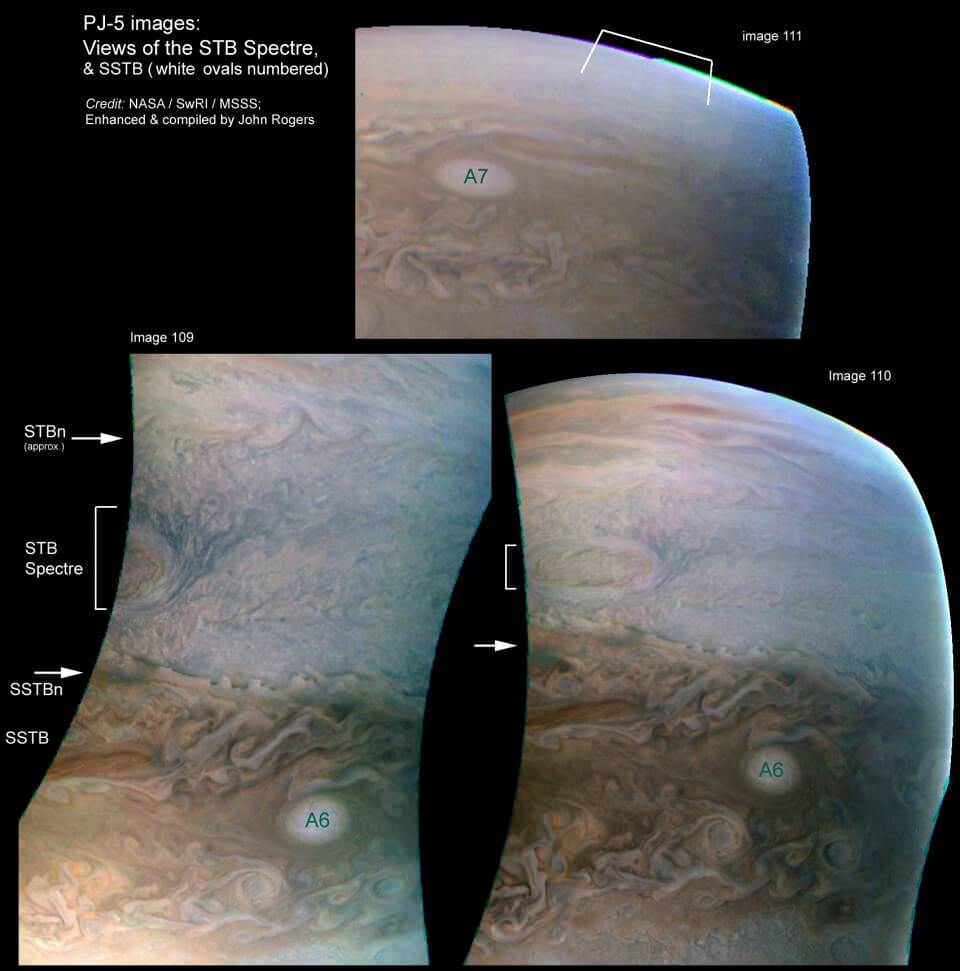
JunoCam closeups of the STB Spectre, with adjacent image showing the SSTB ('string of pearls'). Credit: NASA/SwRI/MSSS

The STB Spectre was one of five Points of Interest (POIs) that were selected by the public to be photographed during Perijove 5 - Juno's fifth orbit of the planet, which began on March 27th, 2017. Before the next maneuver (Perijove 6) commences on May 19th, 2017, the public will once again be able to vote on what features they want to see photographed.

Things that have been captured during previous orbits include the stunning image of the "Jovian pearl", a detailed view of Jupiter's northern clouds, breathtaking images of the swirling clouds round Jupiter's northern and southern poles. Many more are sure to follow between now and July 2018, as Juno conducts its seven remaining perijove maneuvers before being de-orbited and burning up in Jupiter's atmosphere.

To learn more about the rules for voting, and to vote on what you'd like the JunoCam to capture, check out the Southwest Research Institute's (SwRI) JunoCam voting page. And be sure to enjoy this mission video:

Further Reading: NASA

Matt Williams | April 11, 2017 at 6:14 pm | Tags: Featured, Jupiter's atmosphere | URL: http://wp.me/p1CHIY-z6S
Comment    See all comments

Trouble clicking? Copy and paste this URL into your browser: 

https://www.universetoday.com/134966/juno-sees-overlapping-colliding-clouds-jupiter/