Sunday, April 23, 2017

Team Creates Negative Effective Mass In The Lab

New post on Universe Today

Team Creates Negative Effective Mass In The Lab

by Matt Williams

When it comes to objects and force, Isaac Newton's Three Laws of Motion are pretty straightforward. Apply force to an object in a specific direction, and the object will move in that direction. And unless there's something acting against it (like gravity or air pressure) it will keep moving in that direction until something stops it. But when it comes to "negative mass", the exact opposite is true.

As the name would suggest, the term refers to matter whose mass is opposite that of normal matter. Until a few years ago, negative mass was predominantly a theoretical concept and had only been observed in very specific settings. But according to a recent study by an international team of researchers, they created a fluid with a "negative effective mass"under laboratory conditions for the first time .

To put it in the simplest terms, matter can have a negative mass in the same way that a particle can have a negative charge. When it comes to the Universe that we know and study on a regular basis, one could say that we have encountered only the positive form of mass. In fact, one could say that it is the same situation with matter and antimatter. Theoretical physics tells us both exist, but we only see the one on a regular basis.

. Credit: shock.wsu.edu

As Dr. Michael McNeil Forbes - a Professor at Washington State University, a Fellow at the Institute for Nuclear Theory, and a co-author on the study - explained in a WSU press release:

"That's what most things that we're used to do. With negative mass, if you push something, it accelerates toward you. Once you push, it accelerates backwards. It looks like the rubidium hits an invisible wall."

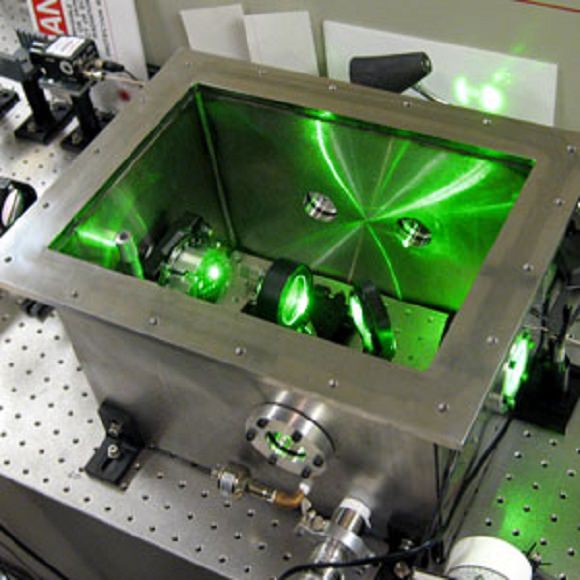
According to the team's study, which was recently published in the Physical Review Letters (under the title "Negative-Mass Hydrodynamics in a Spin-Orbit–Coupled Bose-Einstein Condensate"), a negative effective mass can be created by altering the spin-orbit coupling of atoms. Led by Peter Engels - a professor of physics and astronomy at Washington State University - this consisted of using lasers to control the behavior of rubidium atoms.

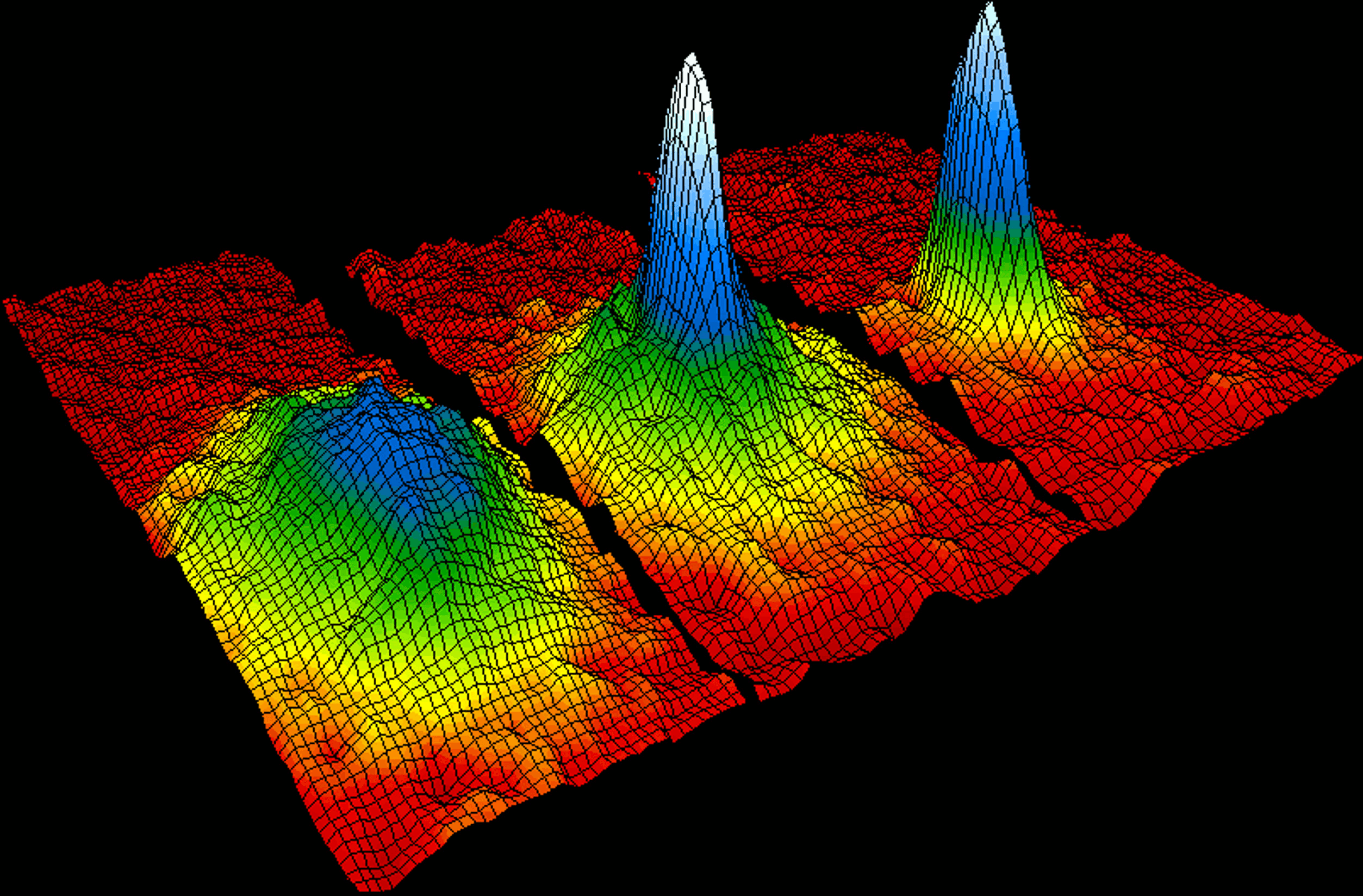
They began by using a single laser to keep rubidium atoms in a bowl measuring less than 100 microns across. This had the effect of slowing the atoms down and cooling them to just a few degrees above absolute zero, which resulted in the rubidium becoming a Bose-Einstein condensate. Named after Satyendra Nath Bose and Albert Einstein (who predicted how their atoms would behave) these types of condensates behaves like a superfluid.
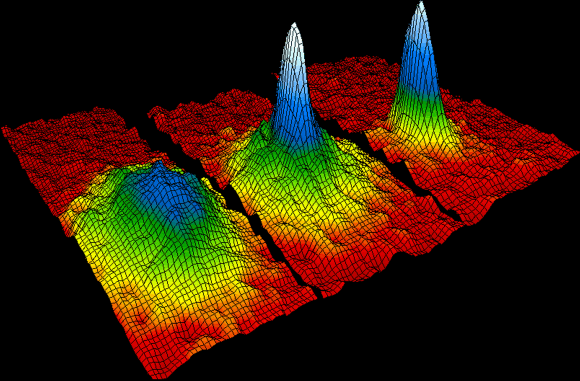
Velocity-distribution data (3 views) for a gas of rubidium atoms, confirming the discovery of a new phase of matter, the Bose–Einstein condensate. Credit: NIST/JILA/CU-Boulder

Basically, this means that their particles move very slowly and behave like waves, but without losing any energy. A second set of lasers was then applied to move the atoms back and force, effectively changing the way they spin. Prior to the change in their spins, the superfluid had regular mass and breaking the bowl would result in them pushing out and expanding away from their center of mass.

But after the application of the second laser, the rubidium rushed out and accelerated in the opposite direction - consistent with how a negative mass would. In previous laboratory experiments, researchers were unable to get atoms to behave in a way that was consistent with negative mass. As Forbes explained, the WSU experiment avoided some of the of the underlying defects that these experiments encountered:

"What's a first here is the exquisite control we have over the nature of this negative mass, without any other complications. It provides another environment to study a fundamental phenomenon that is very peculiar."

And while news of this experiment has been met with fanfare and claims to the effect that the researchers had "rewritten the laws of physics", it is important to emphasize that this research has created a "negative effective mass" - which is fundamentally different from a negative mass.
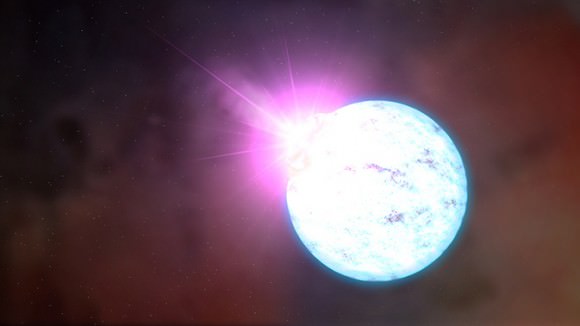
Artist's rendering of an outburst on an ultra-magnetic neutron star, also called a magnetar.
Credit: NASA/Goddard Space Flight Center

As Sabine Hossenfelder, a Research Fellow at the Frankfurt Institute for Advanced Studies, wrote on her website Backreaction in response to the news:

"Physicists use the preamble 'effective' to indicate something that is not fundamental but emergent, and the exact definition of such a term is often a matter of convention. The 'effective radius' of a galaxy, for example, is not its radius. The 'effective nuclear charge' is not the charge of the nucleus. And the 'effective negative mass' – you guessed it – is not a negative mass. The effective mass is merely a handy mathematical quantity to describe the condensate's behavior."

In other words, the researchers were able to get atoms to behave as a negative mass, rather than creating one. Nevertheless, their experiment demonstrates the level of control researchers now have when conducting quantum experiments, and also serves to clarify how negative mass behaves in other systems. Basically, physicists can use the results of these kinds of experiments to probe the mysteries of the Universe where experimentation is impossible.

These include what goes on inside neutron stars or what transpires beneath the veil of a event horizon. Perhaps they could even shed some light on questions relating to dark energy.

Further Reading: Physical Review Letters, WSU

Matt Williams | April 23, 2017 at 9:43 pm | Tags: Featured | Categories: News | URL: http://wp.me/p1CHIY-z9Y
Comment    See all comments

Trouble clicking? Copy and paste this URL into your browser: 

https://www.universetoday.com/135158/team-creates-negative-effective-mass-lab/


SS John Glenn Stellar Space Station Launch – Photo/Video Gallery

New post on Universe Today

SS John Glenn Stellar Space Station Launch – Photo/Video Gallery

by Ken Kremer

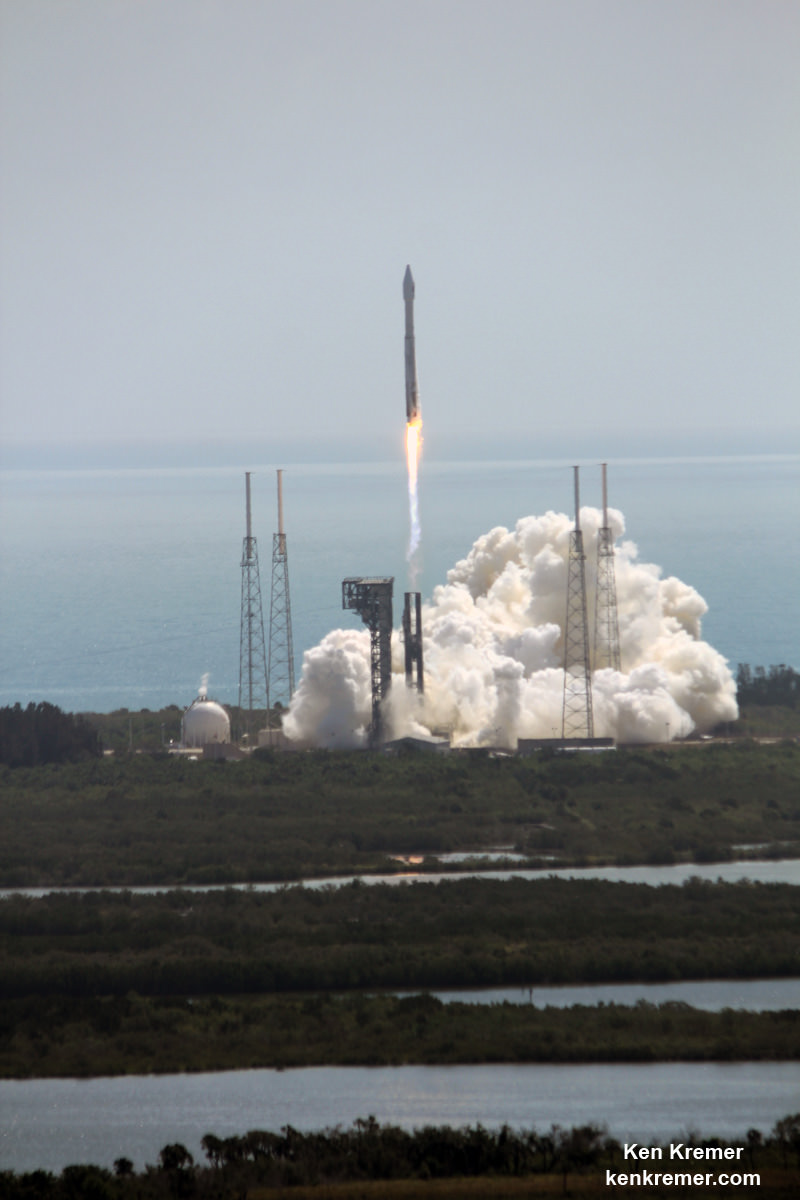
Orbital ATK's seventh cargo delivery flight to the International Space Station -in tribute to John Glenn- launched at 11:11 a.m. EDT April 18, 2017, on a United Launch Alliance Atlas V rocket from Space Launch Complex 41 on Cape Canaveral Air Force Station in Florida. Credit: Ken Kremer/kenkremer.com

KENNEDY SPACE CENTER, FL - This week's blastoff of the 'SS John Glenn' Cygnus cargo freighter atop an Atlas V rocket on a critical mission delivering over 7000 pounds of science and gear to the International Space Station (ISS) yielded stellar imagery from all around the Florida Space Coast.

On the occasion of what amounts to a sentimental third journey to space for NASA astronaut John Glenn - the first American to orbit Earth - near perfect weather conditions enabled spectacular views of the lunchtime liftoff of the United Launch Alliance Atlas V carrying Orbital ATK's Cygnus supply ship named in honor of a true American hero.

The SS John Glenn blasted to orbit on time at 11:11 a.m. EDT Tuesday, April 18 atop a United Launch Alliance Atlas V rocket from Space Launch Complex 41 on Cape Canaveral Air Force Station in Florida.

The stunning events were captured by journalists and tourists gathered from across the globe.

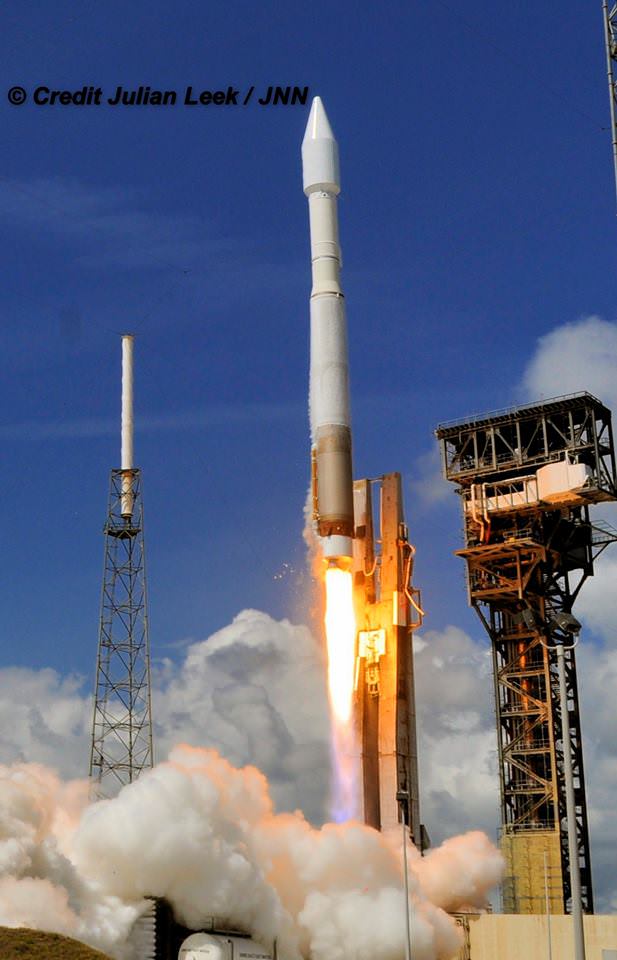
Liftoff of Orbital ATK SS John Glenn OA-7 mission atop ULA Atlas V rocket from Space Launch Complex 41 at Cape Canaveral Air Force Station, FL on April 18, 2017. Credit: Julian Leek

Check out this expanding gallery of eyepopping photos and videos from several space journalist colleagues and friends and myself - for views you won't see elsewhere.

Click back as the gallery grows !

Watch this truly magnificent and unique video from space journalist Jeff Seibert positioned at a Playalinda Beach on the Atlantic Ocean - as excited vacationers and space enthusiasts frolic together in the waves and sands of this public beach.

Video Caption: Launch of Orbital ATK OA-7 Cygnus cargo vessel viewed from Playalinda Beach, FL on April 18, 2017. An Atlas 5 rocket launching a Cygnus cargo vessel, the "S.S. John Glenn" to the ISS loaded with 7452 pounds of science equipment, experiments, consumables and spare parts. Credit: Jeff Seibert

Playalinda is located just north of NASA's Launch Complex 39A and offers the closest and clearest possible views of Atlas rocket launches from only about 5 miles away.

Orbital ATK's seventh cargo delivery flight to the International Space Station -in tribute to John Glenn- launched at 11:11 a.m. EDT April 18, 2017, on a United Launch Alliance Atlas V rocket from Space Launch Complex 41 on Cape Canaveral Air Force Station in Florida. Credit: Ken Kremer/kenkremer.com

The SS John Glenn Cygnus vehicle counts as Orbital ATK's seventh cargo delivery flight to the station.

The vehicle is also known alternatively as the Cygnus OA-7 or CRS-7 mission.

Cygnus OA-7 is loaded with 3459 kg (7626 pounds) of science experiments and hardware, crew supplies, spare parts, gear and station hardware to the orbital laboratory in support over 250 research experiments being conducted on board by the Expedition 51 and 52 crews. The total volumetric capacity of Cygnus exceeds 27 cubic meters.

Liftoff of Orbital ATK SS John Glenn OA-7 mission atop ULA Atlas V rocket from Space Launch Complex 41 at Cape Canaveral Air Force Station, FL on April 18, 2017, as seen from VAB roof at KSC. Credit: Julian Leek

The Orbital ATK SS John Glenn Cygnus is the 2nd US cargo ship to launch to the ISS this year following the SpaceX Dragon CRS-10 mission in February -as I reported here.

Watch for Ken's continuing onsite launch reports direct from the Kennedy Space Center and Cape Canaveral Air Force Station in Florida.

Stay tuned here for Ken's continuing Earth and Planetary science and human spaceflight news.

Ken Kremer

Orbital ATK's 7th cargo delivery flight to the International Space Station launched at 11:11 a.m. EDT April 18, 2017 carrying the SS John Glenn atop a United Launch Alliance Atlas V rocket from Space Launch Complex 41 on Cape Canaveral Air Force Station in Florida, as seen from the VAB roof at KSC. Credit: Ken Kremer/kenkremer.com

Ken Kremer | April 23, 2017 at 9:40 pm | Tags: Orbital ATK | Categories: International Space Station | URL: http://wp.me/p1CHIY-zam
Comment    See all comments

Trouble clicking? Copy and paste this URL into your browser: 

https://www.universetoday.com/135182/ss-john-glenn-stellar-space-station-launch-photovideo-gallery/


How Israeli soldiers interrogated me

april 23, 2017

How Israeli soldiers interrogated me

On Palestinian Prisoners Day detainees and their relatives tell horror stories of torture and abuse in Israeli jails.

America's addiction to war

War brings supposedly disparate parts of the US together to rally around the flag, yellow ribbons and even Donald Trump.

'My biggest regret': Being a migrant worker in Greece

Where is this Europe? asks one Pakistani migrant worker as they share stories of abuse and working without pay.

Why does Le Pen get so much support from young voters?

Experts on French politics say the far-right has successfully attracted young people amid economic decline.

Why did 41 girls die at a Guatemalan youth shelter?

Accusations of abuse and neglect have come to light after a fire at a state-funded youth shelter killed 41 girls.

The art of surviving a Venezuela on the brink

As repression of anti-government protests continue, the human rights situation in Venezuela has deteriorated.

Take a tour of West Jerusalem's Palestinian history

A new documentary brings the hidden urban Palestinian history of West Jerusalem on to screens everywhere.

The Earth versus capitalism

Unfortunately, as of Earth Day 2017, capitalism is winning the war it has been waging against the planet.

PROGRAMMES HIGHLIGHTS

Iron Grandpa

A 72-year-old Finnish weightlifter who has won four world championships is determined to win one final title.

Mahmoud Ahmadinejad: Iran can be better managed

Former president of Iran talks about his surprise election run and calls for regional peace and unity.


Al Jazeera English · P.O. Box 23127 · TV Roundabout · Doha - · Qatar

These Things Can Trigger an Asthma Attack

webmd logo Daily
Sunday, April 23, 2017
Missing Images
These Things Can Trigger an Asthma Attack

You know pollen and dander can set off allergy symptoms, but what about paint, fruit, or even pain relievers?
View Slideshow

New WebMD Pregnancy App

The most trusted pregnancy information is just a tap away.
Get the Free App Now
From the Message Boards
'Why Don't I Look My Weight?' -- Our Doc Responds
'I Don't Deserve to Be Overweight'
Marijuana for Pain Management?
'Am I Bipolar or Not?'
Boyfriend Can't Afford Testosterone Treatments -- Any Suggestions?
Featured
Top Reasons for Stomach Pain
Depression Triggers Common With Aging
How Are Allergies and Eczema Linked?
Get Tips for Keeping Cats Healthy
How Long Is Canned Food Safe to Eat?
ADVERTISEMENT
 
ADVERTISEMENT
 
 
ADVERTISEMENT
Allergy App  
ADVERTISEMENT