Understanding how the Universe came to be is one of the greater challenges of being an astrophysicist. Given the observable Universe's sheer size (46.6 billion light years) and staggering age (13.8 billion years), this is no easy task. Nevertheless, ongoing observations, calculations and computer simulations have allowed astrophysicists to learn a great deal about how galaxies and larger structures have changed over time.
For example, a recent study by a team from the University of Kentucky (UK) has challenged previously-held notions about how our galaxy has evolved to become what we see today. Based on observations made of the Milky Way's stellar disk, which was previously thought to be smooth, the team found evidence of asymmetric ripples. This indicates that in the past, our galaxy may have be shaped by ancient impacts.
The study, titled "Milky Way Tomography with K and M Dwarf Stars: The Vertical Structure of the Galactic Disk", recently appeared in the The Astrophysical Journal. Led by Deborah Ferguson, a 2016 UK graduate, the team consisted of Professor Susan Gardner - from the UK College of Arts and Sciences - and Brian Yanny, an astrophysicist from the Fermilab Center for Particle Astrophysics (FCPA).
This study evolved from Ferguson's senior thesis, which was overseen by Prof. Gardner. At the time, Ferguson sought to expand on previous research by Gardner and Yanny, which also sought to understand the presence of ripples in our galaxy's stellar disk. For the sake of this new study, the team relied on data obtained by the Sloan Digital Sky Survey's (SDSS) 2.5m Telescope, located at the Apache Point Observatory in New Mexico.
This allowed the team to examine the spatial distribution of 3.6 million stars in the Milky Way Galaxy, from which they confirmed the presence of asymmetric ripples. These, they claim, can be interpreted as evidence of the Milky Way's ancient impacts - in other words, that these ripples resulted from our galaxy coming into contact with other galaxies in the past.
These could include a merger between the Milky Way and the Sagittarius dwarf galaxy roughly 0.85 billion years ago, as well as our galaxy's current merger with the Canis Major dwarf galaxy. As Prof. Gardner explained in a recent UK press release:
"These impacts are thought to have been the 'architects' of the Milky Way's central bar and spiral arms. Just as the ripples on the surface of a smooth lake suggest the passing of a distant speed boat, we search for departures from the symmetries we would expect in the distributions of the stars to find evidence of ancient impacts. We have found extensive evidence for the breaking of all these symmetries and thus build the case for the role of ancient impacts in forming the structure of our Milky Way."
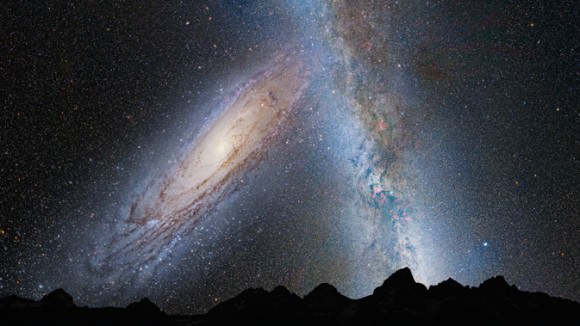
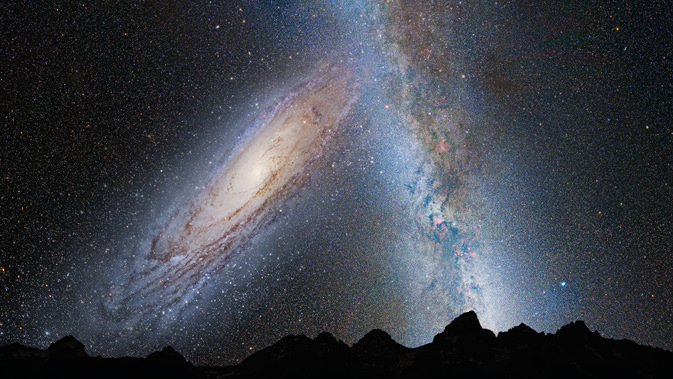
Illustration showing a stage in the predicted merger between our Milky Way galaxy and the neighboring Andromeda galaxy, as it will unfold over the next several billion years. Credit: NASA; ESA; Z. Levay and R. van der Marel, STScI; T. Hallas; and A. Mellinger
As noted, Gardner's previous work also indicated that when it came to north/south symmetry of stars in the Milky Way's disk, there was a vertical "ripple". In other words, the number of stars that lay above or below the stellar disk would increase from one sampling to the next the farther they looked from the center of the galactic disk. But thanks to the most recent data obtained by the SDSS, the team had a much larger sample to base their conclusions on.
And ultimately, these findings confirmed the observations made by Ferguson and Lally, and also turned up evidence of an asymmetry in the plane of the galactic disk as well. As Ferguson explained:
"Having access to millions of stars from the SDSS allowed us to study galactic structure in an entirely new way by breaking the sky up into smaller regions without loss of statistics. It has been incredible watching this project evolve and the results emerge as we plotted the stellar densities and saw intriguing patterns across the footprint. As more studies are being done in this field, I am excited to see what we can learn about the structure of our galaxy and the forces that helped to shape it."
Understanding how our galaxy evolved and what role ancient impact played is essential to understanding the history and evolution of the Universe as a whole. And in addition to helping us confirm (or update) our current cosmological models, studies like this one can also tell us much about what lies in store for our galaxy billions of years from now.
For decades, astronomers have been of the opinion that in roughly 4 billion years, the Milky Way will collide with Andromeda. This event is likely to have tremendous repercussions, leading to the merger of both galaxy's supermassive black holes, stellar collisions, and stars being ejected. While it's doubtful humanity will be around for this event, it would still be worthwhile to know how this process will shape our galaxy and the local Universe.
Further Reading: University of Kentucky, The Astrophysical Journal


 Posts
Posts


 Daily Bite