Friday, September 8, 2017

New device could turn heat energy into a viable fuel source

09/08/2017 09:13 PM EDT

Yi Gu's research group

A new device being developed by Washington State University physicist Yi Gu could one day turn the heat generated by a wide array of electronics into a usable fuel source. The device is a multicomponent, multilayered composite material called a van der Waals Schottky diode. It converts heat into electricity up to three times more efficiently than silicon--a semiconductor material widely used in the electronics industry.


Full story at https://news.wsu.edu/2017/08/30/heat-to-energy-fuel-source/

Source
Washington State University


This is an NSF News From the Field item.


This email was sent using GovDelivery Communications Cloud on behalf of: National Science Foundation Update · 4201 Wilson Boulevard · Arlington, VA 22230 · 703-292-5111 GovDelivery logo

Jordan faces likelihood of much more frequent long and severe droughts

09/08/2017 09:13 PM EDT

satellite image of the Wadi Rum desert and irrigated farmland in Jordan

Jordan is among the world's most water-poor nations, and a new, comprehensive analysis of regional drought and land-use changes in upstream Syria suggests the conditions could get significantly worse.


Full story at http://news.stanford.edu/2017/08/30/extreme-droughts-projected-increase-jordan/

Source
Stanford University


This is an NSF News From the Field item.


This email was sent using GovDelivery Communications Cloud on behalf of: National Science Foundation Update · 4201 Wilson Boulevard · Arlington, VA 22230 · 703-292-5111 GovDelivery logo

BREAKING: Hurricane Irma strengthens to Category 5 as it bears down on Florida's coast

Having trouble viewing this email? | View it in your browser

FB TW g+ Ins

  The National Hurricane Center said Irma's maximum sustained winds have increased to 160 mph, and the storm is about 300 miles south-southeast of Miami.

FOR MORE ON THIS STORY, GO TO:
  USATODAY.COM  
 
Help | Advertise | Home Delivery | Privacy Policy - Your California Privacy Rights  
  © 2017 USA TODAY, a division of Gannett Satellite Information Network, LLC.
7950 Jones Branch Drive, McLean, VA 22108

The Guardian today - Australia edition

View in browser


the guardian today - Australia edition
Saturday 09 Sep 2017
The Guardian logo
Headlines More »
Category four superstorm continues destructive path, with at least 23 people confirmed dead across Caribbean
Sport More »
Culture More »
Comment is free More »
Life and style More »
Technology More »
Science More »
Environment More »
Video More »
Most viewed in last 24 hours More »
As Aristotle noted, close friendship is one of the pinnacles of human experience. What a shame that Thomas's Battersea frowns on such bonds, says psychotherapist and writer Mark Vernon
The Guardian
Sport Culture Comment is free
Guardian News & Media Limited - a member of Guardian Media Group PLC. Registered Office: Kings Place, 90 York Way, London, N1 9GU. Registered in England No. 908396

X-ray Study Shows Older Stars May be More Supportive to Life

New post on Universe Today

X-ray Study Shows Older Stars May be More Supportive to Life

by Matt Williams

Astronomers have long understood that there is a link between a star's magnetic activity and the amount of X-rays it emits. When stars are young, they are magnetically active, due to the fact that they undergo rapid rotation. But over time, the stars lose rotational energy and their magnetic fields weaken. Concurrently, their associated X-ray emissions also begin to drop.

Interestingly, this relationship between a star's magnetic activity and X-ray emissions could be a means for finding potentially-habitable star systems. Hence why an international team led by researchers from Queen's University Belfast conducted a study where they cataloged the X-ray activity of 24 Sun-like stars. In so doing, they were able to determine just how hospitable these star systems could be to life.

This study, titled "An Improved Age-Activity Relationship for Cool Stars Older than a Gigayear", recently appeared in the Monthly Notices of the Royal Astronomical Society. Led by Rachel Booth, a PhD student from the Astrophysics Research Center at Queen's University Belfast, the team used data from NASA's Chandra X-ray Observatory and the ESA's XMM-Newton to examine how the X-ray brightness of 24 Sun-like stars changed over time.
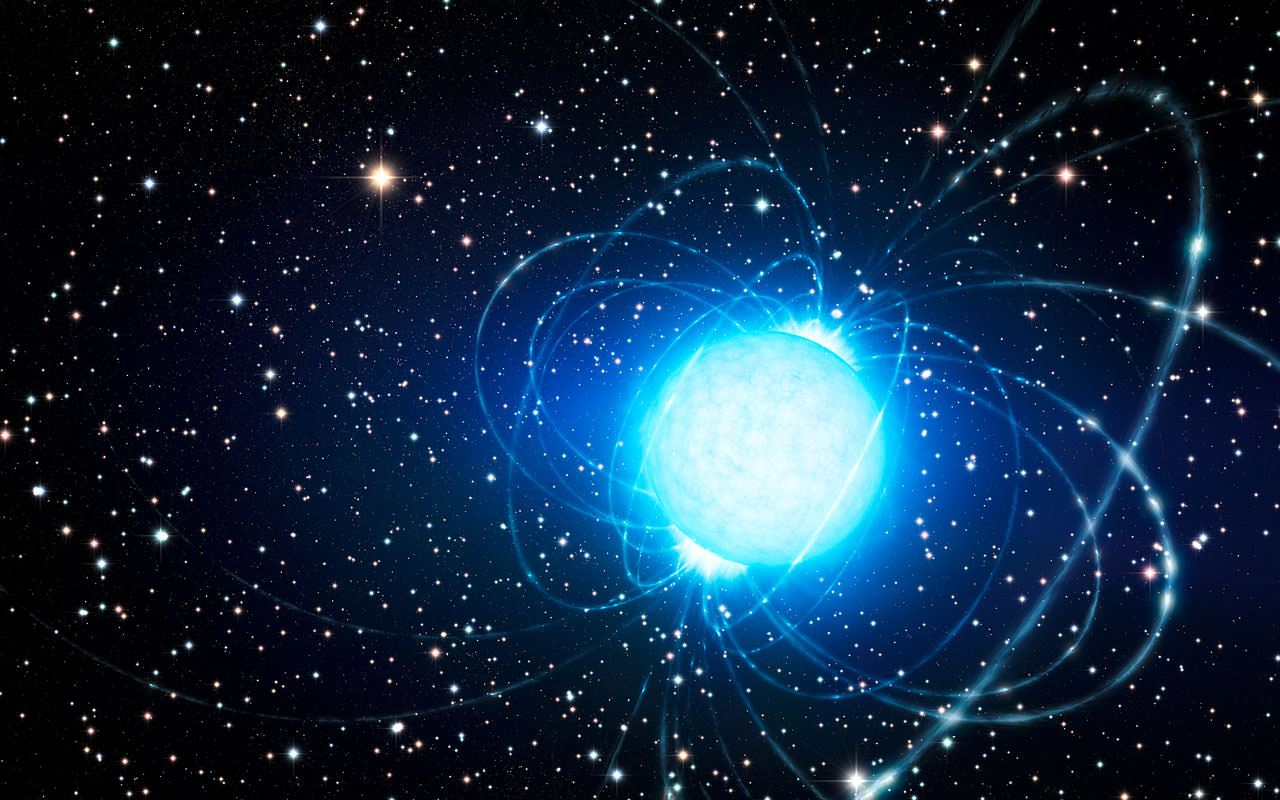
This artist's impression shows the magnetar in the very rich and young star cluster Westerlund 1. Credit: ESO/L. Calçada

To understand how stellar magnetic activity (and hence, X-ray activity) changes over time, astronomers require accurate age assessments for many different stars. This has been difficult in the past, but thanks to mission like NASA's Kepler Space Observatory and the ESA's Convection, Rotation and planetary Transits (CoRoT) mission, new and precise age estimates have become available in recent years.

Using these age estimates, Booth and her colleagues relied on data from the Chandra X-ray observatory and the XMM-Newton obervatory to examine 24 nearby stars. These stars were all similar in spectra to our Sun (a main sequence G-type yellow dwarf star) and at least 1 billion years of age. From this, they determined that there was a clear link between the star's age and their X-ray emissions. As they state in their study:

"We find 14 stars with detectable X-ray luminosities and use these to calibrate the age-activity relationship. We find a relationship between stellar X-ray luminosity, normalized by stellar surface area, and age that is steeper than the relationships found for younger stars..."

In short, of the 24 stars in their sample, the team found that 14 had X-ray emissions that were discernible. From these, they were able to calculate the star's ages and determine that there was a relationship between their longevity and luminosity. Ultimately, this demonstrated that stars like our Sun are likely to emit less high-energy radiation as they exceed 1 billion years in age.

And while the reason for this is not entirely clear, astronomers are currently exploring various possible causes. One possibility is that for older stars, the reduction in spin rate happens more quickly than it does for younger stars. Another possibility is that the X-ray brightness declines more quickly for older, more slowly-rotating stars than it does for younger, faster ones.

Regardless of the cause, the relationship between a star's age and its X-ray emissions could provide astronomers and exoplanet hunters with another tool for gauging the possible habitability of a system. Wherever a G-type or K-type star is to be found, knowing the age of the star could help place constraints on the potential habitability of any planets that orbit it.

Further Reading: Chandra, MNRAS

Matt Williams | September 8, 2017 at 9:59 pm | Tags: Featured | URL: http://wp.me/p1CHIY-zFw
Comment    See all comments

Trouble clicking? Copy and paste this URL into your browser: 

https://www.universetoday.com/137114/x-ray-study-shows-older-stars-may-supportive-life/


On the Front Lines - When Nature Strikes (Encore)

09/08/2017 01:09 PM EDT

A few people walk amid rubble from collapsed buildings

On the Front Lines - When Nature Strikes Natural disasters can bring death and destruction to communities in the United States and around the world, but they can also teach us about Earth's natural processes. Teams of scientists are gathering new information about dangerous natural events, using ...

This is an NSF Multimedia Gallery item.


This email was sent using GovDelivery Communications Cloud on behalf of: National Science Foundation Update · 4201 Wilson Boulevard · Arlington, VA 22230 · 703-292-5111 GovDelivery logo