Wednesday, November 8, 2017

A Brown Dwarf Prevented a Regular Star from Going Through its Full Life Cycle

New post on Universe Today

A Brown Dwarf Prevented a Regular Star from Going Through its Full Life Cycle

by Matt Williams

Eclipsing binary star systems are relatively common in our Universe. To the casual observer, these systems look like a single star, but are actually composed of two stars orbiting closely together. The study of these systems offers astronomers an opportunity to directly measure the fundamental properties (i.e. the masses and radii) of these systems respective stellar components.

Recently, a team of Brazilian astronomers observed a rare sight in the Milky Way - an eclipsing binary composed of  a white dwarf and a low-mass brown dwarf. Even more unusual was the fact that the white dwarf's life cycle appeared to have been prematurely cut short by its brown dwarf companion, which caused its early death by slowly siphoning off material and "starving" it to death.

The study which detailed their findings, titled "HS 2231+2441: an HW Vir system composed by a low-mass white dwarf and a brown dwarf", was recently published the Monthly Notices of the Royal Astronomical Society. The team was led by Leonardo Andrade de Almeida, a postdoctoral fellow from the University of São Paolo's Institute of Astronomy, Geophysics, and Atmospheric Sciences (IAG-USP), along with members from the National Institute for Space Research (MCTIC), and the State University of Feira de Santana.
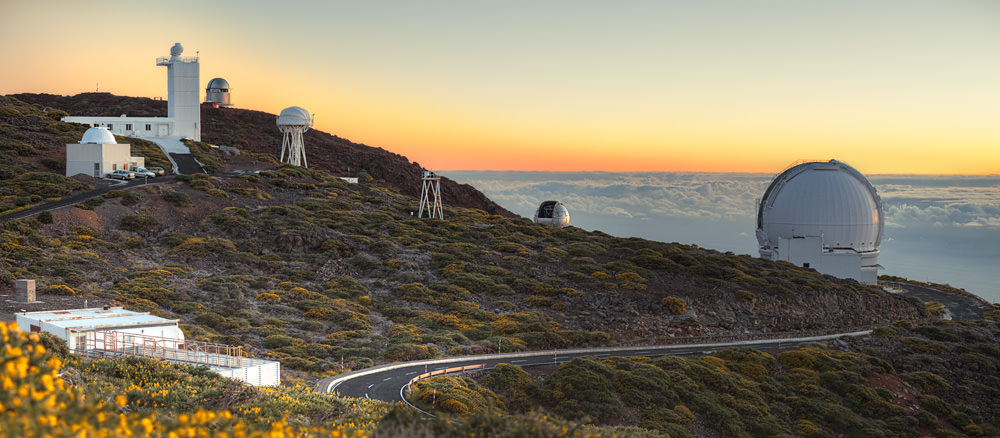
The Observatorio del Roque de los Muchachos, located on the island of La Palma. Credit: IAC

For the sake of their study, the team conducted observations of a binary star system between 2005 and 2013 using the Pico dos Dias Observatory in Brazil. This data was then combined with information from the William Herschel Telescope, which is located in the Observatorio del Roque de los Muchachos on the island of La Palma. This system, known as of HS 2231+2441, consists of a white dwarf star and a brown dwarf companion.

White dwarfs, which are the final stage of intermediate or low-mass stars, are essentially what is left after a star has exhausted its hydrogen and helium fuel and blown off its outer layers. A brown dwarf, on the other hand, is a substellar object that has a mass which places it between that of a star and a planet. Finding a binary system consisting of both objects together in the same system is something astronomers don't see everyday.

As Leonardo Andrade de Almeida explained in a FAPESP press release, "This type of low-mass binary is relatively rare. Only a few dozen have been observed to date."

This particular binary pair consists of a white dwarf that is between twenty to thirty percent the Sun's mass - 28,500 K (28,227 °C; 50,840 °F) - while the brown dwarf is roughly 34-36 times that of Jupiter. This makes HS 2231+2441 the least massive eclipsing binary system studied to date.

This artist's impression shows an eclipsing binary star system. Credit: ESO/L. Calçada.

In the past, the primary (the white dwarf) was a normal star that evolved faster than its companion since it was more massive. Once it exhausted its hydrogen fuel, its formed a helium-burning core. At this point, the star was on its way to becoming a red giant, which is what happens when Sun-like stars exit their main sequence phase. This would have been characterized by a massive expansion, with its diameter exceeding 150 million km (93.2 million mi).

At this point, Almeida and his colleagues concluded that it began interacting gravitationally with its secondary (the brown dwarf). Meanwhile, the brown dwarf began to be attracted and engulfed by the primary's atmosphere (i.e. its envelop), which caused it it lose orbital angular momentum. Eventually, the powerful force of attraction exceeded the gravitational force keeping the envelop anchored to its star.

Once this happened, the primary star's outer layers began to be stripped away, exposing its helium core and sending massive amounts of matter to the brown dwarf. Because of this loss of mass, the remnant effectively died, becoming a white dwarf. The brown dwarf then began orbiting its white dwarf primary with a short orbital period of just three hours. As Almeida explained:

"This transfer of mass from the more massive star, the primary object, to its companion, which is the secondary object, was extremely violent and unstable, and it lasted a short time... The secondary object, which is now a brown dwarf, must also have acquired some matter when it shared its envelope with the primary object, but not enough to become a new star."

Artist's impression of a brown dwarf orbiting a white dwarf star. Credit: ESO

This situation is similar to what astronomers noticed this past summer while studying the binary star system known as WD 1202-024. Here too, a brown dwarf companion was discovered orbiting a white dwarf primary. What's more, the team responsible for the discovery indicated that the brown dwarf was likely pulled closer to the white dwarf once it entered its Red Giant Branch (RGB) phase.

At this point, the brown dwarf stripped the primary of its atmosphere, exposing the white dwarf remnant core. Similarly, the interaction of the primary with a brown dwarf companion caused premature stellar death. The fact that two such discoveries have happened within a short period of time is quite fortuitous. Considering the age of the Universe (which is roughly 13.8 billion years old), dead objects can only be formed in binary systems.

In the Milky Way alone, about 50% of low-mass stars exist as part of a binary system while high mass stars exist almost exclusively in binary pairs. In these cases, roughly three-quarters will interact in some way with a companion - exchanging mass, accelerating their rotations, and eventually en merging.

As Almeida indicated, the study of this binary system and those like it could seriously help astronomers understand how hot, compact objects like white dwarfs are formed. "Binary systems offer a direct way of measuring the main parameter of a star, which is its mass," he said. "That's why binary systems are crucial to our understanding of the life cycle of stars."

It has only been in recent years that low-mass white dwarf stars were discovered. Finding binary systems where they coexist with brown dwarfs - essentially, failed stars - is another rarity. But with every new discovery, the opportunities to study the range of possibilities in our Universe increases.

Further Reading: São Paulo Research Foundation, MNRAS

Comment    See all comments

Trouble clicking? Copy and paste this URL into your browser: 

https://www.universetoday.com/137797/brown-dwarf-prevented-regular-star-going-full-life-cycle/


Busy Space Coast December Ahead as SpaceX Reactivates Damaged Cape Launch Pad, Aims for Year End Maiden Falcon Heavy Blastoff

New post on Universe Today

Busy Space Coast December Ahead as SpaceX Reactivates Damaged Cape Launch Pad, Aims for Year End Maiden Falcon Heavy Blastoff

by Ken Kremer

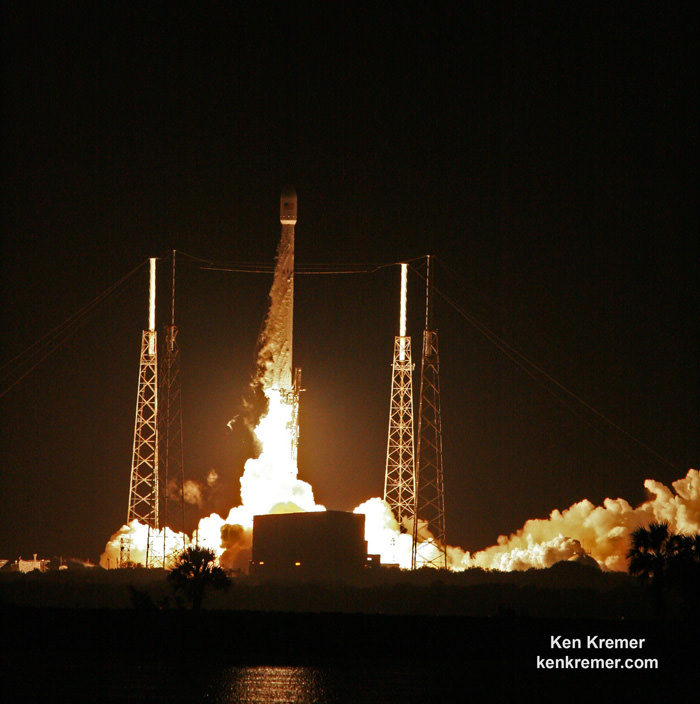
Upgraded SpaceX Falcon 9 blasts off with Thaicom-8 communications satellite on May 27, 2016 from Space Launch Complex 40 at Cape Canaveral Air Force Station, FL. 1st stage booster landed safely at sea minutes later. Credit: Ken Kremer/kenkremer.com

KENNEDY SPACE CENTER, FL - A very busy and momentous December is ahead for SpaceX workers on Florida's Space Coast as the company plans to reactivate the firms heavily damaged pad 40 at Cape Canaveral for a NASA resupply mission liftoff in early December while simultaneously aiming for a Year End maiden launch of the oft delayed Falcon Heavy rocket from NASA's historic pad 39A.

NASA and SpaceX announced that the next SpaceX commercial cargo resupply services mission to the International Space Station (ISS) will launch from Space Launch Complex 40 (SLC-40) at Cape Canaveral Air Force Station (CCAFS) in Florida in December.

The Falcon Heavy, once operational, will be the most powerful rocket in the world. Credit: SpaceX

The launch of the SpaceX Falcon 9 carrying the SpaceX Dragon CRS-13 cargo freighter to the orbiting outpost for NASA will be the first this year from Space Launch Complex 40 at Cape Canaveral Air Force Station (CCAFS) in Florida.

Pad 40 was severely damaged in Sept. 2016 during a catastrophic launch pad explosion of the Falcon 9 during a fueling test that concurrently completely consumed the Israeli AMOS-6 communications satellite bolted on top of the second stage during the planned static hot fire test.

Aerial view of pad and strongback damage at SpaceX Launch Complex-40 as seen from the VAB roof on Sept. 8, 2016 after fueling test explosion destroyed the Falcon 9 rocket and AMOS-6 payload at Cape Canaveral Air Force Station, FL on Sept. 1, 2016. Credit: Ken Kremer/kenkremer.com

Since Sept. 2016, all SpaceX launches from Florida have taken place from NASA's Launch Complex 39A (LC-39A) on the Kennedy Space Center. And all hot fire tests have been conducted minus the expensive payload on top to keep them safe in case of a repeat explosion.

A successful restoration of pad 40 for launch services is one of the critical prerequisites that must be achieved before paving the path to the inaugural blastoff of SpaceX's triple barreled Falcon Heavy booster from pad 39A at NASA's Kennedy Space Center.

Blastoff of SpaceX Dragon CRS12 on its 12th resupply mission to the International Space Station from NASA's Kennedy Space Center in Florida at 12:31 p.m. EDT on Monday, Aug. 14, 2017 as seen from the VAB roof. Credit: Ken Kremer/Kenkremer.com

So if all goes well, SpaceX will have two operational launch pads at Florida's Spaceport- one at KSC and one at the Cape. They also have a pad in California at Vandenberg AFB.

Thus SpaceX could ramp up their already impressive 2017 launch pace of 16 rocket launches so far through the end of October.

An artist's illustration of the Falcon Heavy rocket. Image: SpaceX

An artist's illustration of the Falcon Heavy rocket. Image: SpaceX

SpaceX is targeting late December for liftoff of the mammoth Falcon Heavy on its debut flight – to achieve CEO Elon Musk's stated goal of launching Falcon Heavy in 2017.

The Falcon Heavy launch could come around Dec. 29, sources say.

But the late December Falcon Heavy launch date is dependent on placing pad 40 back in service with a fully successful NASA cargo mission, finishing upgrades to pad 39A for the Heavy as well as completing the rocket integration of three Falcon 9 cores and launch pad preparations.

Furthermore, SpaceX engineers must carry out a successful static fire test of the Falcon Heavy sporting a total of 27 Merlin 1 D engines – 9 engines apiece from each of the three Falcon 9 cores.

Both of the Falcon 9 side cores will be outfitted with nose cones on top in place of a payload and they have been spotted being processed inside the huge processing hanger just outside the pad 39A perimeter fence at the bottom of the ramp.

Both of the side cores are also recycled boosters that will be launched for the second time each.

SpaceX originally hoped to launch Falcon Heavy in 2013, said Musk. But he also said the task was way more challenging then originally believed during a KSC post launch press conference in March 2017 following the first reuse of a liquid fueled booster during the SES-10 mission for SES that launch from pad 39A.

Former Space Shuttle and Apollo Saturn Launch Pad 39A was only reactivated this year by SpaceX for Falcon 9 launches.

SpaceX most recently launched the KoreaSat-5A telecomsat on Oct. 30 from pad 39A.

Plus the first stage booster was successfully recovered after a soft landing on a platform at sea and the booster floated 'back in town' last Thursday – as I witnessed and reported here.

The uncrewed Dragon cargo spacecraft launch on the CRS-13 mission is also a recycled Dragon. It preciously was flown on SpaceX's sixth commercial resupply mission to station for NASA.

Rocket recycling is a feat straight out of science fiction. It's the key part of SpaceX CEO Elon Musk oft stated goal of drastically slashing the high cost of access to space.

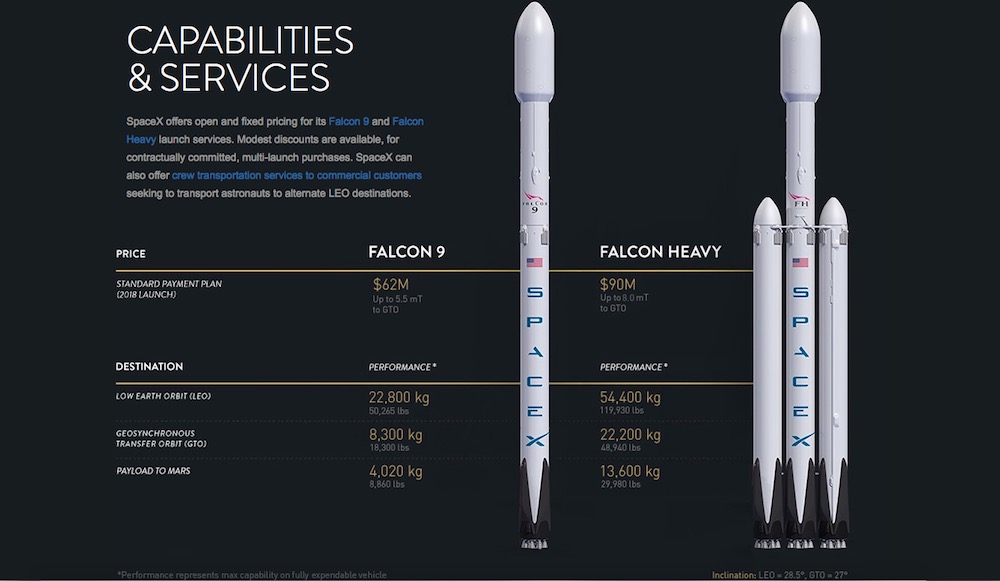
Chart comparing SpaceX's Falcon 9 and Falcon Heavy. Credit: SpaceX

An Orbital ATK Cygnus cargo ship is slated to launch on November 11 from NASA Wallops Flight Facility on Virginia's eastern shore.

Watch for Ken's continuing onsite NASA mission reports direct from the Kennedy Space Center and Cape Canaveral Air Force Station, Florida.

Stay tuned here for Ken's continuing Earth and Planetary science and human spaceflight news.

Ken Kremer

SpaceX Falcon 9 set to deliver JCSAT-16 Japanese communications satellite to orbit on Aug. 14, 2016 from Space Launch Complex 40 at Cape Canaveral Air Force Station, Fl. Credit: Ken Kremer/kenkremer.com

Launch of SpaceX Falcon 9 carrying JCSAT-16 Japanese communications satellite to orbit on Aug. 14, 2016 at 1:26 a.m. EDT from Space Launch Complex 40 at Cape Canaveral Air Force Station, Fl. Credit: Ken Kremer/kenkremer.com

Comment    See all comments

Trouble clicking? Copy and paste this URL into your browser: 

https://www.universetoday.com/137061/busy-space-coast-december-ahead-as-spacex-reactivates-damaged-cape-launch-pad-aims-for-year-end-maiden-falcon-heavy-blastoff/


BREAKING: TripAdvisor places first warning 'badges' on three Mexican resorts after USA TODAY Network investigation found company blocked posts about rapes and injuries

Having trouble viewing this email? | View it in your browser

FB TW g+ Ins

  Since July, when the Milwaukee Journal Sentinel, part of the USA TODAY Network, began investigating the mysterious death of a Wisconsin college student in Mexico - and found widespread problems with tainted alcohol, derelict law enforcement and price gouging from hospitals - more than a dozen travelers from across the country have said TripAdvisor muzzled their first-hand stories of blackouts, rapes and other ways they were injured while vacationing in Mexico. One of the resorts that received a warning badge Wednesday was where Kristie Love and others were assaulted and where Abbey Conner, the 20-year-old Wisconsin woman mysteriously drowned just hours after arriving with her family.

FOR MORE ON THIS STORY, GO TO:
  USATODAY.COM  
 
Help | Advertise | Home Delivery | Privacy Policy - Your California Privacy Rights  
  © 2017 USA TODAY, a division of Gannett Satellite Information Network, LLC.
7950 Jones Branch Drive, McLean, VA 22108

U.S. National Library of Medicine NLM Technical Bulletin Update


11/07/2017 11:08 AM EST

In response to the growing interest in the availability of data associated with articles, PubMed Central (PMC) is reviewing current practices around data and seeking feedback on how to best serve the data needs of the research community.
11/07/2017 09:10 AM EST

The November 2017 full monthly release of RxNorm is available as of Monday, November 6, 2017.
11/07/2017 09:10 AM EST

The 2017AB release of the Unified Medical Language System (UMLS) Knowledge Sources is available for download as of November 6, 2017.
11/07/2017 08:47 AM EST

The National Library of Medicine is pleased to announce that the SNOMED CT Spanish International Edition October 2017 is available for download. This release includes the Spanish translations of the July 2017 SNOMED CT International Edition and Release Notes that highlight the changes for this release.
11/06/2017 07:23 AM EST

On Wednesday, November 8, 2017, National Center for Biotechnology Information (NCBI) staff will present a Webinar on API keys for E-utilities.

This email was sent using GovDelivery Communications Cloud on behalf of: U.S. National Library of Medicine · 8600 Rockville Pike · Bethesda, MD 20894 GovDelivery logo

SF's Tadich Grill fires back, says lawsuit is ‘without merit’ | Inside Scoop Newsletter

Check out this latest selection of content from Inside Scoop.
If you have trouble reading this message, view it in a browser.


Inside Scoop


Wednesday, November 8, 2017
 
 
SF's Tadich Grill fires back, says lawsuit is 'without merit'
 
SF's Tadich Grill fires back, says lawsuit is 'without merit'
 
A day after The Chronicle broke news about a lawsuit surrounding Tadich Grill's ill-fated expansion to Washington, D.C., the restaurant's ownership has fired back.


Trivia Challenge: The great San Francisco restaurant quiz


Thai-inspired Funky Elephant headed to Berkeley


Mezcal celebration Lagrimas is Over Proof's final iteration


SF's Seed + Salt to close Nov. 28


Michael Bauer | How a head of roasted cauliflower became the It veggie


  Support journalism. Support democracy.
Get daily insights into stories that resonate throughout the Bay Area and beyond.
Click here for current San Francisco Chronicle subscription offers.


Connect     Facebook     Twitter     Pinterest     Instagram
 
About   Privacy Policy   Terms of Use