Showing posts with label Canada. Show all posts

Tuesday, March 14, 2017

Canada To Get Its Own Spaceport

New post on Universe Today

Canada To Get Its Own Spaceport

by Evan Gough

Canada is getting its own rocket-launching facility. Maritime Launch Services (MLS) has confirmed its plans to build and operate a commercial launch facility in Nova Scotia, on Canada's east coast. The new spaceport should begin construction in 1 year, and should be in operation by 2022.

The facility will be built near Canso, in the province of Nova Scotia. Maritime Launch Services hopes to launch 8 rockets per year to place satellites in orbit. The Ukrainian Cyclone 4M medium-class rockets that will lift-off from Canso will have a payload of up to 3,350 kg.

The red marker in the map above shows the location of the Maritime Launch Services spaceport. Image: Google

Spaceports have certain requirements that make some locations more desirable. They need to be near transportation infrastructure so that rockets, payloads, and other materials can be transported to the site. They need to be away from major population centres in case of accidents. And they need to provide trajectories that give them access to desirable orbits.

The Nova Scotia site isn't the only location considered by MLS. They evaluated 14 sites in North America before settling on the Canso, NS site, including ones in Mexico and the US. But it appears that interest and support from local governments helped MLS settle on Canso.

The Ukrainian Cyclone M4 rockets have an excellent track record for safety. The company who builds it, Yuzhnoye, has been in operation for 62 years and has launched 875 vehicles and built and launched over 400 spacecraft. Cyclone rockets have launched successfully 221 times.
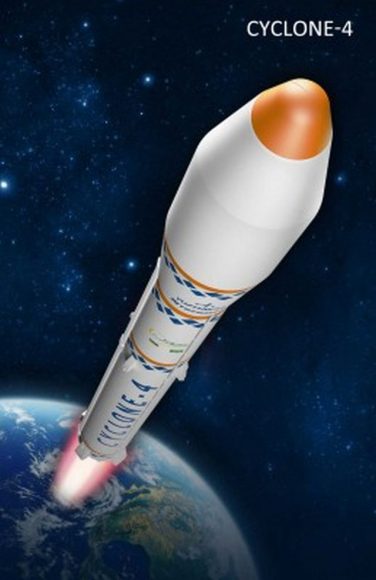
The Cyclone 4. The Cyclone family of rockets have over 200 successful launches to their credit. Image: Yuzhnoye Design Office

The Cyclone 4. The Cyclone family of rockets have over 200 successful launches to their credit. Image: Yuzhnoye Design Office

MLS is a group of American aerospace experts including people who have worked with NASA. They are working with the makers of the Cyclone 4 rocket, who have wanted to open up operations in North America for some time.

The Cyclone rocket family first started operating in 1969. The Cyclone 4 is the newest and most powerful rocket in the Cyclone family. It's a 3-stage rocket that runs on UDMH fuel and uses nitrogen tetroxide for an oxidizer.

There have been other proposals for a Canadian spaceport. The Canadian Space Agency was interested in Cape Breton, also in Nova Scotia, as a launch site for small satellites in 2010. A Canadian-American consortium called PlanetSpace also looked at a Nova Scotia site for a launch facility, but they failed to get the necessary funding from NASA in 2008. Fort Churchill, in the Province of Manitoba, was the site of over 3,500 sub-orbital flights before being shut down in 1985.

The Canso launch facility is an entirely private business proposal. Neither the Canadian government nor the Canadian Space Agency are partners. It's not clear if having a launch facility on Canadian soil will impact the CSA's activities in any way.

But at least Canadians won't have to leave home to watch rocket launches.

Evan Gough | March 14, 2017 at 4:50 pm | Tags: Featured | Categories: News | URL: http://wp.me/p1CHIY-yWU
Comment    See all comments

Trouble clicking? Copy and paste this URL into your browser: 

http://www.universetoday.com/134348/canada-get-spaceport/


Saturday, November 12, 2016

Canada Today: Dams, Fiddles and That New Leader Next Door


View in Browser | Add nytdirect@nytimes.com to your address book.

Saturday, November 12, 2016

The New York Times

NYTimes.com/Canada »

Canada Today

Dams, Fiddles and That New Leader Next Door
The construction site of the hydroelectric facility at Muskrat Falls in Labrador in July.
The construction site of the hydroelectric facility at Muskrat Falls in Labrador in July. Andrew Vaughan/The Canadian Press, via Associated Press
Because many parts of Canada rely on electricity produced by dams, "hydro" is often synonymous with electrical power and electrical utilities. The country's efforts to cut emissions linked to climate change have, not surprisingly, renewed interest in hydroelectricity. But demonstrations in Labrador last month and research led by a Nova Scotia native now at Harvard that was published this week highlighted an often overlooked consequence of hydro dams — mercury buildup in the water behind them. Without costly and time-consuming remediation, they can poison indigenous people who live downstream.
Celtic sounds. While out in Cape Breton, my colleague Craig Smith spent time with Ashley MacIsaac, Natalie MacMaster, Christine Melanson and other musicians to learn the how the "dirt" gets into the island's famous fiddle music. He also discovered that when fiddlers from Cape Breton began traveling in greater numbers to Scotland about 30 years ago, they helped set off a revival of their music in the country where it began. Be sure to watch the Daily 360 video that accompanies Mr. Smith's story.
Across the border. While it's unlikely that Americans unhappy with Donald J. Trump's election as president will lead a mass migration to Canada, the result of this week's vote will probably create a wide range of challenges for Prime Minister Justin Trudeau. Perhaps at the top will be the question of how to go ahead with a carbon tax in Canada if Mr. Trump follows up on promises not to act on climate change in the United States. The Conservative opposition is already arguing that imposing such a tax in Canada without similar American action will disadvantage Canadian companies.
Canada's musical poet. While Leonard Cohen spent much of his life outside of Canada, he maintained in a house in Montreal. On Thursday, after the announcement of Mr. Cohen's death at age 82, mourners gathered there with guitars to sing his songs, the best known of which is "Hallelujah." "Mr. Cohen's sophisticated, magnificently succinct lyrics, with their meditations on love sacred and profane, were widely admired by other artists and gave him a reputation as, to use the phrase his record company concocted for an advertising campaign in the early 1970s, "the master of erotic despair," Larry Rohter wrote in Mr. Cohen's obituary.
Telling all. Robbie Robertson, another major Canadian figure in music, has just published a 500-page book, "Testimony," covering the period of his life up to the break up of the Band. The group's final concert was turned into the acclaimed documentary film "The Last Waltz" by Martin Scorsese. "His memoir is confident and well oiled," Dwight Garner wrote in his review of "Testimony" for the The Times. "At times it has the mythic sweep of an early Terrence Malick movie." The book reveals that Mr. Robertson's family background is as interesting as his time working with musical luminaries like Bob Dylan.
Tourism East. The Times's 36 Hours travel feature made its way to Toronto. Jeremy Egner's agenda mixes some new tourist spots, like the Junction neighborhood, with the old, like Casa Loma.
Tourism West. Suzanne MacNeille of The Times toured the "global buffet" that is the restaurant scene in Vancouver, British Columbia. "It's no secret that food is one of the best ways to get the gist of a place, and that especially holds true for Vancouver," she wrote. "Among the most ethnically diverse cities in Canada, if not North America, the city is home to sizable populations whose background is Chinese, Southeast Asian, First Nations, Korean, Indian, Portuguese, English, Irish, German — again, the list goes on."
A dot in the ocean. Dan Levin looked into the role of strong drink in the territorial dispute between Canada and Denmark over a lump of rock known as Hans Island.
Here are some articles from The Times, not necessarily related to Canada, that I found interesting this week:
Rats enjoy tickling so much that they not only squeak out the equivalent of laughter, but also seek it out.
• Environmentalist are pushing banks, including Toronto-Dominion, to cancel loans to an oil pipeline project in North Dakota that has been vigorously opposed by indigenous Americans.
• Nick Wingfield looks at the pitfalls and benefits of technologies that allow family members to play Big Brother on each other.
• Anne Barnard ventures into Aleppo, Syria, and finds two different cities: "You go from this moonscape of war-destroyed buildings to a street of buses, open shops and apartments with laundry hanging from the balconies."
A native of Windsor, Ontario, Ian Austen was educated in Toronto, lives in Ottawa and has reported about Canada for The New York Times for over a decade. Follow him on Twitter at @ianrausten.
 
HOW ARE WE DOING?
We hope you enjoyed this weekly roundup of Canada Today. Tell us what you think and what you'd like to see, at CanadaToday@nytimes.com.
LIKE THIS EMAIL?
Forward it to your friends, and let them know they can sign up here.
 
ADVERTISEMENT
FOLLOW NYTIMES Facebook FACEBOOK Twitter @nytimes
Get more NYTimes.com newsletters » | Get unlimited access to NYTimes.com and our NYTimes apps for just $0.99. Subscribe »

ABOUT THIS EMAIL

You received this message because you signed up for NYTimes.com's Canada Today newsletter.

Copyright 2016 The New York Times Company | 620 Eighth Avenue New York, NY 10018