Every now and then you see an image or video from space that completely and fully blows your mind. And I think this is the animation of the year. OMG.
It's from a series of photographs captured by the European Space Agency's Rosetta spacecraft of its target, Comet 67P. Twitter user @landru79 took the separate images and stitched them together into a short animation that's absolutely stunning to watch.
#ROSETTA 😍 OSIRIS #67P/CHURYUMOV-GERASIMENKO new albums 😍--ROSETTA EXTENSION 2 MTP030-- Miércoles 1 Junio 2016 all filters stacked pic.twitter.com/Bf173Z5g79
You're seeing the comet rotate in the field of view, with dust particles and cosmic ray particles in the foreground, with stars wheeling in the background.
And just to think, this was happening on another world, millions of kilometers away.
As always, if you have comments or questions, or suggestions on how I can improve this newsletter, please don't hesitate to reply this email or send me an email at frasercain@gmail.com.
You're probably familiar with the Earth's magnetosphere, which surrounds the planet and protects it from harmful radiation from space. But did you know the Earth has a second magnetosphere? Its oceans. ESA's Swarm Satellites measured the strength of this secondary magnetosphere, which is actually really difficult to measure.
Christmas has arrived for astrometry nerds. That's because the Gaia mission just dumped detailed information onto the Internet about the location and movement of 1.7 billion stars in the Milky Way. This is an enormous data release, and should keep astronomers busy for years.
Etienne Leopold Trouvelot created more than 7,000 astronomical illustrations using various telescopes more than a century ago. This article shows some of his best work, including a solar eclipse, Jupiter, and the Aurora Borealis.
In order to see exoplanets directly, you need to be able to block the light from the star, so the much fainter planets are visible. The device to do this is known as a coronograph, and astronomers have plans to develop one capable of blocking light from a star so that planets which are 100 million times fainter are visible.
Isn't this a nice picture of Saturn's rings captured by Cassini? It's an old picture, but I really just love the subtle color variations in the rings. And now I miss Cassini. :-(
I always enjoy new videos from the folks at Kurzgesagt, but this week's episode was really terrific. It's all about how advanced civilizations harness the intense gravity of black holes to generate power. Oh, and use it as a bomb if they liked.
Well, the Uranus potty humor folks are having a field day this week, when it was announced that the gases in Uranus' atmosphere would smell like rotten eggs here on Earth. In other words, Uranus smells like farts. It's with a heavy heart that Bad Astronomer Phil Plait takes on this challenging story to talk about the, uh, smelly science.
About 252 million years ago, something terrible happened to the Earth and more than 90% of all animals went extinct. It was the greatest catastrophe in the history of life on Earth. But life bounced back over the course of 5 million years or so. How did it do it?
Here's the Lagoon Nebula as seen by Nathan @archioptic. This is an emission nebula located about 4,000 light years away in the constellation Sagittarius. Of course, whenever I see a picture of this nebula, I always think it looks like Homer from the Simpsons with a glowing Borg eye. You'll need to look at it upside-down, though.
We feature a different astrophotographer every day on our Instagram page. Want to do a takeover? Use the hashtag #universetoday and I'll check out your photos.
According to modern theories of geological evolution, the last major ice age (known as the Pliocene-Quaternary glaciation) began about 2.58 million years ago during the late Pliocene Epoch. Since then, the world has experienced several glacial and interglacial periods, and has been in an inter-glacial period (where the ice sheets have been retreating) ever since the last glacial period ended about 10,000 years ago.
According to new research, this trend experienced a bit of a hiccup during the late Paleolithic era. It was at this time - roughly 12,800 years ago, according to a new study from the University of Kansas - that a comet struck our planet and triggered massive wildfires. This impact also triggered a short glacial period that temporarily reversed the previous period of warming, which had a drastic affect on wildlife and human development.
The study in question, "Extraordinary Biomass-Burning Episode and Impact Winter Triggered by the Younger Dryas Cosmic Impact ~12,800 Years Ago", was so large that it was divided into two parts. Part I. Ice Cores and Glaciers; and Part II. Lake, Marine, and Terrestrial Sediments, were both recently published by The Journal of Geography, part of the the University of Chicago Press' series of scientific publications.
New research shows that some 12,800 years ago, an astonishing 10 percent of the Earth's land surface, or about 10 million square kilometers, was consumed by fires. Credit: Pexels.com
For the sake of their study, the team combined data from ice core, forest, pollen and other geochemical and isotopic markers obtained from more than 170 different sites across the world. Based on this data, the team concluded that roughly 12,800 years ago, a global disaster was triggered when a comet measuring about 100 km (62 mi) in diameter exploded in our atmosphere and rained fragments down on the surface.
As KU Emeritus Professor of Physics & Astronomy Adrian Melott explained in a KU press release:
"The hypothesis is that a large comet fragmented and the chunks impacted the Earth, causing this disaster. A number of different chemical signatures — carbon dioxide, nitrate, ammonia and others — all seem to indicate that an astonishing 10 percent of the Earth's land surface, or about 10 million square kilometers, was consumed by fires."
Ice ages are characterized by a drop in average global temperatures, resulting in the expansion of ice sheets globally. Credit: NASA
According to their research, these massive wildfires also caused a massive feedback in Earth's climate. As fires rushed across much of the planet's landscape, the smoke and dust clogged the sky and blocked out sunlight. This triggered rapid cooling in the atmosphere, causing plants to die, food sources to dwindle, and ocean levels to drop. Last, but not least, the ice sheets which had been previously retreating began to advance again.
This quasi-ice age, according to the study, lasted about another thousand years. When the climate began to warm again, life began to recover, but was faced with a number of drastic changes. For example, fewer large animals survived, which affected the hunter-gather culture of humans all across North America. This was reflected in the different types of spear points that have been dated to this period.
What's more, pollen samples obtained from this period indicate that pine forests were likely burned off and were replaced by poplar forests, a species that colonizes cleared areas. The authors also suggest that this impact could have been responsible for the so-called Younger Dryas cool episode. This period occurred roughly 12,000 years ago, where gradual climatic warming was temporarily reversed.
Intrinsic to this period was an increase of biomass burning and the extinctions of larger species during the late Pleistocene period (ca. 2,588,000 to 11,700 years ago). These sudden changes are believed to be what led to severe shifts in human populations, causing a decline during the 1000-year cold period, and leading to the adoption of agriculture and animal husbandry once the climate began to warm again.
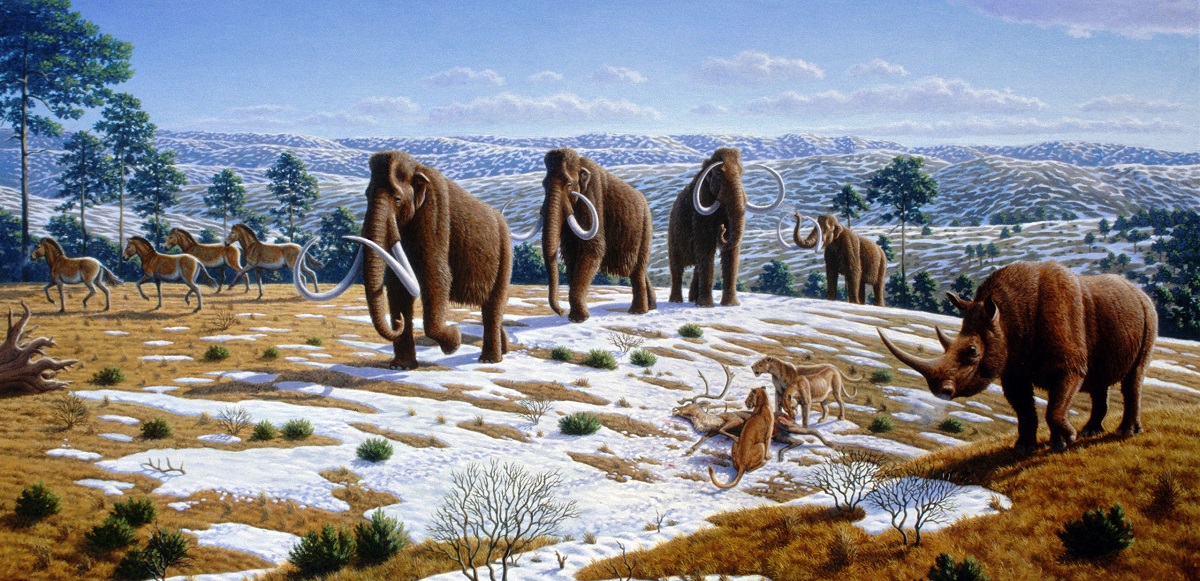
Pleistocene of Northern Spain showing woolly mammoth, cave lions eating a reindeer, tarpans, and woolly rhinoceros. Credit: Wikipedia Commons/Mauricio Antón
In short, this new theory could help explain a number of changes that made humanity what it is today. As Mellot indicated:
"Computations suggest that the impact would have depleted the ozone layer, causing increases in skin cancer and other negative health effects. The impact hypothesis is still a hypothesis, but this study provides a massive amount of evidence, which we argue can only be all explained by a major cosmic impact."
These studies not only provide insight into the timeline of Earth's geological evolution, they also sheds light on the history of the Solar System. According to this study, the remnants of the meteor which struck Earth still persist within our Solar System today. Last, but not least, the climate shifts that these impacts created had a profound effect on the evolution of life here on Earth.
In August of 2014, the ESA's Rosetta mission made history when it rendezvoused with the Comet 67P/Churyumov–Gerasimenko. For the next two years, the probe flew alongside the comet and conducted detailed studies of it. And in November of 2014, Rosetta deployed its Philae probe onto the comet, which was the first time in history that a lander was deployed to the surface of a comet.
During the course of its mission, Rosetta revealed some truly remarkable things about this comet, including data on its composition, its gaseous halo, and how it interacts with solar wind. In addition, the probe also got a good look at the endless stream of dust grains that were poured from the comet's surface ice as it approached the Sun. From the images Rosetta captured, which the ESA just released, it looked a lot like driving through a snowstorm!
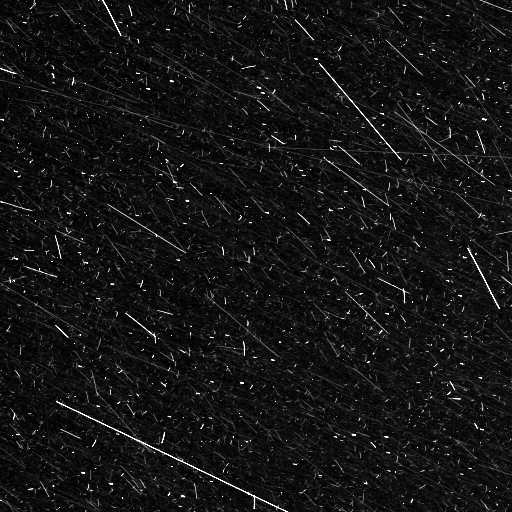
The image below was taken two years ago (on January 21st, 2016), when Rosetta was at a distance of 79 km from the comet. At the time, Rosetta was moving closer following the comet reaching perihelion, which took place during the previous August. When the comet was at perihelion, it was closer to the Sun and at its most active, which necessitated that Rosetta move farther away for its own protection.
Image of the dust and particles the Rosetta mission was exposed to as it flew alongside Comet 67P/Churyumov–Gerasimenko. Credit: ESA/Rosetta/MPS for OSIRIS Team MPS/UPD/LAM/IAA/SSO/INTA/UPM/DASP/IDA
As you can see from the image, the environment around the comet was extremely chaotic, even though it was five months after the comet was at perihelion. The white streaks reveal the dust grains as they flew in front of Rosetta's camera over the course of a 146 second exposure. For the science team directing Rosetta, flying the spacecraft through these dust storms was like trying to drive a car through a blizzard.
Those who have tried know just how dangerous this can be! On the one hand, visibility is terrible thanks to all the flurries. On the other, the only way to stay oriented is to keep your eyes pealed for any landmarks or signs. And all the while, there is the danger of losing control and colliding with something. In much the same way, passing through the comet's dust storms was a serious danger to the spacecraft.
In addition to the danger of collisions, flying through these clouds was also hazardous for the spacecraft's navigation system. Like many robotic spacecraft, Rosetta relies on star trackers to orient itself - where it recognizes patterns in the field of stars to orient itself with respect to the Sun and Earth. When flying closer to the comet, Rosetta's star trackers would occasionally become confused by dust grains, causing the craft to temporarily enter safe mode.
Artist's impression of the Rosetta probe signalling Earth. Credits: ESA-C.Carreau
This occurred on March 28th, 2015 and again on May 30th, 2016, when Rosetta was conducting flybys that brought it to a distance of 14 and 5 km from the comet's surface, respectively. On both occasions, Rosetta's navigation system suffered from pointing errors when it began tracking bright dust grains instead of stars. As a result, on these occasions, the mission team lost contact with the probe for 24 hours.
"We lost contact with the spacecraft on Saturday evening for nearly 24 hours. Preliminary analysis by our flight dynamics team suggests that the star trackers locked on to a false star – that is, they were confused by comet dust close to the comet, as has been experienced before in the mission."
Despite posing a danger to Rosetta's solar arrays and its navigation system, this dust is also of high scientific interest. During the spacecraft's flybys, three of its instruments studied tens of thousands of grains, analyzing their composition, mass, momentum and velocity, and also creating 3D profiles of their structure. By studying these tiny grains, scientists were also able to learn more about the bulk composition of comets.
Another snapshot of Comet 67P/Churyumov–Gerasimenko's dusty emissions, taken on Jan. 21st, 2016. Credit: ESA
Before it reached its grand finale and crashed into the comet's surface on September 30th, 2016, Rosetta made some unique scientific finds about the comet. These included mapping the comet's surface features, discerning its overall shape, analyzing the chemical composition of its nucleus and coma, and measuring the ratio of water to heavy water on its surface.
All of these findings helped scientists to learn more about how our Solar System formed and evolved, and shed some light on how water was distributed throughout our Solar System early in its history. For instance, by determining that the ratio of water to heavy water on the comet was much different than that of Earth's, scientists learned that Earth's water was not likely to have come from comets like Comet 67P/Churyumov–Gerasimenko.
On top of that, the spacecraft took more than a hundred thousand image of the comet with its high-resolution OSIRIS camera (including the ones shown here) and its navigation camera. These images can be perused by going to the ESA's image browser archive. I'm sure you'll agree, they are all as beautiful as they are scientifically relevant!


 Posts
Posts