The term UFO has a way of stirring up speculation and controversy. Even though this bland acronym refers only to an airborne object who's appearance hasn't been explained yet - with no references whatsoever to "aliens" or "extra-terrestrials" - one cannot mention it without inspiring talk of little green men and massive conspiracies.
This has certainly been the reaction to a video that was recently released by the Committee for the Study of Anomalous Air Phenomena (CEFAA), the Chilean government agency responsible for investigating UFOs. Originally captured by a helicopter belonging to the Chilean navy two years ago, the release of this 10-minute video coincided with the conclusion of the Committee's investigation into the anomaly.
Such is the procedure of the CEFAA whenever a UFO - or Unidentified Aerial Phenomena (UAP) as they call them - comes to their attention. And once an investigation into the sighting is concluded, the details are released to the public. Interestingly, this particular encounter - which took place on November 11th, 2014, in the coastal region between San Antonio and Quinteros - had them stumped.

A Chilean Navy version of the Europcopter Airbus Cougar AS-532, which was being flown by the aircrew that spotted the UFO. Credit: Wikipedia Commons/Evogol
According to their report, a Chilean navy helicopter (an Airbus Cougar AS-532, like the one pictured above) was conducting a daytime patrol when a technician aboard spotted an object flying in their airspace. The technician then directed the helicopter's infrared camera towards it and began filming. As the CEFAA recently indicated on their website:
"At 1:52 pm, while filming the terrain, the technician observed a strange object flying to the left over the ocean. Soon both men observed it with the naked eye. They noticed that the velocity and the altitude of the object appeared to be about the same as the helicopter, and estimated that the object was approximately 35 to 40 miles (55-65 km) away. It was traveling W/NW, according to the Captain. The technician aimed the camera at the object immediately and zoomed in with the infra red (IR) for better clarity."
Further details from the investigation revealed that the officers reported the sighting to the General Directorate of Civil Aviation (DGAC) in Santiago. The DGAC reported that no air traffic was authorized to be in the region, and that they could detect no trace of the object on their radar. They also confirmed that their attempts to communicate using the standard radio frequencies (which the helicopter crew had also attempted) yielded no response.
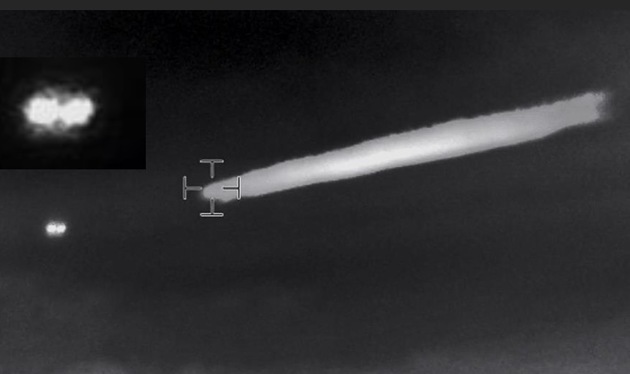
What was even more strange was the way the object appeared as two "hot spots", which looked to be connected. In addition, on two occasions, the object threw off some kind of trail before finally disappearing into the clouds. According to the technician who filmed it, the plume of material appeared to be very hot, which was indicated from the footage that showed how the stream glowed bright in the infrared band.
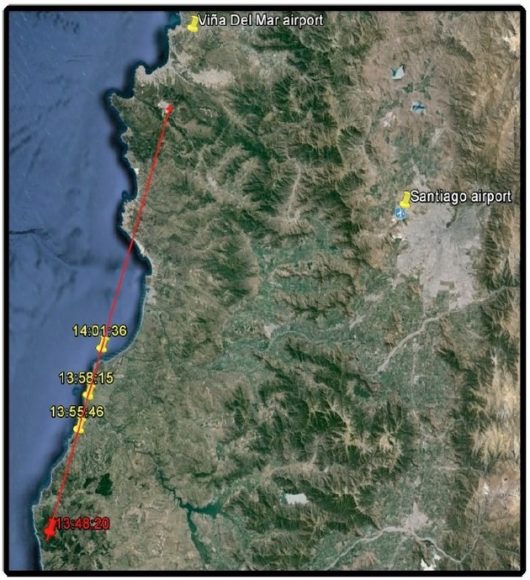
The route of the helicopter, based on the displayed geographic coordinates displayed on the camera. Credit: CEFAA
Much like the object itself, the CEFAA investigation was hard-pressed to explain the appearance of these hot plumes:
"Some analysts have suggested the hypothesis that it is a medium-sized line aircraft and that the stelae of the detachable element may be the reserve water inside the apparatus, thrown by the crew. However, meteorology asserts that neither the altitude at which the object moved, nor the ambient temperature of that moment, allowed such a wake of condensation."
After the encounter, the Chilean Navy submitted the footage to the CEFAA, which has spent the past two years looking into it. However, their investigation proved inconclusive. As General Ricardo Bermúdez, Director of CEFAA during the investigation, told Leslie Kean of the Huffington Post, "We do not know what it was, but we do know what it was not."
In essence, they ruled that the anomalous object could not have been a military or civilian aircraft. They also ruled out the possibility that the clouds it emitted were caused by the expulsion of waste water, and that the object was too low to emit contrails. In the end, the CEFAA cataloged this object as an UAP, which is standard practice whenever a particular sighting merits that designation.
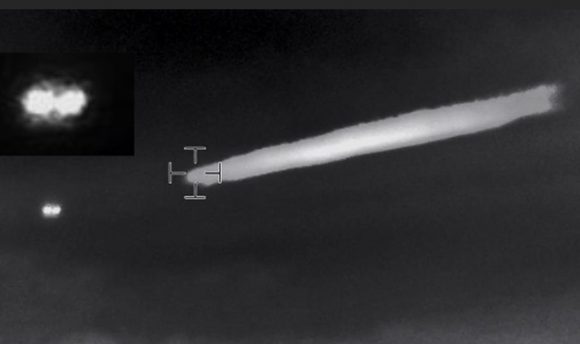
Image captured from the footage shot by the Chilean Navy helicopter, showing the thermal trail cast by the object, and its two bright spots. Credit: CEFAA
However, since the video went public, one UFO hoax-buster has come forward with what he believes to be a sound explanation for the sighting. According to Mick West, an administrator at Metabunk.org - a website dedicated to debunking unscientific theories - what was seen in the video was actually the result a four-engine airplane leaving flying out of Santiago and leaving aerodynamic contrails in its wake.
Using online flight records, West tracked down two flights that were in the same airspace at the time - LA330 (from Santiago to La Serena) and IB6830 (from Santiago to Madrid). After examining the flights GPS data and conducting a 3D analysis, West concluded that the four-engine IB6830 was the likeliest culprit. The thermal plumes were engine exhaust, and its failure to show up on radar was because the radar operators were looking in the wrong place.
As West explained in his write-up about the incident:
"At the time this was spotted (the very first sighting on the video, at 13:52:34) IB6830 was actually around 35 miles away. However it would very quickly get further away. By 13:57 IB6830 would be 65 miles away. This explain why it was not seen on radar (IB6830 was on radar, just not where they thought it was)."
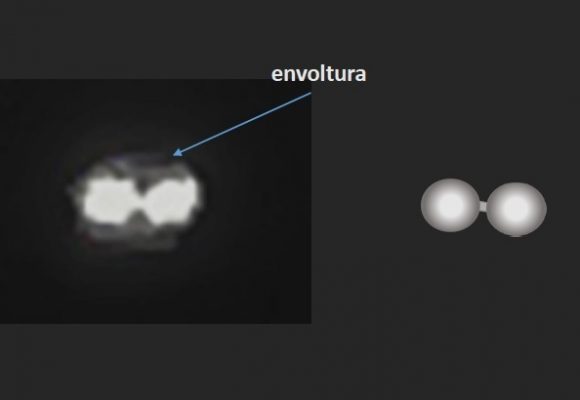
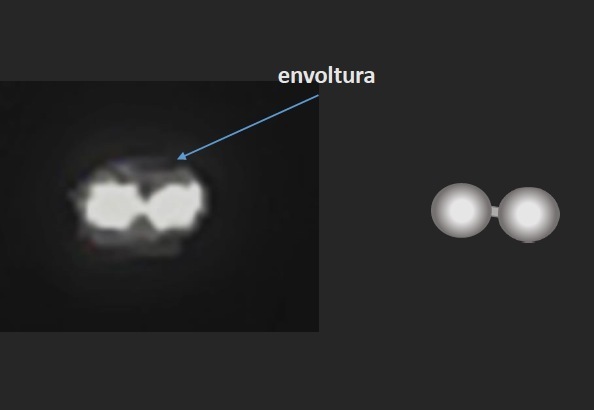
Image captured from the video showing two connected white circular lights, or "hot spots". "Envoltura" means "envelope", refers to the glow surrounding the two spots. Credit: CEFAA
In addition to being in exactly the right position (according to West), aerodynamic contrails explains the thermal flare and the two "thermal spotlights" on the object itself (see image above). Basically, the pilots were looking at the plane's engine glow, which was caused by its two engines on either side of the fuselage glowing hot and giving the appearance of two connected hot spots.
As the plane climbed, its engine exhaust created hot trails that looked like plumes when viewed through an IR camera. Given the fact that the plane was at a higher altitude than originally reported, the presence of contrails would therefore be a possibility, which is something the CEFAA had ruled because the object was believed to be too close to the ground for those to form.
As William of Ockham famously said, "Among competing hypotheses, the one with the fewest assumptions should be selected." In this case, it would seem that West's hypothesis accounts for all the knowns and unknowns in this case, and is therefore the correct one. In the coming weeks and months, the Chilean government may choose to revisit their ruling and reconsider designating this a UAP.
But in the meantime, UFO enthusiasts are likely to interpret this however they want. And many (not all) may indeed see this video as further confirmation that extra-terrestrials are already among us!
Cue the theme music from X-Files! And be sure to watch West's video explaining his conclusions:
https://youtu.be/2bFfuIidCK0
Further Reading: CEFAA, Huff Post, Metabunk


 Posts
Posts