Slightly less expected was the sight of pro-Brexit MPs who had argued fervently that parliament did not need to approve article 50 suddenly changing tack to celebrate the second-reading vote as a triumph for democracy. Either way, things will get more tricky for the government this week as MPs get to debate and vote on the dozens of amendments tabled for the article. The government has indicated it does not want to back down, but all depends on whether enough pro-leave Conservative MPs club together to push through an amendment, for example on the rights of EU nationals in the UK. The view from Europe The European view was on full show in Malta on Friday where the EU's 28 leaders met for an informal summit, and where Theresa May's much-trumpeted planned bilateral chat with Angela Merkel was called off at the last minute. May had also hoped to brief her fellow leaders on her meeting the previous week with Donald Trump. However, the mooted idea of the UK as a bridge between the EU and US was met with some scepticism. "I don't think there is a necessity for a bridge," said Lithuania's Dalia Grybauskaitė. "We communicate with the Americans on Twitter." France's François Hollande was similarly unconvinced, and in one telling moment managed to speak as if the UK had already left the EU. Answering a question on climate change at a close-of-summit press conference, the French president began: "Europe is not just 27 countries individually," somehow forgetting the 28th hasn't officially left yet. Meanwhile, back in Westminster Labour MPs have been told to cancel their leave, stay in Westminster and prepare for a three-line whip in the final vote on the article 50 bill. Labour's frontbench and backbenchers have tabled rafts of amendments on topics ranging from EU citizens to second referendums. Last week Rachel Maskell, Jo Stevens and Dawn Butler left the shadow cabinet in order to vote against the bill on its second reading, and others have said they will vote against it on its third reading if Labour amendments are not accepted. The name on everyone's lips is Clive Lewis, once viewed as the up-and-coming heir to Jeremy Corbyn, who has been agonising over the vote. Corbyn told BBC Radio 4 he was a "very lenient person", hinting that those who defy the three-line whip will not necessarily be sacked. Three whips defied their own orders and voted against the bill last week but have kept their jobs. "The Labour whips' office is turning into an advisory service," one said on Monday. Another MP whose vote will be in the spotlight is Diane Abbott, the shadow home secretary and close Corbyn ally, who left the House of Commons before the last vote on the bill complaining of a migraine. Her fellow Labour MP John Mann claimed she "gave herself a sick note" rather than help to trigger Britain's exit from the EU. Abbott's constituency of Hackney North and Stoke Newington voted heavily for remain. You should also know ... - Two high court judges blocked a legal challenge to the government's strategy for leaving the single market and the European Economic Area.
- Mike Russell, Scotland's Brexit minister, accused the government of reneging on promises made by leave campaigners that Scotland would gain new powers after leaving the EU.
- The first regional hearing of the home affairs select committee inquiry into immigration, in Bedford, heard worries from agricultural businesses about hiring seasonal workers.
- The former pensions secretary Stephen Crabb said people who backed Brexit in the belief it would lead to a cut in immigration into the UK were voting for something that was in effect impossible.
Read this: In the New Statesman, Stephen Bush is puzzled by a call from Yvette Cooper, the Labour MP who chairs the home affairs committee, for a post-Brexit debate about immigration, something she argues has been lacking. If I'm not mistaken, literally days before a referendum on our continuing membership of the European Union, about half of the Labour party was suddenly seized by a desire to talk about the need to 'reform' free movement. As doing this was probably the least helpful intervention imaginable, I find it hard to believe that politicians in general, and Labour politicians in particular, have a problem with talking about immigration. It seems to me that Britain's problem is not a deficit of debates about immigration, but a surplus. It feels as if, actually, we're pretty clear what people think about immigration. About a quarter of the country thinks that immigration is a good thing and three-quarters are varying degrees of hostile to it. Matthew Parris in the Spectator on why leavers are still so angry: What's bugging them? Why do they, the winners, keep lashing out whenever one of the losers doubts or questions their plans? You can almost see the veins standing out on their necks as they rail against the people who didn't win the referendum … I think most of these voters, MPs and journalists are public-spirited patriots who are secretly, usually unconsciously, terrified that they've done the wrong thing. They do of course care. They urged their country forward into a leap in the dark and now worry desperately lest it turn out badly. The TSSA union boss Manuel Cortes, a key Corbyn backer, writes for the Guardian on why Labour MPs must not back article 50 at its third reading if no Labour amendments are passed.
I hope Labour's amendments are accepted as they will bring greater clarity and democratic scrutiny to the Brexit process. But the question Labour MPs must ask themselves before they walk into the lobbies tomorrow is: what is their plan if their amendments are defeated? Having set out their stall, they must not then wave through legislation that counters Labour's shared values. There is no case for a Tory Brexit at any costs. If the amendments fail, Labour must whip its MPs to vote against Tory Brexit. Labour is, after all, the opposition. I realise feelings on this issue are heated, and understand the political toxicity around free movement of people because of need to deal with a strong Ukip challenge in many areas, but sometimes in politics you just need to do what is right. Tweet of the week One pro-leave Conservative MP gets a touch shirty about the number of proposed amendments piling up around the article 50 bill. | 


 Posts
Posts















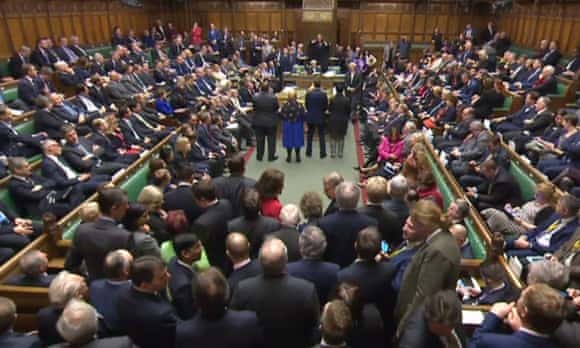
 MPs await the outcome of a vote on the article 50 bill. Photograph: AFP/Getty Images