Welcome to the Guardian's weekly Brexit briefing, a summary of developments as the UK heads to the EU door marked "exit". If you would like to receive it as a weekly early morning email, please sign up here. You can listen to our latest Brexit Means … podcast here. Also: producing the Guardian's independent, in-depth journalism takes a lot of time and money. We do it because we believe our perspective matters – and it may be your perspective too. If you value our Brexit coverage, please become a Guardian Supporter and help make our future more secure. Thank you. The big picture Whether Theresa May's attempt to relaunch her premiership will work is anyone's guess, but her unlikely appeal to Labour and other parties to "come forward with your own views and ideas" is at least an acknowledgement that the embattled prime minister will need help to deliver Brexit. It's no accident that her speech on Tuesday comes as the government is on the point of publishing its repeal bill, which will reverse the 1972 European Communities Act, transfer EU statutes wholesale into British law, adopt EU standards – and leave ministers with powers to amend it all later without parliamentary scrutiny. Rebel Tory and Labour MPs, along with Liberal Democrats, the SNP, the Greens and Plaid Cymru, have formed a cross-party group to lead parliamentary opposition to a hard Brexit and see the bill as their first opportunity to do so. Chuka Umunna, who led the Labour rebellion against leaving the single market, said: We won't accept MPs being treated as spectators in the Brexit process ... We will be fighting in parliament for a future relationship with the EU that protects our prosperity and rights at work. Among further challenges to the government's full-bore Brexit objective of leaving both the single market and the customs union, Philip Hammond insisted people wanted a "sensible Brexit" and warned "it would be madness" not to seek "the closest possible arrangement" with the bloc. The chancellor's remarks followed a punchy intervention from UK business leaders, who demanded ministers agree an indefinite delay to Britain's exit from the single market and customs union to allow more time for talks on a long-term trade deal. Carolyn Fairbairn, director-General of the CBI, said: This is a time to be realistic. Instead of a cliff edge, the UK needs a bridge to the new EU deal. Even with the greatest possible goodwill on both sides, it's impossible to imagine the detail will be clear by the end of March 2019. Adding to the prime minister's woes, at least nine Conservative MPs reportedly reject the government's plans to withdraw from Euratom, saying leaving the European atomic energy community could harm the UK's nuclear power industry and put cancer patients at risk. Dominic Cummings, the director of Vote Leave, said it would be moronic. The view from Europe More Brexit home truths came Britain's way from Brussels last week. Michel Barnier, the European commission's chief negotiator, reiterated that the UK could not expect to leave the EU single market and keep the benefits, or quit the customs union and expect "frictionless trade": I have heard some people in the UK argue that one can leave the single market and keep all of its benefits. That is not possible ... I have heard some people in the UK argue that one can leave the single market and build a customs union to have frictionless trade. That is not possible. The decision to leave the EU has consequences. Meanwhile, Guy Verhofstadt, the European parliament's Brexit representative, and eight other MEP's called Britain's offering on the rights of EU citizens in the UK "a damp squid" and threatened to veto any Brexit deal if it is not improved: We will never endorse the retroactive removal of acquired rights. The European parliament will reserve its right to reject any agreement that treats EU citizens, regardless of their nationality, less favourably than they are at present. And Pascal Lamy, a former EU commissioner and two-time head of the World Trade Organisation, warned the government not to make the "mistake" of cutting itself adrift from EU scientific programmes after Brexit. Meanwhile, back in Westminster With the the prime minister's attempts to survive as Tory leader looking increasingly precarious, allies of David Davis, the Brexit secretary, mooted the possibility of replacing her before the party's autumn conference. Andrew Mitchell is reported to have told a dinner of Conservative MPs that the prime minister needed to be replaced, saying May was "dead in the water ... weak, had lost her authority and couldn't go on". Grant Shapps, a former Conservative party chairman, criticised the dysfunctional, arrogant and corrosive attitude of May's team before the election and said she would need to "operate a completely different model to remain in power". May said on the way to the G20 summit in Hamburg that it had been "the right decision" to call the early election that cost her a parliamentary majority, insisting that she would push ahead with her programme for government and would be remaining in place. Meanwhile, Jeremy Corbyn – with Labour as much as eight points clear in the polls – drew record crowds to a miners' gala in Durham. He urged May to end the public sector pay cap, order a public inquiry into the "national catastrophe" of the Grenfell fire, abandon the Conservative "nightmare" and call a snap general election. You should also know ... Read these In the Observer, Nick Cohen argues that the pre-referendum claims made for our future trading position within Europe have been exposed as hot air: Economics did not trump politics when Britain voted to leave the EU. It does not trump politics now that 27 countries are determined to preserve the union ... As German industrialists make clear, they would rather lose British sales than see the world's richest market undermined. One Whitehall source sounded as weary as Cassandra as he described how ministers ignored the warnings of the civil service that EU countries meant it when they said we could not leave the single market and retain the benefits of being in the single market. "They think it's just a negotiating tactic," he told me. "They think they will buckle because EU countries export more to us than we export to them. They don't understand or want to understand." In the Spectator, Alex Massie seizes on the occasion of Helmut Kohl's funeral to reflect eloquently on how the British – or most of them – have never really understood the European project: We created a political culture in which the default setting or assumption was that, while still better than the alternatives, the EU could never be anything other than intrinsically hostile to British interests. We never saw the nobility of the project because we never talked about it and, perhaps, because if we had, the British people would have laughed at such talk. Because that kind of talk ... was alien to the British people's idea of their own history and their conception of what a European future could, or would have to, be. And at CapX, Chris Deerin takes an entertaining (if sobering) canter through all the many ways in which the government is botching Brexit – and imagines a scenario in which it could, just conceivably, not happen: Brexiteers and Remainers together, let's admit the bleedin' obvious: it's not going well, is it? Let's not pretend we're cruising towards a generous "have cake and eat it" deal with the EU. Don't claim the government has its act together. Don't say that the civil service machine is humming smoothly, spooling out sophisticated proposals for how to come out on top in the negotiation process and build an exciting and shinily sleek New Britain in the aftermath. None of that is happening ... Reader, it is my duty to say it: oh shit. I have scanned the horizon for a hero riding to Brexit's rescue and found none. I have spoken to politicians, civil servants, academics, experts both at home and abroad, and have identified an overwhelming consensus: Britain is screwed. The situation is so grim that for the first time since June 23, I wonder whether the country might rethink. Tweet of the week: Good spot: | 

 Posts
Posts














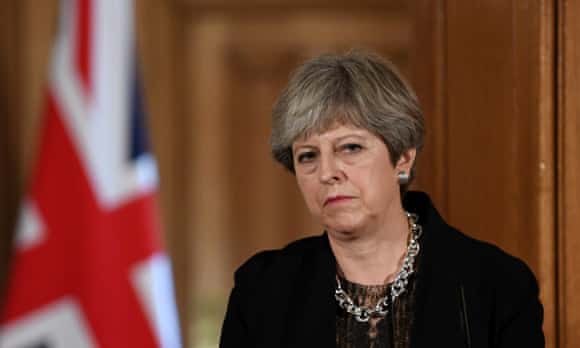
 Theresa May's speech on Tuesday will pitch for a cross-party consensus on Brexit. Photograph: Lukas Coch/AAP