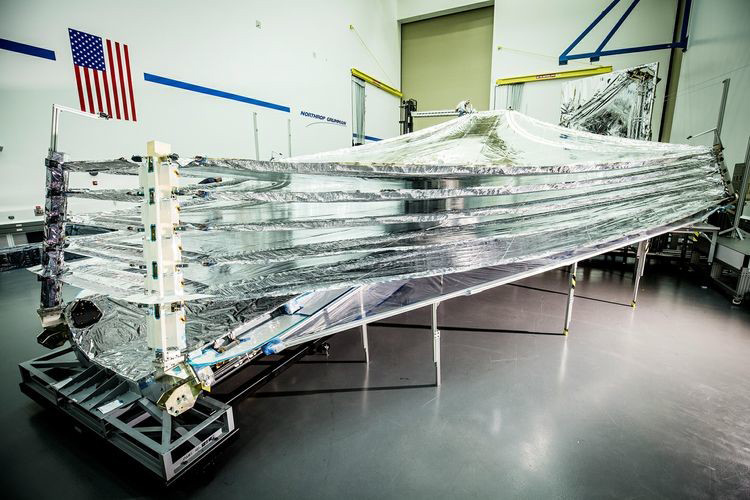
All 5 layers of the Webb telescope sunshield installed at Northrop Grumman's clean room in Redondo Beach, California. The five sunshield membrane layers are each as thin as a human hair. Credits: Northrop Grumman Corp.
The complex multilayered sunshield that will protect the delicate optics and state of the art science instruments of NASA's James Webb Space Telescope (JWST) is now fully installed on the spacecraft bus in California, completing another major milestone on the path to launch, NASA announced.
Meanwhile a critical cryogenic cooling test of Webb's mirrors and science instrument bus has commenced inside a giant chamber at NASA's Johnson Space Center in Texas.
NASA's James Webb Space Telescope is the most powerful space telescope ever built and is the scientific successor to the phenomenally successful Hubble Space Telescope (HST).
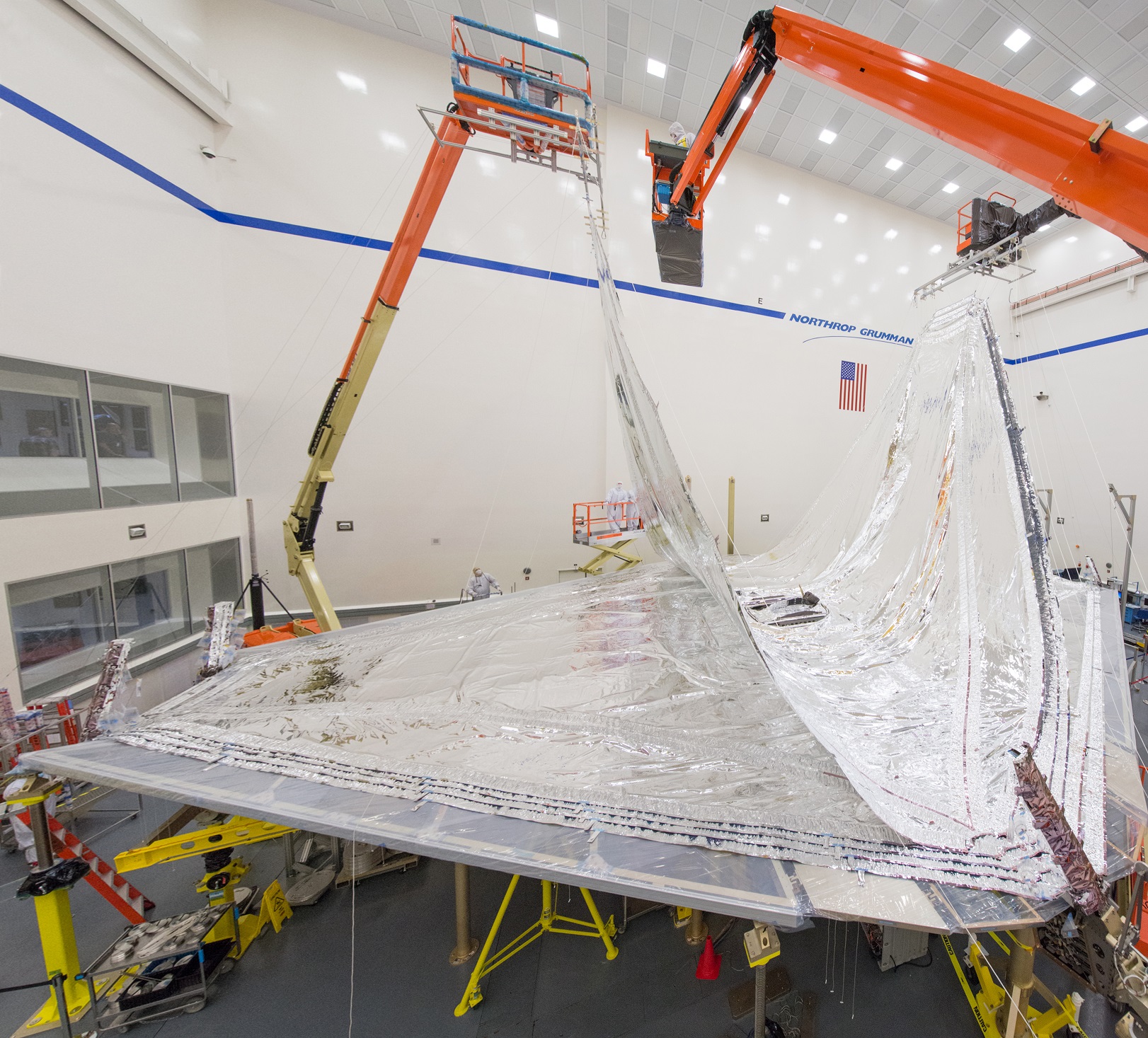
The sunshield layers work together to reduce the temperatures between the hot and cold sides of the observatory by approximately 570 degrees Fahrenheit. Each successive layer of the sunshield, which is made of Kapton, is cooler than the one below. The sunshield is in the clean room at Northrop Grumman Aerospace Systems in Redondo Beach, California.
Credits: Northrop Grumman Corp.
The Webb telescopes groundbreaking tennis court sized sunshield subsystem consists of five layers of kapton that will keep the optics and instruments incredibly cool. Each layer is as thin as a human hair.
"The sunshield layers work together to reduce the temperatures between the hot and cold sides of the observatory by approximately 570 degrees Fahrenheit," according to NASA. "Each successive layer of the sunshield is cooler than the one below."
The painstaking work to integrate the five sunshield membranes was carried out in June and July by engineers and technicians working at the Northrop Grumman Corporation facility in Redondo Beach, California.
"All five sunshield membranes have been installed and will be folded over the next few weeks," said Paul Geithner, deputy project manager - technical for the Webb telescope at NASA's Goddard Space Flight Center in Greenbelt, Maryland.
Northrop Grumman designed the Webb telescope's optics and spacecraft bus for NASA's Goddard Space Flight Center in Greenbelt, Maryland, which manages Webb.

Two sides of the James Webb Space Telescope (JWST). Credit: NASA
"This is a huge milestone for the Webb telescope as we prepare for launch," said Jim Flynn, Webb sunshield manager, Northrop Grumman Aerospace Systems. "The groundbreaking tennis court sized sunshield will shield the optics from heat and assist in providing the imaging of the formation of stars and galaxies more than 13.5 billion years ago."
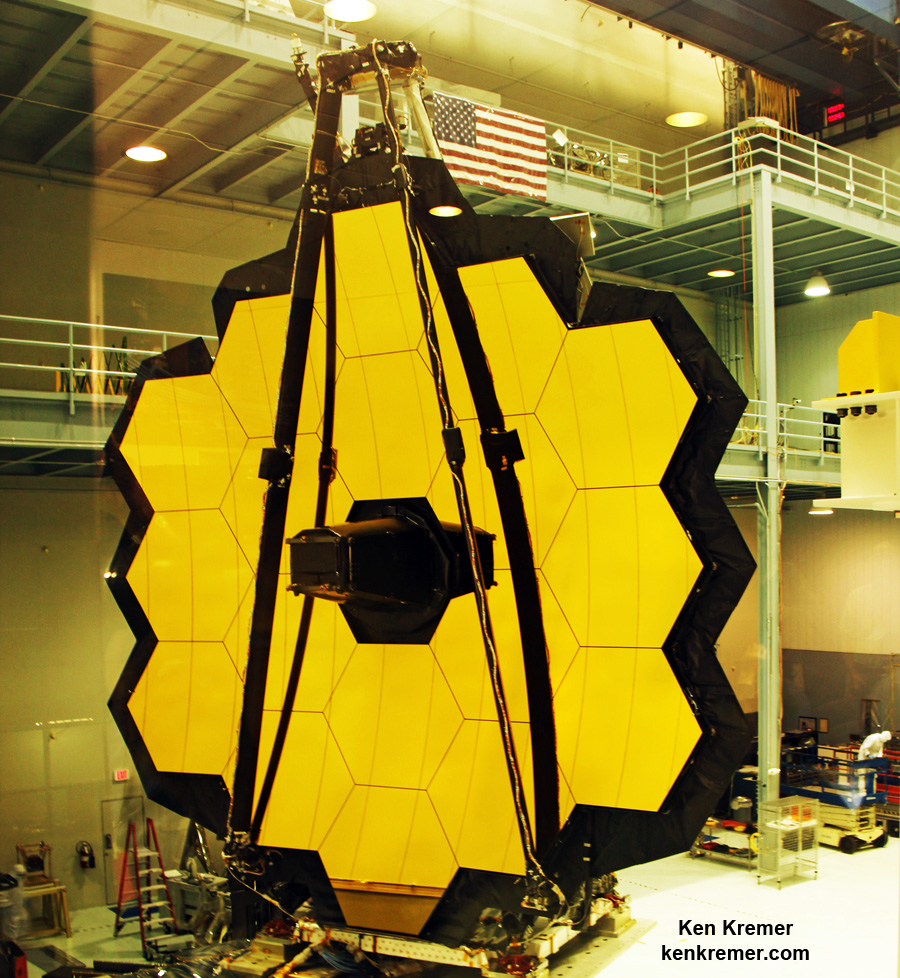
The 18-segment gold coated primary mirror of NASA's James Webb Space Telescope is raised into vertical alignment in the largest clean room at the agency's Goddard Space Flight Center in Greenbelt, Maryland, on Nov. 2, 2016. The secondary mirror mount booms are folded down into stowed for launch configuration. Credit: Ken Kremer/kenkremer.com
Webb is designed to look at the first light of the Universe and will be able to peer back in time to when the first stars and first galaxies were forming. It will also study the history of our universe and the formation of our solar system as well as other solar systems and exoplanets, some of which may be capable of supporting life on planets similar to Earth.
Watch for Ken's onsite space mission reports direct from the Kennedy Space Center and Cape Canaveral Air Force Station, Florida.
Stay tuned here for Ken's continuing Earth and Planetary science and human spaceflight news.
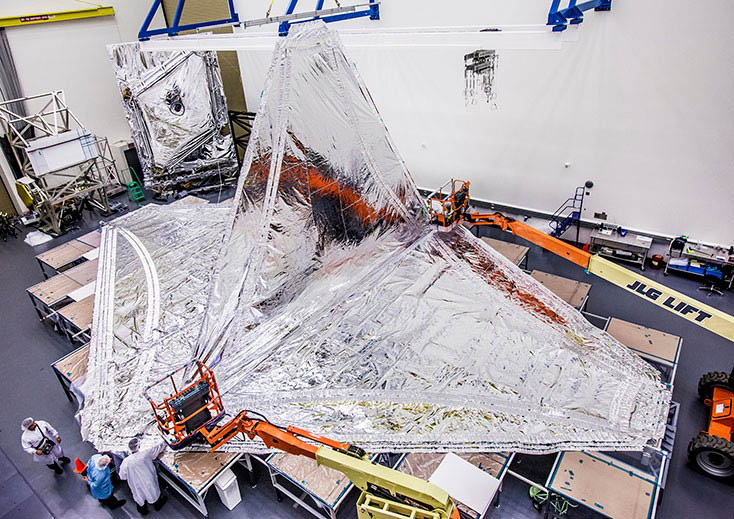
The first layer of the Webb telescope sunshield installed at Northrop Grumman's clean room in Redondo Beach, California. Credits: Northrop Grumman Corp.
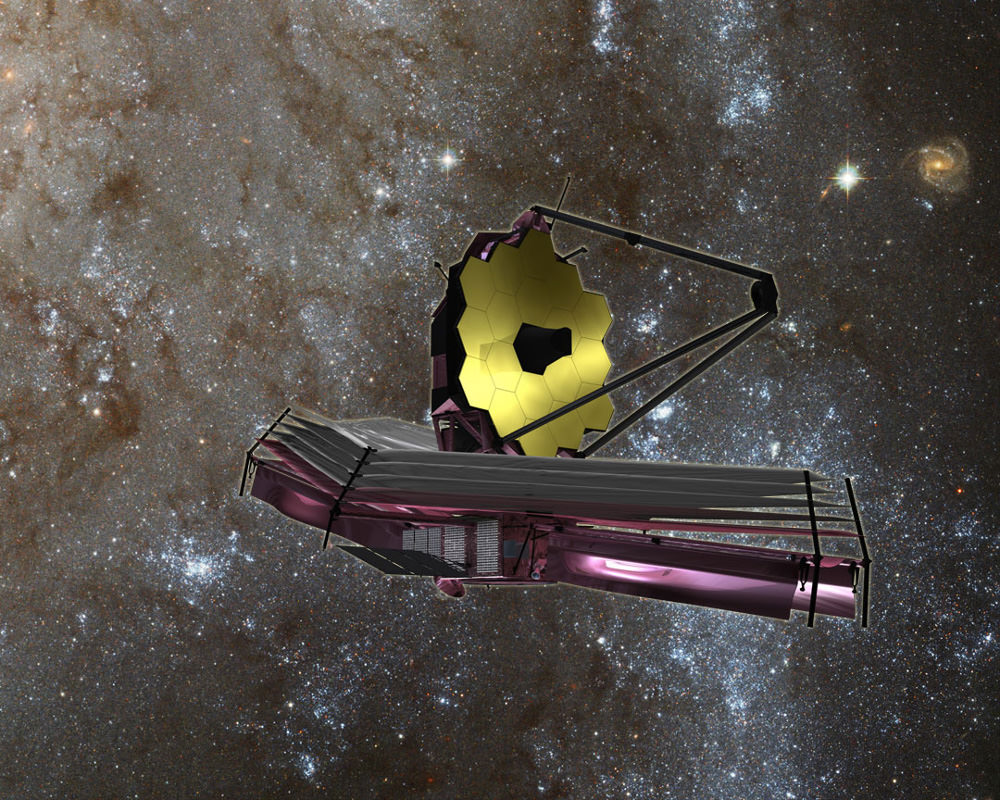
Artist's concept of the James Webb Space Telescope (JWST) with Sunshield at bottom. Credit: NASA/ESA


 Posts
Posts


