Tuesday, September 5, 2017

Mergers and acquisitions involving UK companies: Apr to June 2017, Deaths registered in England and Wales, provisional: week ending 25 Aug 2017, and Pensioners in the EU and UK

Logo

View in browser

5 September 2017

Business, industry and trade

Mergers and acquisitions involving UK companies: Apr to June 2017

During the second quarter (Apr to Jun) of 2017 the value of successful mergers and acquisitions (M&A) involving UK companies saw a notable increase when compared with the values seen in the first Quarter 1 ( Jan to Mar) of 2017.

There were a total of 155 successfully domestic and cross-border acquisitions and disposals involving UK companies worth £30.0 billion in Quarter 2 2017, compared with 214 transactions valued at £16.5 billion in Quarter 1 2017.


People, population and community

Deaths registered in England and Wales, provisional: week ending 25 Aug 2017

The provisional number of deaths registered in England and Wales in the week ending 25 August 2017 (week 34) was 9,382; this represents an increase of 83 deaths registered in comparison with the previous week (week 33).

The average number of deaths for the corresponding week over the previous 5 years was 8,953.


What do we know about older people from the UK living in other EU countries, and vice versa? 

pensioner in EU feature title image

How many British pensioners live in other EU countries, and how many pensioners from other EU countries live in the UK? 

Explore our latest article on pensioners in the EU and UK. 

Our digital team regularly write about our approach and progress to the website and social media.

Visit our Digital Blog

National Statistical is our corporate blog. It's the place to find insight into the role data plays in the decisions affecting our lives, the changes we are making to take advantage of it and the ways we keep it secure. 

Visit our Corporate Blog

local map from website

Looking for local statistics?

A handy guide to let you know where to find local statistics.

Census logo

Census

Discover how our census statistics help paint a picture of the nation and how we live.

visual promo image

Visual.ONS

Visual.ONS is a website exploring new approaches to making ONS statistics accessible and relevant to a wide public audience.


This email was sent using GovDelivery Communications Cloud on behalf of: Office for National Statistics · Room 1.101 · Government Buildings · Cardiff Road · Newport · South Wales · NP10 8XG · 0845 601 3034 GovDelivery logo

Latest news from Parliament

05-09-2017 09:30 AM BST

EU Energy and Environment Sub-Committee takes evidence on Wednesday 6 September at 10.30am
04-09-2017 01:30 PM BST

Political Polling and Digital Media Committee takes evidence on Tuesday 5 September
 

The following link will allow you to view a copy of the latest news items.


This email was sent using GovDelivery Communications Cloud on behalf of: United Kingdom Parliament · Houses of Parliament · London SW1A 0AA, United Kingdom · 020 7219 3000 GovDelivery logo

Brexit weekly briefing: talks stall as negotiators trade verbal blows

EU Referendum Morning Briefing

Brexit weekly briefing: talks stall as negotiators trade verbal blows

UK and EU appear no closer to any deal after latest talks while Tory whips in Westminster try to discourage newly emboldened rebels

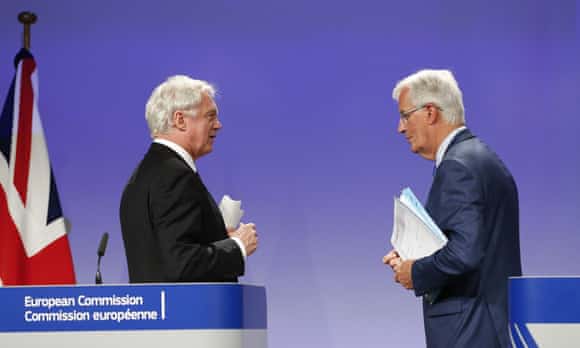
David Davis (left) and Michel Barnier
David Davis (left) and Michel Barnier Photograph: Xinhua/Rex/Shutterstock

Jon Henley European affairs correspondent


Welcome to the Guardian's weekly Brexit briefing, a summary of developments as the UK stumbles to the EU door marked "exit". If you would like to receive it as a weekly early morning email, please sign up here.

You can listen to our latest Brexit Means podcast here. Also: producing the Guardian's independent, in-depth journalism takes a lot of time and money. We do it because we believe our perspective matters – and it may be your perspective too.

If you value our Brexit coverage, please become a Guardian Supporter and help make our future more secure. Thank you.

The big picture

At this stage of negotiations of this magnitude, you might expect the two sides not to be singing from the same hymn-sheet. But what's more alarming is that they don't appear to be singing the same hymn – or even be in the same church.

The third round of Brexit talks came to an end last week with Britain and the EU at an impasse – and the chief negotiators, David Davis and Michel Barnier, unable to agree whether any progress had been made and even trading verbal blows.

Davis accused the EU of a lack of "flexibility and imagination"; Barnier said the UK's approach was "nostalgic and unrealistic". How did it come to this? Because the two sides have radically different views of what the talks are for.

Britain is after a deal: essentially, it wants to leave the EU, the single market and the customs union, but get more (or rather, keep as much as possible of what it now has) for less. It seems to think the EU should give it this because a) BMW, prosecco, etc; and b) it is Britain, after all.

But this the EU cannot give, because it believes the kind of have-cake-and-eat-it, half-in-half-out deal the UK wants would end up undermining the entire EU edifice, which is built on the autonomy of its decision-making, the rule of its law and the integrity of its single market.

Barnier made this absolutely plain, detecting "a sort of nostalgia" in the UK's position papers around "continuing to enjoy the benefits of the single market and EU membership, without actually being part of it":

Britain wants to adopt its own standards and regulations, but also to have these standards recognised automatically in the EU. This is simply impossible. You cannot be outside the single market and shape its legal order … The single market, the EU capacity to regulate, to supervise, to enforce our laws, must not and will not be undermined by Brexit.

It's also about money, of course. Barnier said the UK did not feel "legally obliged" to honour its post-Brexit financial obligations, while Davis said Britain had a "very different legal stance" on the question of the divorce bill.

The Sunday Times suggested Theresa May was set to approve a financial settlement as high as £50bn, which might ease the path towards a trade deal but this was, the Brexit secretary said, "nonsense" and "completely wrong".

In any event, Brexit talks are now considered highly unlikely to move on from the article 50 divorce negotiations to discuss a future trade agreement in October as was originally hoped.

The view from Europe

Barnier doubled down at the weekend, telling an annual economic forum in Italy that since the British government was not doing the job, the EU would have ensure Brexit was an educational process for the Brits:

There are extremely serious consequences of leaving the single market and it hasn't been explained to the British people. We intend to teach people … what leaving the single market means.

The turn of phrase may have been unfortunate, inevitably prompting accusations that Brussels was bent on teaching the UK a lesson, something Barnier belatedly recognised:

I said: #Brexit = occasion to explain single market benefits in all countries, incl my own. We do not want to "educate" or "teach lessons".

— Michel Barnier (@MichelBarnier) September 4, 2017

But there is no mistaking the EU view that the government has yet to show it grasps the repercussions of leaving the EU's single market and customs union.

Pierre Sellal, France's ambassador to the EU, told an event in Paris last week that the picture the UK was giving was one of "confusion and hesitation", while the EU27 showed "clarity, unity ... a certain degree of serenity":

The impression is of a huge underestimation of the implications, the consequences, of their decision. We also have the feeling that there is a certain reticence to accept the consequences of this choice: 'We want to leave, but we're not really ready to fully assume the inevitable consequences'."

In a possible indication of the continent's priorities, Angela Merkel and Martin Schulz, her rival to become Germany's chancellor, did not mention Brexit once in their TV election debate on Sunday.

Meanwhile, back in Westminster

Whips are braced for battles with newly emboldened Conservative rebels over the European Union (withdrawal) bill as parliament returns this week.

The bill, which gets its second reading on Thursday, will transpose EU legislation into British law from the day the UK leaves the EU but critics say it will allow ministers sweeping powers to change key areas of the law without sufficient parliamentary scrutiny.

Both May and Davis warned Tory MPs that trying to obstruct the bill's passage via amendments would risk a victory for Labour's leader, Jeremy Corbyn. Furious MPs, including former ministers, said such arm-twisting and "macho posturing" would backfire, making a leadership challenge more likely this autumn.

The shadow Brexit secretary, Keir Starmer, warned May the government would face a parliamentary battle unless she answered concerns about accountability. Asked if Labour would vote against the bill, he said:

We haven't reached that stage yet, but I have been very, very clear. Whilst we accept the result of the referendum, we are not giving a blank cheque to the government to do it in whichever way it wants because it is not in the public interest.

Senior party sources said members could force a rethink of Labour policy on free movement and permanent membership of the single market, with Brexit set to overtake internal reform as the key topic dominating the autumn conference.

You should also know ...

Read these:

In the Guardian, Natalie Nougayrède says the UK has barely begun to understand Brussels' mindset and is still busy negotiating with itself. She likens the EU27's view of Brexit to a ship leaving port:

The port's many inhabitants wanting to make sure that ship is neither carrying cannons that it may shoot back at them, nor equipment that would make it impossible for the port to thrive. They also want to know that the departing ship's captain won't seek to return as if nothing had changed, or demand a say in how the place develops without abiding by all of the locally agreed rules.

The departing ship is watched with both sadness and concern, but there is no rush to take on its navigational problems. They're keen to keep close contact with it in the future – but within conditions they consider non-negotiable ...

Britain and the EU are not struggling with Brexit together: Britain is seeking its own route, and it is essentially alone in that quandary. On the EU side, there is only one imperative: self-preservation.

In the Observer, Nick Cohen says the fantasy that Brexit would be easy is costing us dear, with a smooth exit from Europe jeopardised by the prime minister's vacillation:

No one in the government has hammered home the uncomfortable truth that clearly we will have to pay a divorce bill if we want to extract concessions from the EU on trade and jobs. Clearly, too, the EU will try to push it as high as it can. Instead, May has struck fantastical poses: that the European court of justice can have no say in British life, for instance.

The failure to confront the central leave lie that "we hold all the cards" is having huge consequences. A government unable to tell the truth about tough choices ahead is in no position to handle the toughest negotiations since 1945. It is also wide open to a rightwing backlash.

Tweet of the week

LBC's James O'Brien on the leave camp's enraged reaction to Barnier's comments on "educating" people about the single market:

Brexit latest: People who don't know much about the ramifications of leaving the EU furious at suggestion that more knowledge would be good.

— James O'Brien (@mrjamesob) September 4, 2017
Guardian News & Media Limited - a member of Guardian Media Group PLC. Registered Office: Kings Place, 90 York Way, London, N1 9GU. Registered in England No. 908396

Monday, September 4, 2017

The Guardian today: UK at centre of secret $3bn Azerbaijani money laundering and lobbying scheme

View in browser
the guardian today
Tuesday 05 Sep 2017
The Guardian logo
Headlines More »
Exclusive: Leaked data reveals thousands of covert payments, including to European politicians and journalists
Most viewed in last 24 hours More »
For decades, Ri Chun-hee has been one of the few trusted to inform the people about great moments in the country's history. What do we know about her?
Sport More »
Comment is free More »
Culture More »
Business More »
Technology More »
Travel More »
Life and style More »
The Guardian
Football Comment is free Environment
Guardian News & Media Limited - a member of Guardian Media Group PLC. Registered Office: Kings Place, 90 York Way, London, N1 9GU. Registered in England No. 908396