During the Scientific Revolution, which took place between the 16th and 18th centuries, numerous inventions and discoveries were made that forever changed the way humanity viewed the Universe. And while this explosion in learning owed its existence to countless individuals, a few stand out as being especially worthy of praise and remembrance.
One such individual is Gionvanni Domenico Cassini, also known by his French name Jean-Dominique Cassini. An Italian astronomer, engineer, and astrologer, Cassini made many valuable contributions to modern science. However, it was his discovery of the gaps in Saturn's rings and four of its largest moons for which he is most remembered, and the reason why the Cassini spacecraft bears his name.
Early Life and Education:
Giovanni Domenico Cassini was born on June 8th, 1625, in the small town of Perinaldo (near Nice, France) to Jacopo Cassini and Julia Crovesi. Educating by Jesuit scientists, he showed an aptitude for mathematics and astronomy from an early age. In 1648, he accepted a position at the observatory at Panzano, near Bologna, where he was employed by a rich amateur astronomer named Marquis Cornelio Malvasia.
During his time at the Panzano Observatory, Cassini was able to complete his education and went on to become the principal chair of astronomy at the University of Bologna by 1650. While there, he made several scientific contributions that would have a lasting mark.
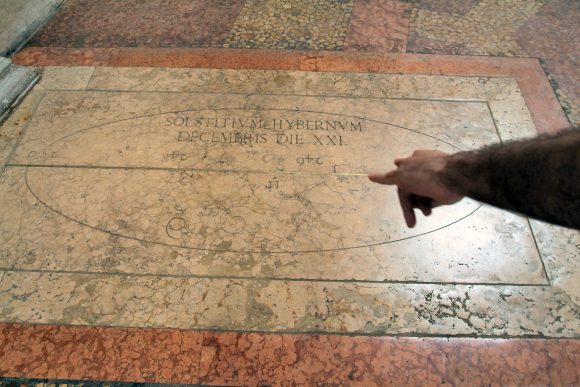
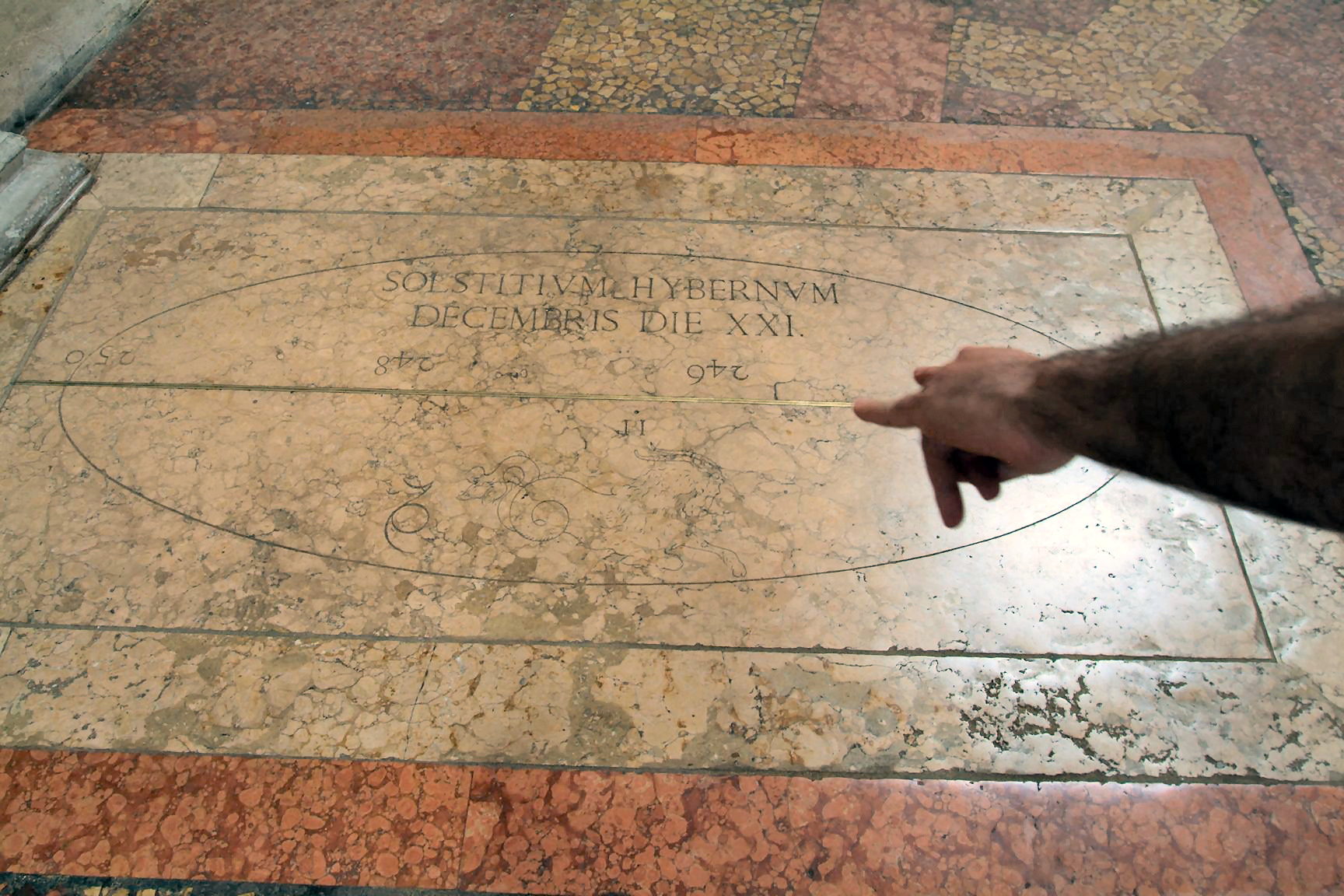
La Meridiana, the meridian line calculated by Cassini while living in Bologna. Credit: Wikipedia Commons/Ilario/Cassinam
This included the calculation of an important meridian line, which runs along the left aisle of the San Petronio Basilica in Bologna. At 66.8 meters (219 ft) in length, it is one of the largest astronomical instruments in the worl and allowed for measurements that were (at the time) uniquely precise. This meridian also helped to settle the debate about whether or not the Universe was geocentric or heliocentric.
During his time in Italy, Cassini determined the obliquity of the Earth's ecliptic - aka. it's axial tilt, which he calculated to be 23° and 29' at the time. He also studied the effects of refraction and the Solar parallax, worked on planetary theory, and observed the comets of 1664 and 1668.
In recognition of his engineering skills, Pope Clement IX employed Cassini with regard to fortifications, river management and flooding along the Po River in northern Italy. In 1663, Cassini was named superintendent of fortifications and oversaw the fortifying of Urbino. And in 1665, he was named the inspector for the town of Perugia in central Italy.
Paris Observatory:
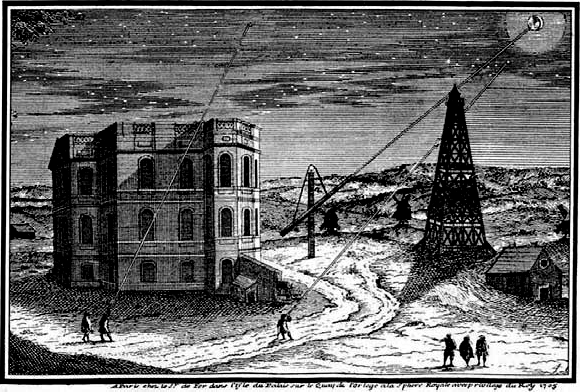
In 1669, Cassini received an invitation by Louis XIV of France to move to Paris and help establish the Paris Observatory. Upon his arrival, he joined the newly-found Academie Royale des Sciences (Royal Academy of Sciences), and became the first director of the Paris Observatory, which opened in 1671. He would remain the director of the observatory until his death in 1712.
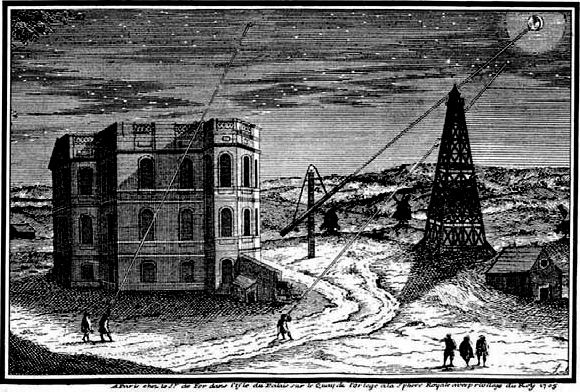
An engraving of the Paris Observatory during Cassini's time. Credit: Public Domain
In 1673, Cassini obtained his French citizenship and in the following year, he married Geneviève de Laistre, the daughter of the lieutenant general of the Comte de Clermont. During his time in France, Cassini spent the majority of his time dedicated to astronomical studies. Using a series of very long air telescopes, he made several discoveries and collaborated with Christiaan Huygens in many projects.
In the 1670s, Cassini began using the triangulation method to create a topographic map of France. It would not be completed until after his death (1789 or 1793), when it was published under the name Carte de Cassini. In addition to being the first topographical map of France, it was the first map to accurately measure longitude and latitude, and showed that the nation was smaller than previously thought.
In 1672, Cassini and his colleague Jean Richer made simultaneous observations of Mars (Cassini from Paris and Richer from French Guiana) and determined its distance to Earth through parallax. This enabled him to refine the dimensions of the Solar System and determine the value of the Astronomical Unit (AU) to within 7% accuracy. He and English astronomer Robert Hooke share credit for the discovery of the Great Red Spot on Jupiter (ca. 1665).
In 1683, Cassini presented an explanation for "zodiacal light" - the faint glow that extends away from the Sun in the ecliptic plane of the sky - which he correctly assumed to be caused by a cloud of small particles surrounding the Sun. He also viewed eight more comets before his death, which appeared in the night sky in 1672, 1677, 1698, 1699, 1702 (two), 1706 and 1707.

Illustration of Jupiter and the Galilean satellites. Credit: NASA
In ca. 1690, Cassini was the first to observe differential rotation within Jupiter's atmosphere. He created improved tables for the positions of Jupiter's Galilean moons, and discovered the periodic delays between the occultations of Jupiter's moons and the times calculated. This would be used by Ole Roemer, his colleague at the Paris Observatory, to calculate the velocity of light in 1675.
In 1683, Cassini began the measurement of the arc of the meridian (longitude line) through Paris. From the results, he concluded that Earth is somewhat elongated. While in fact, the Earth is flattened at the poles, the revelation that Earth is not a perfect sphere was groundbreaking.
Cassini also observed and published his observations about the surface markings on Mars, which had been previously observed by Huygens but not published. He also determined the rotation periods of Mars and Jupiter, and his observations of the Moon led to the Cassini Laws, which provide a compact description of the motion of the Moon. These laws state that:
- The Moon takes the same amount of time to rotate uniformly about its own axis asit takes to revolve around the Earth. As a consequence, the same face is always pointed towards Earth.
- The Moon's equator is tilted at a constant angle (about 1°32' of arc) to the plane of the Earth's orbit around the Sun (i.e. the ecliptic)
- The point where the lunar orbit passes from south to north on the ecliptic (aka. the ascending node of the lunar orbit) always coincides with the point where the lunar equator passes from north to south on the ecliptic (the descending node of the lunar equator).
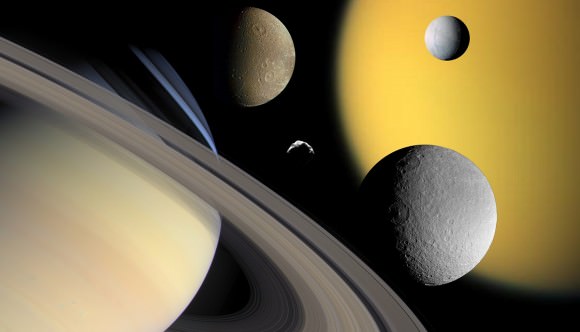
A collage of Saturn (bottom left) and some of its moons: Titan, Enceladus, Dione, Rhea and Helene. Credit: NASA/JPL/Space Science Institute
Thanks to his leadership, Giovanni Cassini was the first of four successive Paris Observatory directors that bore his name. This would include his son, Jaques Cassini (Cassini II, 1677-1756); his grandson César François Cassini (Cassini III, 1714-84); and his great grandson, Jean Dominique Cassini (Cassini IV, 1748-1845).
Observations of Saturn:
During his time in France, Cassini also made his famous discoveries of many of Saturn's moons - Iapetus in 1671, Rhea in 167, and Tethys and Dione in 1684. Cassini named these moons Sidera Lodoicea (the stars of Louis), and correctly explained the anomalous variations in brightness to the presence of dark material on one hemisphere (now called Cassini Regio in his honor).
In 1675, Cassini discovered that Saturn's rings are separated into two parts by a gap, which is now called the "Cassini Division" in his honor. He also theorized that the rings were composed of countless small particles, which was proven to be correct.
Death and Legacy:
After dedicating his life to astronomy and the Paris Observatory, Cassini went blind in 1711 and then died on September 14th, 1712, in Paris. And although he resisted many new theories and ideas that were proposed during his lifetime, his discoveries and contributions place him among the most important astronomers of the 17th and 18th centuries.

A comparison of the geocentric and heliocentric models of the universe. Credit: history.ucsb.edu
As a traditionalist, Cassini initially held the Earth to be the center of the Solar System. In time, he would come to accept the Solar Theory of Nicolaus Copernicus within limits, to the point that he accepted the model proposed by Tycho Brahe. However, he rejected the theory of Johannes Kepler that planets travel in ellipses and proposed hat their paths were certain curved ovals (i.e. Cassinians, or Ovals of Cassini)
Cassini also rejected Newton's Theory of Gravity, after measurements he conducted which (wrongly) suggested that the Earth was elongated at its poles. After forty years of controversy, Newton's theory was adopted after the measurements of the French Geodesic Mission (1736-1744) and the Lapponian Expedition in 1737, which showed that the Earth is actually flattened at the poles.
For his lifetime of work, Cassini has been honored in many ways by the astronomical community. Because of his observations of the Moon and Mars, features on their respective surfaces were named after him. Both the Moon and Mars have their own Cassini Crater, and Cassini Regio on Saturn's moon Iapetus also bears his name.
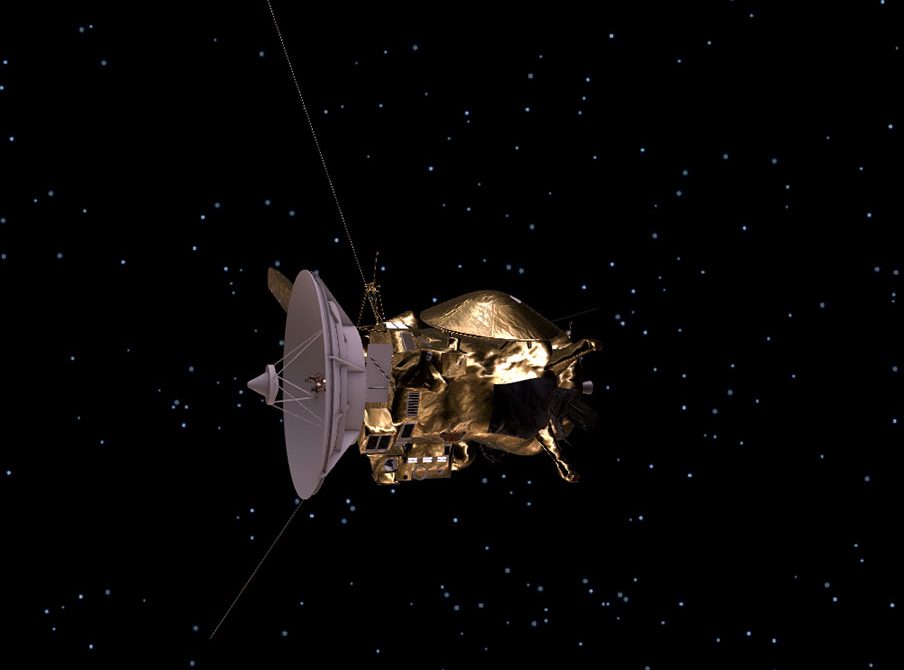
Then there is Asteroid (24101) Cassini, which was discovered by C.W. Juels at in 1999 using the Fountain Hills Observatory telescope. Most recently, there was the joint NASA-ESA Cassini-Huygens missions which recently finished its mission to study Saturn and its moons. This robotic orbiter and lander mission was named in honor of the two astronomers who were chiefly responsible for discovering Saturn system of moons.
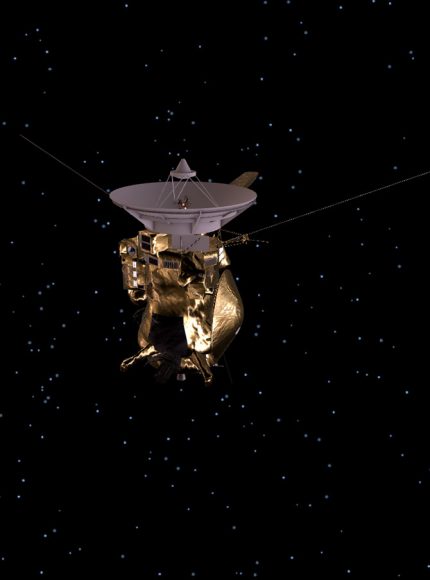
Artist's impression of the Cassini space probe, part of the Cassini-Huygens mission to explore Saturn and its moons. Credit: NASA/JPL
In the end, Cassini's passion for astronomy and his contributions to the sciences have ensured him a lasting place in the annals of history. In any discussion of the Scientific Revolution and of the influential thinkers who made it happen, his name appears alongside such luminaries as Copernicus, Galileo, and Newton.
We have written many interesting articles about Giovanni Cassini here at Universe Today. Here's How Many Moons Does Saturn Have?, The Planet Saturn, Saturn's Moon Rhea, Saturn's "Yin-Yang" Moon Iapetus, Saturn's Moon Dione.
For more information, be sure to check out NASA's Cassini-Huygens mission page, and the ESA's as well.
Astronomy Cast also has some interesting episodes on the subject. Here's Episode 229: Cassini Mission, and Episode 230: Christiaan Huygens.
Sources:


 Posts
Posts