Wednesday, January 4, 2017

The Guardian today - Australia edition


View in browser
Sign up to our Morning Mail Sign up now »
A daily wrap of what's happening, stories we love and the latest news, sent early in the morning. Click here to sign up to our Morning Mail
the guardian today - Australia edition
Thursday 05 Jan 2017
The Guardian logo
Headlines More »
Bureau of Meteorology's annual climate statement cites unprecedented bushfires in regions that don't usually burn and worst coral bleaching on record
Sport More »
Culture More »
Comment is free More »
Life and style More »
Technology More »
Science More »
Environment More »
Video More »
Most viewed in last 24 hours More »
The president-elect's tweets approvingly repeated WikiLeaks founder's claim that the Russian state was not the source of the hacked emails from the DNC
The Guardian
Sport Culture Comment is free

Guardian News & Media Limited - a member of Guardian Media Group PLC. Registered Office: Kings Place, 90 York Way, London, N1 9GU. Registered in England No. 908396

JPL News - Day in Review


DAY IN REVIEW
NASA JPL latest news release
NASA Selects Two Missions to Explore the Early Solar System

NASA has selected two missions that have the potential to open new windows on one of the earliest eras in the history of our solar system - a time less than 10 million years after the birth of our sun. The missions, known as Lucy and Psyche, were chosen from five finalists and will proceed to mission formulation, with the goal of launching in 2021 and 2023, respectively.

"Lucy will visit a target-rich environment of Jupiter's mysterious Trojan asteroids, while Psyche will study a unique metal asteroid that's never been visited before," said Thomas Zurbuchen, associate administrator for NASA's Science Mission Directorate in Washington. "This is what Discovery Program missions are all about - boldly going to places we've never been to enable groundbreaking science."

Lucy, a robotic spacecraft, is scheduled to launch in October 2021. It's slated to arrive at its first destination, a main belt asteroid, in 2025. From 2027 to 2033, Lucy will explore six Jupiter Trojan asteroids. These asteroids are trapped by Jupiter's gravity in two swarms that share the planet's orbit, one leading and one trailing Jupiter in its 12-year circuit around the sun. The Trojans are thought to be relics of a much earlier era in the history of the solar system, and may have formed far beyond Jupiter's current orbit.

"This is a unique opportunity," said Harold F. Levison, principal investigator of the Lucy mission from the Southwest Research Institute in Boulder, Colorado. "Because the Trojans are remnants of the primordial material that formed the outer planets, they hold vital clues to deciphering the history of the solar system. Lucy, like the human fossil for which it is named, will revolutionize the understanding of our origins."

Lucy will build on the success of NASA's New Horizons mission to Pluto and the Kuiper Belt, using newer versions of the RALPH and LORRI science instruments that helped enable the mission's achievements. Several members of the Lucy mission team also are veterans of the New Horizons mission. Lucy also will build on the success of the OSIRIS-REx mission to asteroid Bennu, with the OTES instrument and several members of the OSIRIS-REx team.

The Psyche mission will explore one of the most intriguing targets in the main asteroid belt - a giant metal asteroid, known as 16 Psyche, about three times farther away from the sun than is the Earth. This asteroid measures about 130 miles (210 kilometers) in diameter and, unlike most other asteroids that are rocky or icy bodies, is thought to be comprised mostly of metallic iron and nickel, similar to Earth's core. Scientists wonder whether Psyche could be an exposed core of an early planet that could have been as large as Mars, but which lost its rocky outer layers due to a number of violent collisions billions of years ago.

The mission will help scientists understand how planets and other bodies separated into their layers - including cores, mantles and crusts - early in their histories.

"This is an opportunity to explore a new type of world - not one of rock or ice, but of metal," said Psyche Principal Investigator Lindy Elkins-Tanton of Arizona State University in Tempe. "16 Psyche is the only known object of its kind in the solar system, and this is the only way humans will ever visit a core. We learn about inner space by visiting outer space."

Psyche, also a robotic mission, is targeted to launch in October of 2023, arriving at the asteroid in 2030, following an Earth gravity assist spacecraft maneuver in 2024 and a Mars flyby in 2025.

In addition to selecting the Lucy and Psyche missions for formulation, the agency will extend funding for the Near Earth Object Camera (NEOCam) project for an additional year. The NEOCam space telescope is designed to survey regions of space closest to Earth's orbit, where potentially hazardous asteroids may be found.

"JPL is delighted with the news that Psyche will be moving forward and for the additional support for the development of NEOCam. These two exciting and important missions will provide far greater understanding of the role asteroids play in our solar system," said JPL Director Mike Watkins.

"These are true missions of discovery that integrate into NASA's larger strategy of investigating how the solar system formed and evolved," said NASA's Planetary Science Director Jim Green. "We've explored terrestrial planets, gas giants, and a range of other bodies orbiting the sun. Lucy will observe primitive remnants from farther out in the solar system, while Psyche will directly observe the interior of a planetary body. These additional pieces of the puzzle will help us understand how the sun and its family of planets formed, changed over time, and became places where life could develop and be sustained - and what the future may hold."

Discovery Program class missions like these are relatively low-cost, their development capped at about $450 million. They are managed for NASA's Planetary Science Division by the Planetary Missions Program Office at Marshall Space Flight Center in Huntsville, Alabama. The missions are designed and led by a principal investigator, who assembles a team of scientists and engineers, to address key science questions about the solar system.

The Discovery Program portfolio includes 12 prior selections such as the MESSENGER mission to study Mercury, the Dawn mission to explore asteroids Vesta and Ceres, and the InSight Mars lander, scheduled to launch in May 2018.

NASA's other missions to asteroids began with the NEAR orbiter of asteroid Eros, which arrived in 2000, and continues with Dawn, which orbited Vesta and now is in an extended mission phase at Ceres. The OSIRIS-REx mission, which launched on Sept. 8, 2016, is speeding toward a 2018 rendezvous with the asteroid Bennu, and will deliver a sample back to Earth in 2023. Each mission focuses on a different aspect of asteroid science to give scientists the broader picture of solar system formation and evolution.

Read more about NASA's Discovery Program and missions at:

https://discovery.nasa.gov/missions.cfml

NASA's Jet Propulsion Laboratory, Pasadena, California, manages the Psyche mission, as well as NEOCAM, Dawn and InSight for the agency.


NASA Jet Propulsion Laboratory | jplnewsroom@jpl.nasa.gov | NASA's Jet Propulsion Laboratory | 4800 Oak Grove Dr | Pasadena, CA 91109


NASA Announces Missions to Explore Early Solar System


Matt Williams posted: "It's a New Year, with new challenges and new opportunities! And NASA, looking to kick things off, has announced the two new missions that will be launching in the coming decade. These robotic missions, named Lucy and Psyche, are intended to help us unders"

New post on Universe Today

NASA Announces Missions to Explore Early Solar System

by Matt Williams

It's a New Year, with new challenges and new opportunities! And NASA, looking to kick things off, has announced the two new missions that will be launching in the coming decade. These robotic missions, named Lucy and Psyche, are intended to help us understand the history of the early Solar System, and will deploy starting in 2021 and 2023, respectively.

While Lucy's mission is to explore one of Jupiter's Trojan asteroids, Psyche will explore a metal asteroid known as 16 Psyche. And between the two of them, it is hoped that they will answer some enduring questions about planetary formation and how the Solar System came to be. More than that, these mission represent historic firsts for NASA and human space exploration.

NASA's Discovery Program, of which Lucy and Psyche are part, was created in 1992 to compliment their larger "flagship" programs. By bringing scientists and engineers together to design missions, the Discovery Program's focus has been to maximize scientific research by creating many smaller missions that have shorter development periods and require less in the way of operational resources.
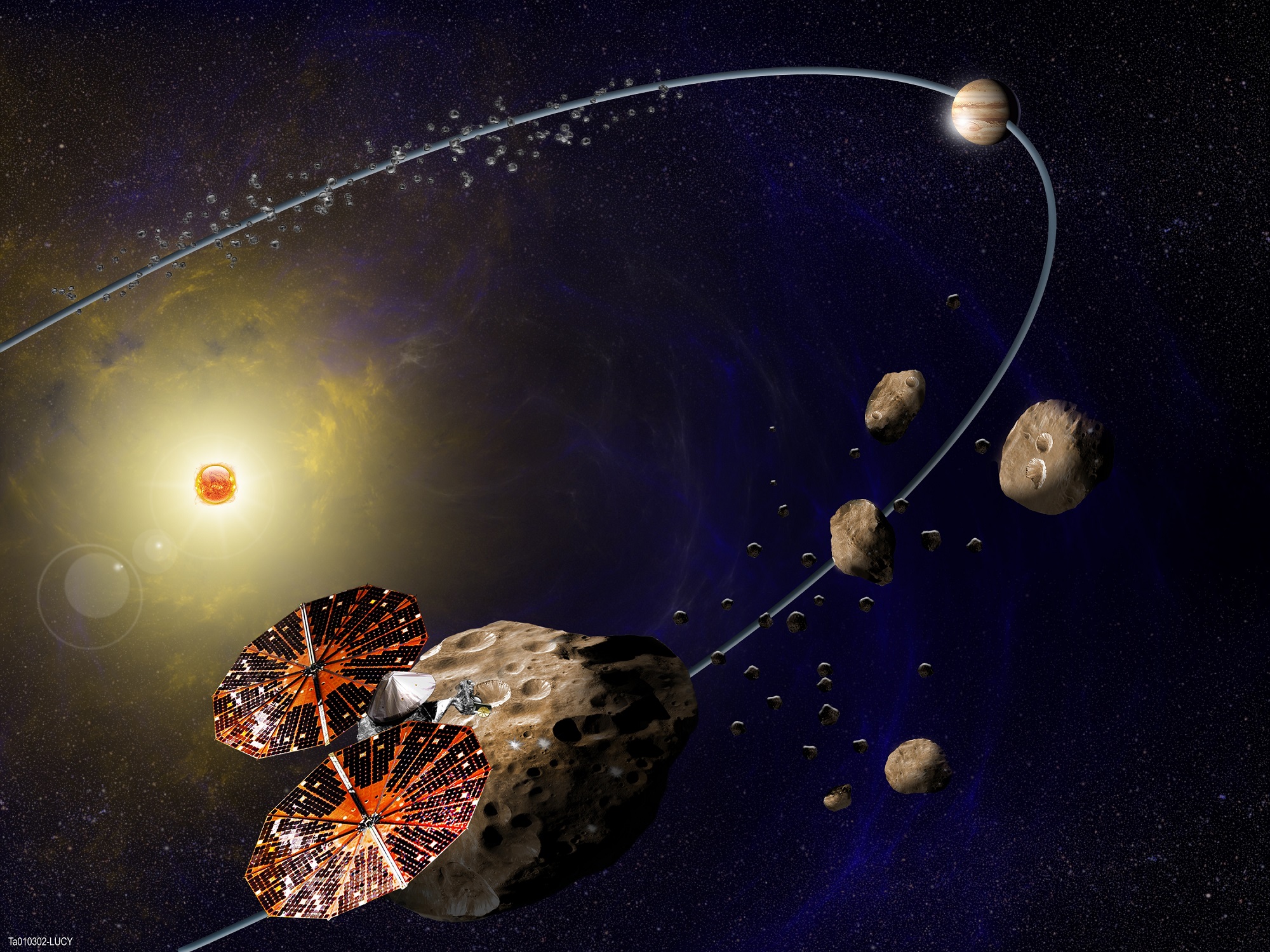
Artist's concept of the Lucy spacecraft flying by Eurybates, one of the six diverse and scientifically important Trojans it will study. Credit: SwRI

The Lucy mission is scheduled to launch in October of 2021, and is expected to arrive at its first destination (a Main Belt asteroid) in 2025. It will then set course for Jupiter's Trojans, a group of asteroids that are trapped by Jupiter's gravity and share its orbit. These asteroids are thought to be relics of the early Solar System; and between 2027 and 2033, Lucy will study six of them.

In addition to being the first mission to explore Jupiter's Trojan population, Lucy is also of historic importance because of the number of asteroids it will visit. Throughout the course of its mission, it is will investigate six Trojans, which is the total number of Main Belt asteroids that have been studied to date. The nature of these six asteroids is also expected to tell us much about the early history of the Solar System.

As Harold F. Levison - the principal investigator of the Lucy mission from the Southwest Research Institute (SwRI) in Boulder, Colorado - explained during a NASA call-in briefing:

"One of the surprising aspects of this population is their diversity. If we look at them through telescopes on the Earth, we see that they are very different from one other in their color, in their spectra. And so, we believe that's telling us something about how the Solar System formed and evolved... This diversity in these objects, we believe, are due to the fact that they actually formed in very different regions of the Solar System, with very different physical characteristics. And something occurred in the history of the Solar System where these objects started off at very different distances, but during the formation and evolution of the Solar System, they got moved around and placed in these stable reservoirs near Jupiter's orbit."
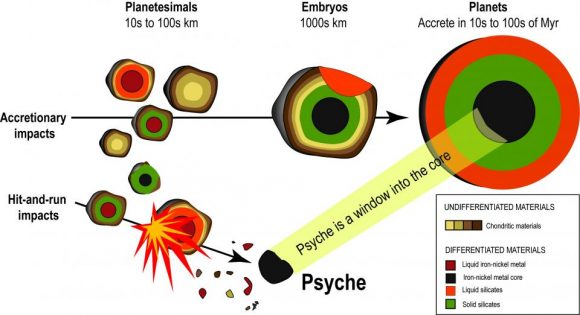
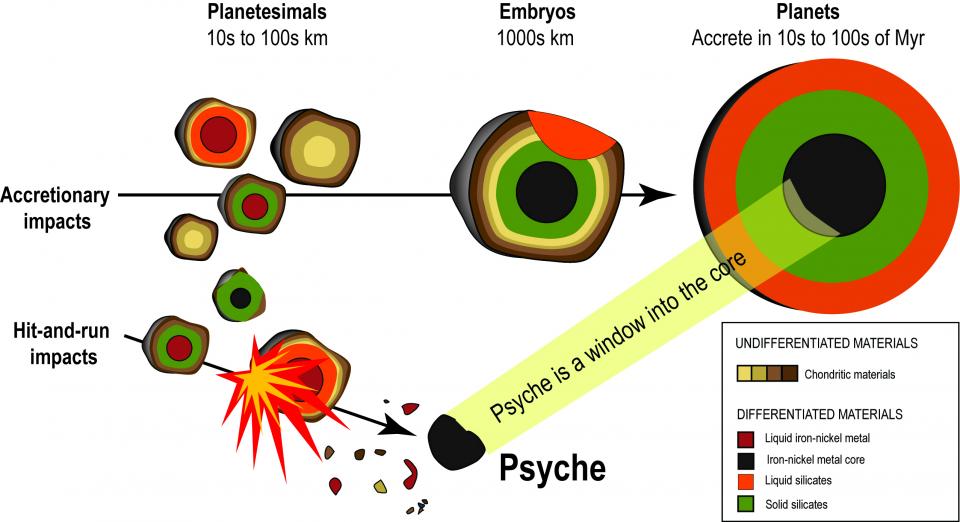
Artist's impression of how Psyche may have been a planetary core that came to be exposed. Credit: sese.asu.edu

The six Trojans that Lucy is intended investigate were selected because the diversity of their physical characteristics show that they are from different locations throughout the Solar System. As Levison put it, "These small bodies really are the fossils of planet formation, and that's why we named Lucy after the human ancestor known as Lucy."

In addition, Lucy will build on the success of missions like New Horizons and OSIRIS-REx., which includes using updated versions of instruments they used to explore Pluto, the Kuiper Belt, and the asteroid Bennu -i.e. the RALPH and LORRI instruments and the OTES instrument. In addition, several members of the New Horizons and OSIRIS-REx science teams will be lending their expertise to the Lucy mission.

Similarly, the Psyche mission will of be immense scientific value since it will visit the only metal asteroid known to exist. This asteroid measures about 210 km (130 mi) in diameter and is believed to be composed entirely of iron and nickel. In this respect, it is similar to Earth's metallic core, as well as the cores of every terrestrial planet in the Solar System.

It is for this reason why scientists believe it may be the exposed core of a Mars-sized planet. According to this theory, 16 Psyche experienced several major collisions during the early history of the Solar System, which caused it to shed its rocky mantle. The robotic probe will launch in 2023 and is expected to arrive by 2030 - after receiving an Earth gravity-assist maneuver in 2024 and a Mars flyby in 2025.

By measuring its composition, magnetic field, and mapping its surface features, Lucy's science team hopes to learn more about the history of planetary formation. As Lindy Elkins-Tanton - the Principal Investigator of Psyche and the Director of the School of Earth and Space Exploration at Arizona State University - said during the NASA call-in briefing:

"Humankind has visited rocky worlds and icy worlds and worlds made of gas. But we have never seen a metal world. Psyche has never been visited or had a picture taken that was more than a point of light. And so, its appearance remains a mystery. This mission will be true exploration and discovery. We think that Psyche is the metal core of a small planet that was destroyed in the high-energy, high-speed, first one-one-hundredth of the age of our Solar System. By visiting Psyche we can literally visit a planetary core the only way humanity can... Psyche let's us visit inner space by visiting outer space."

Not only are planetary cores thought to be where magnetic fields originate (which are necessary for the emergence of life), but they are entirely inaccessible to us. The very edge of Earth's outer core is roughly 2,890 km (1790 mi) from our planet's surface. But the deepest humanity has ever dug has been to a depth of 12 km (7.5 mi), which took place at the Kola Superdeep Borehole, in Russia.

In addition, within the Earth's core, temperature and pressure conditions are estimated to reach 5700 K (5400 °C; 9752 °F) and 330 to 360 gigapascals (over three million times normal air pressure). This makes exploring the core of our planet (or any other planet in the Solar System, for that matter) completely impractical. Hence why a robotic mission to a world like Pysche is such an opportunity.

And since Psyche is the only rounded body of metal that is known to exist in the Solar System, the asteroid is as improbably as it is unique. And since no missions have ever taken place to explore its surface, and no pictures exist that can tell us what its surface features would look like, the Psyche mission is sure to shed some serious light on what a metal world looks like.

"What do we think it might look like?" asked Tanton. "Does it have surface sulfur lava flows on its surface? Is it covered with towering cliffs created when solidifying metal shrank and the exterior of the body broke into fault? Is its surface a combination of iron metal and green mineral crystal as iron meteorites are? And what does an impact crater in metal look like? Could its edges or its metal flashes become frozen in the cold of space before they fell back on the surface. We don't know."

Jim Green, NASA's Planetary Science Director, expressed enthusiasm for the Discovery 13 and 14 missions in a recent NASA press release:

"These are true missions of discovery that integrate into NASA's larger strategy of investigating how the solar system formed and evolved. We've explored terrestrial planets, gas giants, and a range of other bodies orbiting the sun. Lucy will observe primitive remnants from farther out in the solar system, while Psyche will directly observe the interior of a planetary body. These additional pieces of the puzzle will help us understand how the sun and its family of planets formed, changed over time, and became places where life could develop and be sustained - and what the future may hold."

Lucy and Psyche were chosen from five finalists that were selected for further development back in September 2015. These in turn were chosen from 27 mission concepts that were submitted back in November of 2014. Examples of past and present Discovery missions include the Kepler space probe, the Dawn spacecraft, the Mars Pathfinder, and the InSight lander (which is scheduled to launch in 2018).

Further Reading: NASA

Comment    See all comments

Trouble clicking? Copy and paste this URL into your browser: 

http://www.universetoday.com/132702/nasa-announces-missions-explore-early-solar-system/


BREAKING: Samsung will soon reveal root cause behind exploding Galaxy Note 7 phones


Having trouble viewing this email? | View it in your browser

FB TW g+ Ins

  At a press conference, a top U.S. executive said Samsung is reflecting and listening to third party experts "to understand what happened, and to make sure it does not happen again."

FOR MORE ON THIS STORY, GO TO:
  USATODAY.COM  


 Help | Advertise | Home Delivery | Privacy Policy - Your California Privacy Rights  
  © 2017 USA TODAY, a division of Gannett Satellite Information Network, LLC.
7950 Jones Branch Drive, McLean, VA 22108