Wednesday, January 11, 2017

The Guardian today: Donald Trump lashes out at media and intelligence agencies over Russia claims


View in browser
the guardian today
Thursday 12 Jan 2017
The Guardian logo
Headlines More »
Cancer operations were cancelled and a birthing centre closed as hospitals last week declared top level alert to cope with overcrowding
Donald Trump More »
At president-elect's first press conference since July, originally called to explain how he would avoid conflicts of interest, Trump called Russia dossier 'fake news'
Most viewed in last 24 hours More »
It's safe to say that the Trump administration is already in shambles – and it hasn't even started yet
Sport More »
Comment is free More »
Culture More »
Business More »
Technology More »
Travel More »
Life and style More »
Eyewitness picture of the day More »
Hot-air balloons carrying tourists
Hot-air balloons carrying tourists take off before sunrise near the ancient city Bagan.
Reuters
The Guardian
Football Comment is free Environment


Guardian News & Media Limited - a member of Guardian Media Group PLC. Registered Office: Kings Place, 90 York Way, London, N1 9GU. Registered in England No. 908396

A “Breakthrough” to Search for Planets in Closest Star System to Earth


Matt Williams posted: "Ever since the European Southern Observatory (ESO) announced that they had discovered an exoplanet in the nearby system of Proxima Centauri, there have been a lot of questions about this exoplanet. In addition to whether or not this planet could actually "

New post on Universe Today

A "Breakthrough" to Search for Planets in Closest Star System to Earth

by Matt Williams

Ever since the European Southern Observatory (ESO) announced that they had discovered an exoplanet in the nearby system of Proxima Centauri, there have been a lot of questions about this exoplanet. In addition to whether or not this planet could actually support life, astronomers have also been eager to see of its companion stars - Alpha Centauri A and B - have exoplanets too.

Prior to the discovery of Proxima b, Alpha Centauri was thought to host the closest exoplanets to Earth (Alpha Bb and Bc). However, time has cast doubt on the existence of the first, while the second's existence remains unconfirmed. But thanks to a recent agreement between the ESO and Breakthrough Initiatives, we may yet find out if there are exoplanets in Alpha Centauri - which will come in handy when it comes time to explore there!

In accordance with this agreement, Breakthrough Initiatives will provide additional funds so that the ESO's Very Large Telescope (VLT), located at the La Silla Paranal Observatory in Chile, can be modified to conduct a special search program of Alpha Centauri. This will involve upgrading the VLT Imager and Spectrometer for mid-Infrared (VISIR) instrument with new equipment that will enhance its planet-hunting abilities.
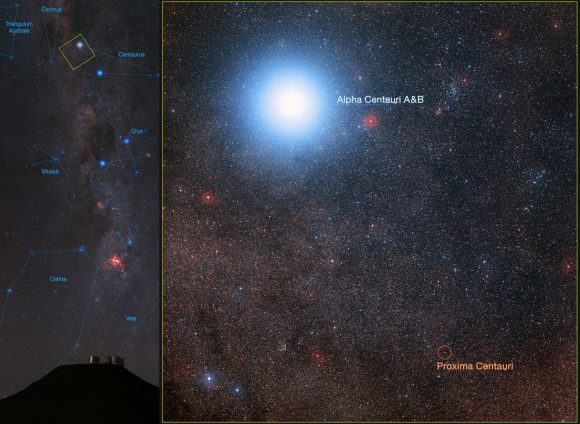
Image of the Alpha Centauri AB system and its distant and faint companion, Proxima Centauri. Credit: ESO

This includes a new instrument module that will allow the VLT to use a technique known as coronagraphy - a form of adaptive optics that corrects for a star's brightness, thus making it easier for a telescope to spot the thermal glow of orbiting planets around them. While the Breakthrough Prize Foundation will pay a large fraction of the upgrade costs, the ESO will be making the VLT and its staff available to conduct the survey - which is scheduled for 2019.

Such an agreement is truly a win-win scenario. For the ESO, this will not only improve the VLT's imaging abilities, but will also assist with the development of the European Extremely Large Telescope (E-ELT). This proposed array, which is scheduled for completion by 2024, will rely on the Mid-infrared E-ELT Imager and Spectrograph (METIS) instrument to hunt for potentially habitable exoplanets.

Any lessons learned from the upgrade of VISIR will allow them to develop the necessary expertise to run METIS, and will also allow them to test the effectiveness of the technology beforehand. For Breakthrough Initiatives, determining if there are any planets in the Alpha Centauri system will go a long way towards helping them mount their historic mission to this star.

In the coming years, Breakthrough Initiatives hopes to mount the first interstellar voyage in history using a lightsail and nanocraft that would rely on lasers to push it up to relativistic speeds (20% the speed of light). Known as Breakthrough Starshot, this craft could be ready to launch in a few years time, and would reach Alpha Centauri in just 20 years time.
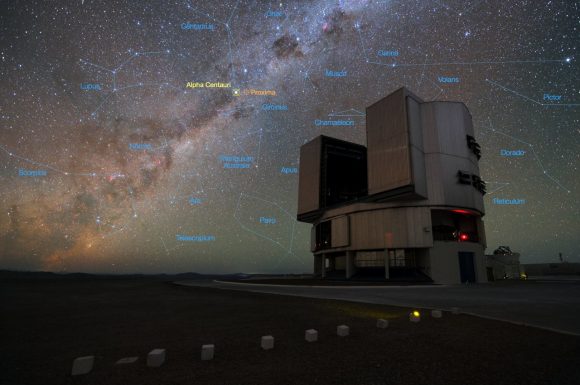
The ESO's Very Large Telescope (VLT) at the Paranal Observatory in Chile and a stellar backdrop showing the location of Alpha Centauri. Credit: ESO

Once there, the nanocraft (using a series of microsensors) would relay information back to Earth about the Alpha Centauri system - which would include any information on its system of planets, and whether or not they are habitable. Hence, determining if there's anything there to study in the first place will help lay the groundwork for the mission.

As Professor Avi Loeb - the Frank B. Baird, Jr. Professor of Science at Harvard and a member of the Breakthrough Starshot Advisory Committee - told Universe Today via email:

"We hope that the partnership between the Breakthrough Prize Foundation and ESO will lead to the discovery of new habitable planets around the nearest stars. Once discovered, we could search for the molecular signatures of life in the atmosphere of these planets, and potentially even send a spacecraft that will reach them within our lifetime. The latter is the driver for the Starshot Initiative. The discovery of habitable nearby planets will provide us with targets for photography by gram-scale spacecrafts, launched at a fraction of the speed of light and  equipped with cameras. For example, we would like to find out whether such planets are covered by blue oceans, green vegetation or yellow deserts."

It's one of the hallmarks of the new space age: a private and public organization coming together for the sake of mutual benefit. But when those benefits include advancing scientific research, space exploration, and the hunt for habitable planets other than our own, it truly is a win-win situation!

In the meantime, enjoy this video provided by ESO about their new partnership with Breakthrough Initiatives:

https://youtu.be/H7fmfZS-JxE

Further Reading: ESO, Breakthrough Initiatives

Comment    See all comments

Trouble clicking? Copy and paste this URL into your browser: 

http://www.universetoday.com/132777/breakthrough-search-planets-closest-star-system-earth/


BREAKING: Texas has executed death row inmate Christopher Wilkins, the nation's first execution in 2017


Having trouble viewing this email? | View it in your browser

FB TW g+ Ins

  More than 11 years after killing two men, Wilkins, 48, was put to death by lethal injection Wednesday, the Associated Press reported. Wilkins' attorneys asked the U.S. Supreme Court to halt the execution, saying he had poor legal help at trial and during other appeals. Seven executions were carried out last year in Texas, the fewest since 1996.

FOR MORE ON THIS STORY, GO TO:
  USATODAY.COM  


Help | Advertise | Home Delivery | Privacy Policy - Your California Privacy Rights  
  © 2017 USA TODAY, a division of Gannett Satellite Information Network, LLC.
7950 Jones Branch Drive, McLean, VA 22108


JPL News - Day in Review


LATEST NEWS
NASA JPL latest news release
Huygens: 'Ground Truth' From an Alien Moon

2005 Historic Descent to Titan Revisited

After a two-and-a-half-hour descent, the metallic, saucer-shaped spacecraft came to rest with a thud on a dark floodplain covered in cobbles of water ice, in temperatures hundreds of degrees below freezing. The alien probe worked frantically to collect and transmit images and data about its environs -- in mere minutes its mothership would drop below the local horizon, cutting off its link to the home world and silencing its voice forever.

Although it may seem the stuff of science fiction, this scene played out 12 years ago on the surface of Saturn's largest moon, Titan. The "aliens" who built the probe were us. This was the triumphant landing of ESA's Huygens probe.

Huygens, a project of the European Space Agency, traveled to Titan as the companion to NASA's Cassini spacecraft, and then separated from its mothership on Dec. 24, 2004, for a 20-day coast toward its destiny at Titan.

The probe sampled Titan's dense, hazy atmosphere as it slowly rotated beneath its parachutes, analyzing the complex organic chemistry and measuring winds. It also took hundreds of images during the descent, revealing bright, rugged highlands that were crosscut by dark drainage channels and steep ravines. The area where the probe touched down was a dark, granular surface, which resembled a dry lakebed.

Thoughts on Huygens

Today the Huygens probe sits silently on the frigid surface of Titan, its mission concluded mere hours after touchdown, while the Cassini spacecraft continues the exploration of Titan from above as part of its mission to learn more about Saturn and its moons. Now in its dramatic final year, the spacecraft's own journey will conclude on September 15 with a fateful plunge into Saturn's atmosphere.

With the mission heading into its home stretch, Cassini team members and NASA leaders look back fondly on the significance of Huygens:

"The Huygens descent and landing represented a major breakthrough in our exploration of Titan as well as the first soft landing on an outer-planet moon. It completely changed our understanding of this haze-covered ocean world."
-- Linda Spilker, Cassini project scientist at NASA's Jet Propulsion Laboratory, Pasadena, California

"The Huygens images were everything our images from orbit were not. Instead of hazy, sinuous features that we could only guess were streams and drainage channels, here was incontrovertible evidence that at some point in Titan's history -- and perhaps even now -- there were flowing liquid hydrocarbons on the surface. Huygens' images became a Rosetta stone for helping us interpret our subsequent findings on Titan."
-- Carolyn Porco, Cassini imaging team lead at Space Science Institute, Boulder, Colorado

"Cassini and Huygens have shown us that Titan is an amazing world with a landscape that mimics Earth in many ways. During its descent, the Huygens probe captured views that demonstrated an entirely new dimension to that comparison and highlights that there is so much more we have yet to discover. For me, Huygens has emphasized why it is so important that we continue to explore Titan."
-- Alex Hayes, a Cassini scientist at Cornell University, Ithaca, New York

"Twelve years ago, a small probe touched down on an orangish, alien world in the outer solar system, marking humankind's most distant landing to date. Studying Titan helps us tease out the potential of habitability of this tiny world and better understand the chemistry of the early Earth."
-- Jim Green, director of planetary science at NASA Headquarters, Washington

A collection of Huygens' top science findings is available from ESA at:

http://sci.esa.int/huygens-titan-science-highlights

The Cassini-Huygens mission is a cooperative project of NASA, ESA (European Space Agency) and the Italian Space Agency. NASA's Jet Propulsion Laboratory, a division of Caltech in Pasadena, manages the mission for NASA's Science Mission Directorate, Washington. JPL designed, developed and assembled the Cassini orbiter.

More information about Cassini:

http://www.nasa.gov/cassini

http://saturn.jpl.nasa.gov


NASA Jet Propulsion Laboratory | jplnewsroom@jpl.nasa.gov | NASA's Jet Propulsion Laboratory | 4800 Oak Grove Dr | Pasadena, CA 91109


How to Get More Protein at Breakfast


Starting your day with protein may help you stay fuller longer -- and even help you lose weight. Here are some energizing breakfast ideas to try.
Trouble viewing this email? View as a Webpage Wednesday, January 11, 2017
Special
Missing Images! Slideshow
How to Get More Protein at Breakfast
Starting your day with protein may help you stay fuller longer -- and even help you lose weight. Here are some energizing breakfast ideas to try.
Slideshow
What Is Diverticulitis, Exactly?
Quiz
How Long Does It Take Food to Reach Your Stomach?
Quiz
From the Side, the Spine Resembles Which Letter?
Slideshow
See How the Sun Can Damage Your Skin
Slideshow
Physical Symptoms of Depression -- It's Not All in Your Head
Diabetes Explained
Type 1
Type 2
ADVERTISEMENT
ADVERTISEMENT
 
Missing image   Missing image   Missing image   Missing image   Missing image
 
WebMD.com   |  Mobile Apps
WebMD Privacy Policy
 
© 2017 WebMD, LLC. All rights reserved.
WebMD Office of Privacy | 1201 Peachtree Street, NE | Atlanta, GA 30361