Monday, February 6, 2017

U.S. National Library of Medicine NLM Technical Bulletin Update

02/06/2017 02:41 PM EST

On March 20 - 22, 2017, NCBI will host a genomics hackathon on the NIH campus. This hackathon will focus on advanced bioinformatics analysis of next generation sequencing data and metadata. This event is for students, postdocs and investigators, or other researchers already engaged in the use of genomics data or pipelines for genomic analyses from next generation sequencing data. However, there are projects available to other non-scientific developers, mathematicians, or librarians. The event is open to anyone selected for the hackathon who is able to travel to NIH.
This email was sent using GovDelivery, on behalf of: U.S. National Library of Medicine · 8600 Rockville Pike · Bethesda, MD 20894 Powered by GovDelivery

The Guardian today - Australia edition

View in browser


the guardian today - Australia edition
Tuesday 07 Feb 2017
The Guardian logo
Headlines More »
The conservative Liberal is leaving the party in a move that will blow a hole in the Coalition agenda on the first day of parliament
Sport More »
Culture More »
Comment is free More »
Life and style More »
Technology More »
Science More »
Environment More »
Video More »
Most viewed in last 24 hours More »
It might have a record-tying 14 Oscar nominations but the musical hit has been criticized for its treatment of race, gender and jazz
The Guardian
Sport Culture Comment is free
Guardian News & Media Limited - a member of Guardian Media Group PLC. Registered Office: Kings Place, 90 York Way, London, N1 9GU. Registered in England No. 908396

A Black Hole’s Record Breaking Lunch

New post on Universe Today

A Black Hole's Record Breaking Lunch

by Nancy Atkinson

Does a distant black hole provide a new definition of pain and suffering?

The black hole, named XJ1500+0154, appears to be the real-life equivalent of the Pit of Carkoon, the nesting place of the all-powerful Sarlacc in Star Wars, which slowly digested its victims.

Over ten years ago, this giant black hole ripped apart a star and has since continued a very long lunch, feasting on the stars' remains. Astronomers have been carefully monitoring this slow 'digestion,' because it is so unusual for what are called tidal disruption events (TDEs), where tidal forces from black holes tear stars apart.

"We have witnessed a star's spectacular and prolonged demise," said Dacheng Lin from the University of New Hampshire in Durham, New Hampshire, who led the observations of this event. "Dozens of tidal disruption events have been detected since the 1990s, but none that remained bright for nearly as long as this one."

This artist's illustration depicts what astronomers call a "tidal disruption event," or TDE, when an object such as a star wanders too close to a black hole and is destroyed by tidal forces generated from the black hole's intense gravitational forces. (Credit: NASA/CXC/M.Weiss.

This decade-long feast has gone on ten times longer than any other observed TDE.

XJ1500+0154 is located in a small galaxy about 1.8 billion light years from Earth, and three telescopes have been monitoring this X-ray event: the Chandra X-ray Observatory, the Swift satellite, and the XMM-Newton.

TDEs are different from another, more common black-hole related source of X-rays in the galaxy, active galactic nuclei (AGN). Like the digestion of the Sarlacc, AGNs really can last for thousands of years. These are supermassive black holes at the center of galaxies that pull in surrounding gas and "emit copious amounts of radiation, including X-rays," explained Lin in a blog post on the Chandra website. "Radiation from AGNs do not vary a lot because the gas surrounding them extends over a large scale and can last for tens of thousands of years."

In contrast, TDEs are relatively short-lived, lasting only a few months. During a TDE, some of the stellar debris is flung outward at high speeds, while the rest falls toward the black hole. As it travels inwards to be consumed by the black hole, the material heats up to millions of degrees, generating a distinct X-ray flare.

XJ1500+0154 has provided an extraordinarily long, bright phase, spanning over ten years. Lin and his team said one explanation could be the most massive star ever to be completely torn apart during a TDE.

"To have the event last so long at such high luminosity requires full disruption of a relatively massive star, about twice the mass of the sun," Lin wrote; however, "disruption of such massive stars by the SMBH is very unlikely because stars this massive are rare in most galaxies, unless the galaxy is young and actively forming stars, as in our case.

So, another more likely explanation is that this is the first TDE observed where a smaller star was completely torn apart.

Lin also said this event has broad implications for black hole physics.
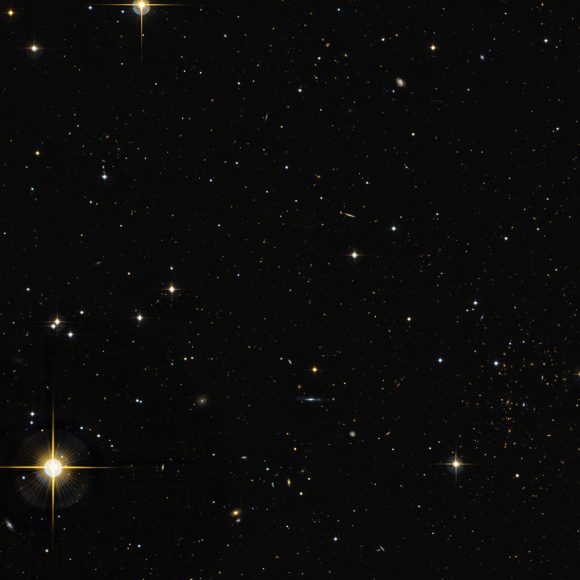
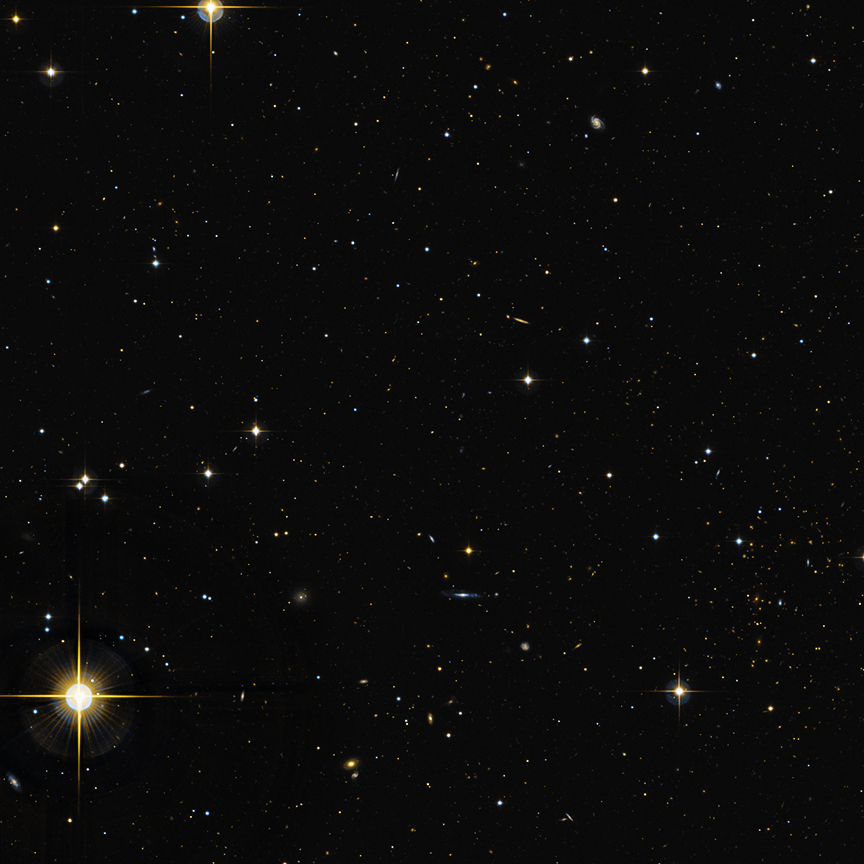
An optical image shows the galaxy and a cross to mark the location of XJ1500+0154. This image reveals that XJ1500+0154 is found in the center of the galaxy, implying that the source likely originates from a supermassive black hole that resides there. Credit: Canada France Hawaii Telescope(CFHT)

"To fully explain the super-long duration of our event requires the application of recent theoretical progress on the study of TDEs," he wrote. "In the last two years, several groups independently found that it can take a long time after the disruption of the star for the stellar debris to settle onto the accretion disk and into the SMBH. Therefore, the event can evolve much more slowly than previously thought."

Additionally, the X-ray data also indicate that radiation from material surrounding this black hole has consistently surpassed what is called the Eddington limit, which is defined as a balance between the outward pressure of radiation from the hot gas and the inward pull of the gravity of the black hole.

Seeing evidence of such rapid growth may help astronomers understand how supermassive black holes were able to reach masses about a billion times higher than the sun when the universe was only about a billion years old.

"This event shows that black holes really can grow at extraordinarily high rates," said co-author Stefanie Komossa of QianNan Normal University for Nationalities in Duyun City, China. "This may help understand how precocious black holes came to be."

Lin and his team will continue to monitor this event, and they expect the X-ray brightness to fade over the next few years, meaning the supply of 'food' for this long lunch will soon be consumed. slowly be significantly reduced in the next decade. This would result in XJ1500+0154 fading in X-ray brightness over the next several years.

For further reading:
Paper: A likely decade-long sustained tidal disruption event
Lin's blog post on the Chandra website
Chandra press release
Additional images and information from Chandra

Nancy Atkinson | February 6, 2017 at 7:46 pm | Tags: Featured, Tidal Distruption Event | URL: http://wp.me/p1CHIY-yF7
Comment    See all comments

Trouble clicking? Copy and paste this URL into your browser: 

http://www.universetoday.com/133245/black-holes-record-breaking-lunch/


JPL News - Day in Review

DAY IN REVIEW
NASA JPL latest news release
NASA's Curiosity Rover Sharpens Paradox of Ancient Mars

Fast Facts:

› Curiosity rover findings add to a puzzle about ancient Mars because the same rocks that indicate a lake was present also indicate there was very little carbon dioxide in the air to help keep a lake unfrozen.

› No carbonate has been found definitively in rock samples analyzed by Curiosity.

› A new study calculates how much carbon dioxide could have been in the ancient atmosphere without resulting in carbonate detectable by the rover: not much.

Mars scientists are wrestling with a problem. Ample evidence says ancient Mars was sometimes wet, with water flowing and pooling on the planet's surface. Yet, the ancient sun was about one-third less warm and climate modelers struggle to produce scenarios that get the surface of Mars warm enough for keeping water unfrozen.

A leading theory is to have a thicker carbon-dioxide atmosphere forming a greenhouse-gas blanket, helping to warm the surface of ancient Mars. However, according to a new analysis of data from NASA's Mars rover Curiosity, Mars had far too little carbon dioxide about 3.5 billion years ago to provide enough greenhouse-effect warming to thaw water ice.

The same Martian bedrock in which Curiosity found sediments from an ancient lake where microbes could have thrived is the source of the evidence adding to the quandary about how such a lake could have existed. Curiosity detected no carbonate minerals in the samples of the bedrock it analyzed. The new analysis concludes that the dearth of carbonates in that bedrock means Mars' atmosphere when the lake existed -- about 3.5 billion years ago -- could not have held much carbon dioxide.

"We've been particularly struck with the absence of carbonate minerals in sedimentary rock the rover has examined," said Thomas Bristow of NASA's Ames Research Center, Moffett Field, California. "It would be really hard to get liquid water even if there were a hundred times more carbon dioxide in the atmosphere than what the mineral evidence in the rock tells us." Bristow is the principal investigator for the Chemistry and Mineralogy (CheMin) instrument on Curiosity and lead author of the study being published this week in the Proceedings of the National Academy of Science.

Curiosity has made no definitive detection of carbonates in any lakebed rocks sampled since it landed in Gale Crater in 2011. CheMin can identify carbonate if it makes up just a few percent of the rock. The new analysis by Bristow and 13 co-authors calculates the maximum amount of carbon dioxide that could have been present, consistent with that dearth of carbonate.

In water, carbon dioxide combines with positively charged ions such as magnesium and ferrous iron to form carbonate minerals. Other minerals in the same rocks indicate those ions were readily available. The other minerals, such as magnetite and clay minerals, also provide evidence that subsequent conditions never became so acidic that carbonates would have dissolved away, as they can in acidic groundwater.

The dilemma has been building for years: Evidence about factors that affect surface temperatures -- mainly the energy received from the young sun and the blanketing provided by the planet's atmosphere -- adds up to a mismatch with widespread evidence for river networks and lakes on ancient Mars. Clues such as isotope ratios in today's Martian atmosphere indicate the planet once held a much denser atmosphere than it does now. Yet theoretical models of the ancient Martian climate struggle to produce conditions that would allow liquid water on the Martian surface for many millions of years. One successful model proposes a thick carbon-dioxide atmosphere that also contains molecular hydrogen. How such an atmosphere would be generated and sustained, however, is controversial.

The new study pins the puzzle to a particular place and time, with an on-the-ground check for carbonates in exactly the same sediments that hold the record of a lake about a billion years after the planet formed.

For the past two decades, researchers have used spectrometers on Mars orbiters to search for carbonate that could have resulted from an early era of more abundant carbon dioxide. They have found far less than anticipated.

"It's been a mystery why there hasn't been much carbonate seen from orbit," Bristow said. "You could get out of the quandary by saying the carbonates may still be there, but we just can't see them from orbit because they're covered by dust, or buried, or we're not looking in the right place. The Curiosity results bring the paradox to a focus. This is the first time we've checked for carbonates on the ground in a rock we know formed from sediments deposited under water."

The new analysis concludes that no more than a few tens of millibars of carbon dioxide could have been present when the lake existed, or it would have produced enough carbonate for Curiosity's CheMin to detect it. A millibar is one one-thousandth of sea-level air pressure on Earth. The current atmosphere of Mars is less than 10 millibars and about 95 percent carbon dioxide.

"This analysis fits with many theoretical studies that the surface of Mars, even that long ago, was not warm enough for water to be liquid," said Robert Haberle, a Mars-climate scientist at NASA Ames and a co-author of the paper. "It's really a puzzle to me."

Researchers are evaluating multiple ideas for how to reconcile the dilemma.

"Some think perhaps the lake wasn't an open body of liquid water. Maybe it was liquid covered with ice," Haberle said. "You could still get some sediments through to accumulate in the lakebed if the ice weren't too thick."

A drawback to that explanation is that the rover team has sought and not found in Gale Crater evidence that would be expected from ice-covered lakes, such as large and deep cracks called ice wedges, or "dropstones," which become embedded in soft lakebed sediments when they penetrate thinning ice.

If the lakes were not frozen, the puzzle is made more challenging by the new analysis of what the lack of a carbonate detection by Curiosity implies about the ancient Martian atmosphere.

"Curiosity's traverse through streambeds, deltas, and hundreds of vertical feet of mud deposited in ancient lakes calls out for a vigorous hydrological system supplying the water and sediment to create the rocks we're finding," said Curiosity Project Scientist Ashwin Vasavada of NASA's Jet Propulsion Laboratory, Pasadena, California. "Carbon dioxide, mixed with other gases like hydrogen, has been the leading candidate for the warming influence needed for such a system. This surprising result would seem to take it out of the running."

When two lines of scientific evidence appear irreconcilable, the scene may be set for an advance in understanding why they are not. The Curiosity mission is continuing to investigate ancient environmental conditions on Mars. It is managed by JPL, a division of Caltech in Pasadena, for NASA's Science Mission Directorate, Washington. Curiosity and other Mars science missions are a key part of NASA's Journey to Mars, building on decades of robotic exploration to send humans to the Red Planet in the 2030s. For more about Curiosity, visit:

http://www.nasa.gov/curiosity

Learn about NASA's Journey to Mars at:

http://www.nasa.gov/journeytomars


NASA Jet Propulsion Laboratory | jplnewsroom@jpl.nasa.gov | NASA's Jet Propulsion Laboratory | 4800 Oak Grove Dr | Pasadena, CA 91109


15 Reasons You're Not Hungry