Monday, February 13, 2017

BREAKING NEWS: National security adviser Michael Flynn resigns

If you have trouble reading this message, view it in a browser.


Breaking News


February 13, 2017 | Updated 8:15 PM PT


  Flynn resigns amid Russia controversy  


National security adviser Michael Flynn has resigned after reports he misled Trump administration officials about his contacts with Russia's ambassador to the U.S. Flynn's departure marks an extraordinarily early shakeup in the president's senior team of advisers.


  Support authentic journalism!
Get daily insights into stories that resonate throughout the Bay Area and beyond.
Click here for San Francisco Chronicle subscription offers.


Connect     Facebook     Twitter     Pinterest     Google+
 
About   Privacy Policy   Terms of Use


BREAKING: Michael Flynn resigns as President Trump's national security adviser, reports say

Having trouble viewing this email? | View it in your browser

FB TW g+ Ins

  This is a developing story. Stay tuned to USA TODAY for more information.

FOR MORE ON THIS STORY, GO TO:
  USATODAY.COM  
 

Help | Advertise | Home Delivery | Privacy Policy - Your California Privacy Rights  
  © 2017 USA TODAY, a division of Gannett Satellite Information Network, LLC.
7950 Jones Branch Drive, McLean, VA 22108


BREAKING: DOJ warned the Trump administration that Michael Flynn could be vulnerable to Russian blackmail, reports say

Having trouble viewing this email? | View it in your browser

FB TW g+ Ins

  Sally Yates, the former acting attorney general who was fired by President Trump in late January, warned the White House that national security adviser Michael Flynn could be vulnerable to Russian blackmail and was misleading about his interactions with Russia's ambassador, The Washington Post and CNN reported Monday night.

FOR MORE ON THIS STORY, GO TO:
  USATODAY.COM  
 

Help | Advertise | Home Delivery | Privacy Policy - Your California Privacy Rights  
  © 2017 USA TODAY, a division of Gannett Satellite Information Network, LLC.
7950 Jones Branch Drive, McLean, VA 22108


Through The Nuclear Looking Glass: The Moon & The Bomb

New post on Universe Today

Through The Nuclear Looking Glass: The Moon & The Bomb

by Matt Williams

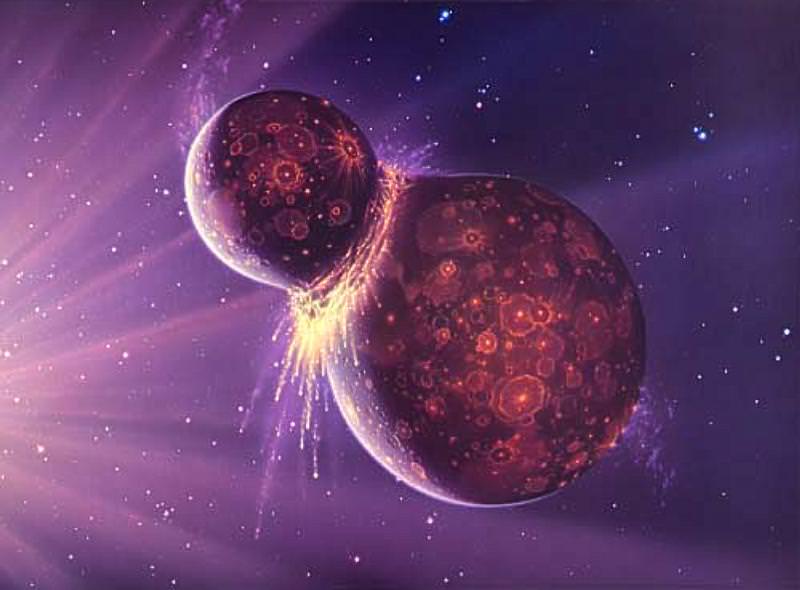
For centuries, scientists have been attempting to explain how the Moon formed. Whereas some have argued that it formed from material lost by Earth due to centrifugal force, others asserted that a performed Moon was captured by Earth's gravity. In recent decades, the most widely-accepted theory has been the Giant-impact hypothesis, which states that the Moon formed after the Earth was struck by a Mars-sized object (named Theia) 4.5 billion years ago.

According to a new study by an international team of researchers, the key to proving which theory is correct may come from the first nuclear tests conducted here on Earth, some 70 years ago. After examining samples of radioactive glass obtained from the Trinity test site in New Mexico (where the first atomic bomb was detonated), they determined that samples of Moon rocks showed a similar depletion of volatile elements.

The study was led by James Day - a professor of geoscience at the Scripps Institution of Oceanography at the University of California, San Diego. Along with his colleagues - who hail from the Paris Institute of Earth Physics, the McDonnell Center for the Space Sciences, and NASA's Johnson Space Center - they examined samples of glass retrieved from the Trinity test site to determine their chemical compositions.

A frame of the 'Trinity' fireball, taken .025 seconds after the detonation of the atomic bomb. Credit: US Govt. Defense Threat Reduction Agency

This glass, known as trinite, was created when the plutonium bomb was detonated at the Trinity test site in 1945 as part of the Manhattan Project. To a distance of 350 meters (1,100 feet) from ground zero, arkosic sand (which is primarily composed of quartz grains and feldspar) was converted to green-colored glass by the extreme heat and pressure caused by the massive explosion.

For years, scientists have been studying these glass deposits, which they determined was the result of sand being sucked up into the explosion, and then rained down as molten liquid onto the surface. When Day and his colleagues examined it, they noted that samples of the glass were depleted of zinc and other volatile elements - which are known to evaporate under extreme heat and pressure - depending on how far they were from ground zero.

According to their study, which was published in Science Advances on February 8th, 2017, samples of trinite that were obtained between 10 and 250 meters (30 to 800 feet) from the blast site were depleted of these elements far more than samples that were taken from farther away. In addition, the isotopes of zinc that remained were heavier and less-reactive than in others.

They then compared these results to studies performed on lunar rocks, which showed a similar depletion of volatile elements. From this, they determined that similar heat and pressure conditions existed at one time on the Moon which caused these elements to evaporate. This is consistent with the theory that a massive impact took place in the past that turned the Moon's surface into an ocean of magma.

A huge impact may have formed the Moon, but other large impacts could have determined the makeup of Earth and other planetary bodies. Image Credit: Joe Tucciarone

As Day explained in a UC San Diego press release:

"The results show that evaporation at high temperatures, similar to those at the beginning of planet formation, leads to the loss of volatile elements and to enrichment in heavy isotopes in the left over materials from the event. This has been conventional wisdom, but now we have experimental evidence to show it."

While the predominant theory since the 1980s has been the Giant impact hypothesis, the debate has been ongoing and subject to new findings. For example, back in January of 2017, a new study published in Nature Geoscience - which was led by by Raluca Rufu of the Weizmann Institute of Science in Rehovot, Israel - indicated that the Moon may have been the result of many smaller collisions.

Using computer simulations, the Weizmann team found that multiple small impacts could have formed many moonlets around Earth which would have then coalesced to create the Moon. But by showing that volatile elements undergo the same kinds of reactions to heat and pressure, regardless of where the reaction takes place, Day and his colleagues have offered some solid evidence that the points towards a single impact event.

This study is just the latest in a series that is helping Earth scientists to put constraints on when and how the Moon formed, which are also helping us to get a better understanding of the history of the Solar System and its formation.

Further Reading: Science Advances, UCSD

Matt Williams | February 13, 2017 at 9:09 pm | Tags: Featured, manhattan project, trinite | URL: http://wp.me/p1CHIY-yHL
Comment    See all comments

Trouble clicking? Copy and paste this URL into your browser: 

http://www.universetoday.com/133409/nuclear-looking-glass-moon-bomb/


U.S. National Library of Medicine NLM Technical Bulletin Update

02/13/2017 02:32 PM EST

The National Library of Medicine is pleased to announce the release of an updated SNOMED CT to ICD-10-CM mapping file.
This email was sent using GovDelivery, on behalf of: U.S. National Library of Medicine · 8600 Rockville Pike · Bethesda, MD 20894 Powered by GovDelivery

BREAKING: Senate unanimously confirms David Shulkin as Veterans Affairs secretary

Having trouble viewing this email? | View it in your browser

FB TW g+ Ins

  Shulkin, the lone holdover from the Obama administration among President Trump's Cabinet picks, has been the VA undersecretary for health since July 2015 and has not drawn the harsh opposition from Democrats that other Trump nominees have faced.

FOR MORE ON THIS STORY, GO TO:
  USATODAY.COM  
 

Help | Advertise | Home Delivery | Privacy Policy - Your California Privacy Rights  
  © 2017 USA TODAY, a division of Gannett Satellite Information Network, LLC.
7950 Jones Branch Drive, McLean, VA 22108


JPL News - Day in Review

DAY IN REVIEW
NASA JPL latest news release
Descent into a Frozen Underworld

JPL tests robotics in ice caves near active volcano

Mt. Erebus is at the end of our world -- and offers a portal to another.

It's our planet's southernmost active volcano, reaching 12,448 feet (3,794 meters) above Ross Island in Antarctica. Temperatures at the surface are well below freezing most of the year, but that doesn't stop visits from scientists: Erebus is also one of the few volcanoes in the world with an exposed lava lake. You can peer over the lip of its main crater and stare straight into it.

It's also a good stand-in for a frozen alien world, the kind NASA wants to send robots to someday. That's why Aaron Curtis, a post-doctoral scholar at NASA's Jet Propulsion Laboratory, Pasadena, California, spent the month of December exploring ice caves beneath the volcano. For several weeks, he tested robots, a drill and computer-aided mapping technology that could one day help us understand the icy worlds in our outer solar system.

It was Curtis' seventh visit to Mt. Erebus, which he made on behalf of both JPL and the Mt. Erebus Volcano Observatory. He traveled with several colleagues who were studying everything from the age of the rocks to the composition of gasses emitted from the lava lake.

Ocean worlds like Europa are sure to be distinctly more alien than Erebus. Europa's temperatures are hundreds of degrees below freezing; its ice is certain to be different than that of Earth's; its surface is bathed in Jupiter's radiation.

But there are some similarities that make Erebus a good testing ground for future technologies.

"We think some features of these caves are similar to what you might see on a moon like Europa," Curtis said.

Aaron Curtis, a postdoctoral scholar at JPL

Aaron Curtis, a postdoctoral scholar at JPL, peers into the caldera of Mt. Erebus, an active volcano in Antarctica. Image Credit: Dylan Taylor
› Larger view

Frozen beauty

For the ancient Greeks, Erebus was an entrance to the underworld. It's a fitting namesake: scientists have discovered that Mt. Erebus has its own underworld -- though one of stunning beauty.

The volcano's gases have carved out massive caves, which are filled with forests of hoarfrost and cathedral-like ice ceilings. Curtis said the heat from Erebus keeps the caves cozy -- close to 32 degrees Fahrenheit (0 degrees Celsius) -- and drives warm gases out of vents at the surface, where they freeze into towers. Within the caves, the mixing of warm and cold air forms icy "chimneys" that reach toward the ground.

While pursuing his doctorate at the New Mexico Institute of Mining and Technology, Curtis wrote his dissertation on the formation of these caves. He said that in recent years, scientists have also discovered a diverse array of microscopic organisms living in their interior. These extremophiles, as they're known, suggest that life might be possible on distant planets with similar cave systems.

Aaron Curtis, a post-doctoral scholar at JPL

Aaron Curtis, a post-doctoral scholar at JPL, in one of the Mt. Erebus ice caves. Image Credit: Dylan Taylor.
› Larger view

Tools for an Icy Moon

Curtis joined JPL's Extreme Environments Robotics Group in 2016, where engineers are developing nimble machines that can climb, scurry and rove across difficult terrain.

Aaron Parness, manager of the Robotic Prototyping Lab, said Mt. Erebus was a good testing ground for some of the robots and instruments in development. When a member of the group is conducting field research, they often test each other's work. It's part of the rapid design prototyping that steers the group's efforts.

"Field testing shows you things that are hard to learn in the laboratory," Parness said. "We jump on those opportunities. Even if the prototype isn't ready to work perfectly, it doesn't mean it isn't ready to teach us lessons on how to make the next iteration better."

Curtis tested several unique projects at Mt. Erebus. There was the Ice Screw End Effector (ISEE), a kind of ice drill designed for the "feet" of a wall-climbing robot called LEMUR. The drill would allow LEMUR to attach itself to walls, while also pulling out samples of the ice with each step. Future designs might be able to check for chemical signs of life within these samples.

ISEE hadn't seen much field testing before this trip -- just the ice growing inside a fridge at JPL.

"We're trying to get a feel for what kind of ice this drill works in," Curtis said. He added that ice can be plastic or brittle depending on different densities, humidity and other factors. The ice caves under Erebus proved to have much higher concentrations of air than expected: "The differences involved can be like trying to climb a marshmallow versus a light metal."

Another test was for PUFFER, an origami-inspired robot that can sit flat during storage and "puff up" to explore a wider area. PUFFER has driven extensively around JPL, in Pasadena's Arroyo Seco and other desert environments -- but not on snow. Curtis joysticked the robot around using newly designed snow wheels, which have a broad, flat surface.

Another tool that that could be helpful for future explorers is a structured light sensor used for creating 3-D cave maps. JPL's Jeremy Nash and Renaud Detry provided the sensor, which relies on computer vision to map the interior of a cave.

Curtis said that ice is a hard material to 3-D model, in large part because it's so reflective. Light has a tendency to bounce off its surface, making it difficult for a computer to read that data and reconstruct a space.

"Ice sparkles, and the sparkly crystals look different from each angle," Curtis said. "It's like a hall of mirrors."

Aaron Curtis, a post-doctoral scholar at JPL

A helicopter brings in supplies to Lower Erebus Hut, a camp at 11,000 feet. The camp is considered the main base of operations that scientists work out of. Image Credit: Dylan Taylor
› Larger view

Adventurous Science

Make no mistake about it -- a research trip to Mt. Erebus isn't exactly a vacation.

Curtis and his colleagues faced three large blizzards during their trip, each lasting around a week. That led to travel delays when supply helicopters couldn't make safe passage.

The team also dealt with limited energy in a region that experiences six months of night, blocking out sunlight for solar cells. Wind turbines on the volcano are the most common form of energy, though they face their own challenges: frost builds up on the blades, causing them to vibrate themselves to bits.

But the chance to conduct research in such a desolate and awe-inspiring location is hard to pass up.

"When I smell that hydrogen sulfide perfuming the minus-25-degrees-Celsius air, there's nowhere I'd rather be," Curtis said.


NASA Jet Propulsion Laboratory | jplnewsroom@jpl.nasa.gov | NASA's Jet Propulsion Laboratory | 4800 Oak Grove Dr | Pasadena, CA 91109