In the past few decades, astronomers and geophysicists have benefited immensely from the study of planetary magnetic fields. Dedicated to mapping patterns of magnetism on other astronomical bodies, this field has grown thanks to missions ranging from the Voyager probes to the more recent Mars Atmosphere and Volatile EvolutioN (MAVEN) mission.
Looking ahead, it is clear that this field of study will play a vital role in the exploration of the Solar System and beyond. As Jared Espley of NASA's Goddard Space Flight Center outlined during a presentation at NASA's Planetary Science Vision 2050 Workshop, these goals include advancing human exploration of the cosmos and the search for extra-terrestrial life.
Consider the case of Earth and its "twin planet", Mars. Earth has a magnetic field that ranges in strength from 25 to 65 microteslas (0.25 to 0.65 gauss), which ensures that habitable conditions can exist on its surface. Mars, by contrast, once had a magnetic field, which allowed for the existence of a thicker atmosphere and liquid water on its surface.

Artist's rendering of a solar storm hitting Mars and stripping ions from the planet's upper atmosphere. Credits: NASA/GSFC
The process by which this occurred was mapped extensively by orbiters like MAVEN and the Mars Global Surveyor (MGS). According to data provided by these missions, scientists now know that roughly 4.2 billion years ago, Mars' magnetic field disappeared. Over the course of the next 500 million years, the planet's atmosphere was slowly stripped away, which caused its surface to become the cold, desiccated place we see today.
Because of this, being able to measure planetary magnetic fields could be a boon to astronomers and planetary researchers. As Jared Espley told Universe Today via email:
"Directly measuring magnetic fields at and near the worlds of the Solar System tells us a lot about how those worlds work. Broadly speaking, we can learn about their interior structure and composition and how the charged gases in their atmospheres move and behave. For example, we can probe whether places like Europa have subsurface oceans, what Jupiter's interior structure looks like, and whether Mars lost its atmosphere via solar wind erosion."
As a research assistant at Goddard's Solar System Exploration Division (SSED), Espley is well versed in the study of things like Mars' induced magnetosphere, the physics of space plasma, and the developed of mangetometers. And as he explained during the course of his presentation at the 2050 Workshop, their are several applications for this field of study going forward. They include:

Artist's impression of the interior of Mars. Credit: NASA/JPL
Subsurface Sounding:
When it comes to the exploration of planets like Mars, magnetometry be useful in helping scientists determine its subsurface structure and composition. As it stands, missions like the Interior Exploration using Seismic Investigations, Geodesy and Heat Transport (InSight) lander - which is scheduled to launch in 2018 - are intended to provide information on its seismology, temperature, and history of formation.
By using networks of electromagnetic sensors such as magnetometers, such missions could be augmented by allowing for more in-depth studies of a planet's interior structure. In addition, they could be used to located things like aquifers, which would help in the search for Martian life and identify resources needed for human exploration, and even colonization.
Similar missions could be mounted to Venus and Mercury, thus revealing how all the terrestrial planets in the Solar System were created, what they have in common, and what sets them apart.
Aerial Geomagnetic Surveys:
By placing magnetometers on aerial platforms such as gliders or balloons, detailed geophysical characterization of planetary surfaces could be conducted. This would allow future missions to explore of the geophysical history of planets with respect to events that altered the magnetization of the crust - i.e. volcanism, plate tectonics, impact cratering, and more.
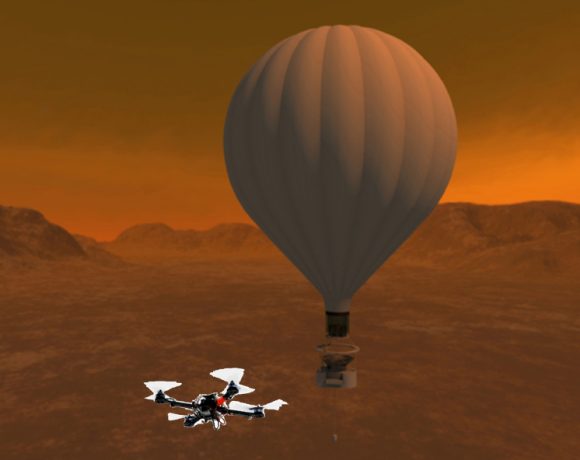
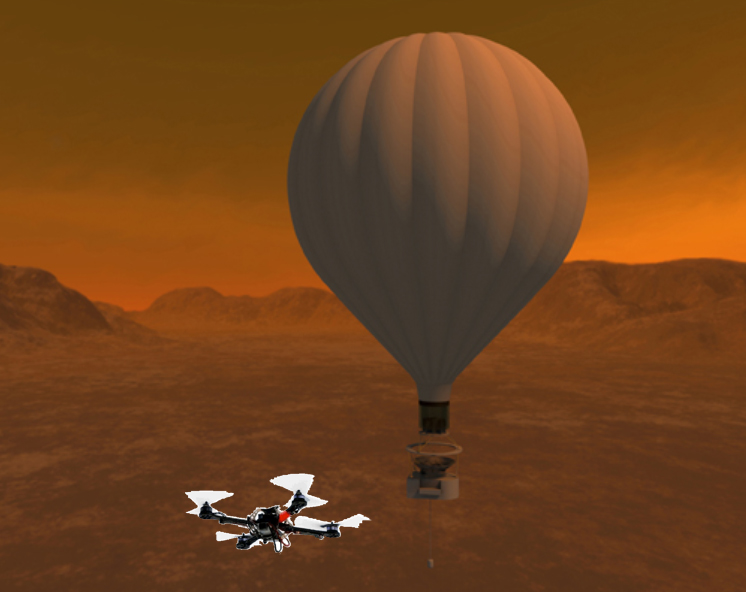
Artist's concept of the Titan Aerial Daughter (TAD) quadcopter and its "Mothership" balloon. Credit: NASA/STMD
Such surveys are used on Earth routinely to characterize the materials in the near subsurface, or for the sake of mineral exploration. But on other planets and moons, they could help shed on light on some of the deeper mysteries, which include whether or not they could support life. This is especially the case on moons like Europa, Ganymede, Enceladus, and Titan.
Currently, there are proposals in place for the aerial exploration of Titan. These include concepts like the Aerial Vehicle for In-situ and Airborne Titan Reconnaissance (AVIATR), the Titan Aerial Daughtercraft (TAD), and the "Dragonfly". There's also the Mars Helicopter "Scout", a vehicle that would use two coaxial counter-rotating blades to explore Mars' atmosphere (and which is expected to launch as part of the Mars 2020 mission).
Planetary Magnetospheres:
Magnetometers could also be used to help resolve some enduring mysteries in the study of magnetospheres. For instance, planetary magnetospheres are highly dynamic, and it can be difficult to distinguish between phenomena that are time-dependent or spatially-dependent - i.e. magnetic reconnection, escaping atmospheric plasma structures, and plasma waves.
By deploying multiple spacecraft of small groups of CubeSats equipped with magnetometers (and plasma spectrometers), it would be possible to more fully address how planetary magnetospheres work. Such missions have been conducted around Earth for the sake of measuring Earth's magnetic field, as part of geologic surveys, and to measure the interaction between solar wind and Earth's magnetosphere.
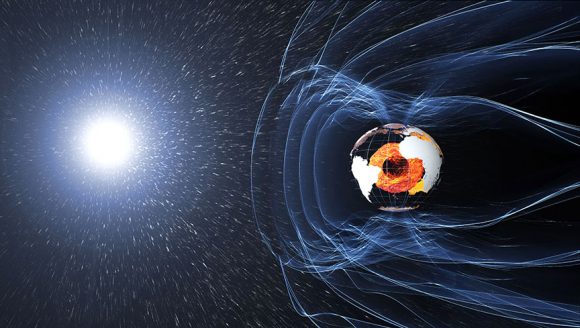
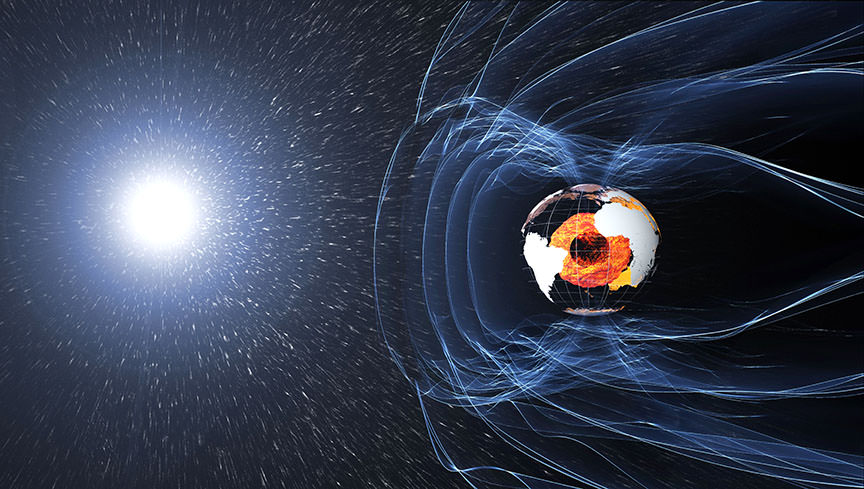
The magnetic field and electric currents in and around Earth generate complex forces that have immeasurable impact on every day life. Credit: ESA/ATG medialab
In addition, missions to other planets have been conducted that made use of magnetometers. A three-axis fluxgate magnetometer was part of the Mariner 2 and Mariner 10 missions (which explored Venus and Mercury), and the MESSENGER mission to Mercury. A dual technique magnetometer was also part of the Cassini-Huygens mission to explore Saturn. And the returns on these missions show how future missions could be of equal value.
Ice Giants:
Neptune and Uranus are known to have powerful and unique magnetospheres, possessing dipoles that are strongly tilted relative to their rotational axes. However, not much effort has been directed into studying them and determining why this is the case. As such, a Flagship mission that could explore and measure their fields using magnetometers would be of major scientific value.
Ocean Worlds:
The study of Europa, Enceladus, Titan, and other moons are likely to be a major undertaking in the coming decades. In fact, it was a major theme at the Planetary Science Vision 2050 Workshop, which featured presentations from the Europa Lander Mission Concept Team and the Roadmaps to Ocean Worlds (ROW) team. These mission will be dedicated to finding extra-terrestrial life in our Solar System and learning more about its formation.
And as Espley indicated, magnetometry could play a key role in these missions. For starters, they would allow missions to measure the depth and location of the potentially-habitable subsurface oceans these moon's are known (or suspected) to have. In addition, such a mission to Ganymede could help characterize its magnetic field, which would be of immense scientific value since it is the only non-gas giant other than Earth known to have one.
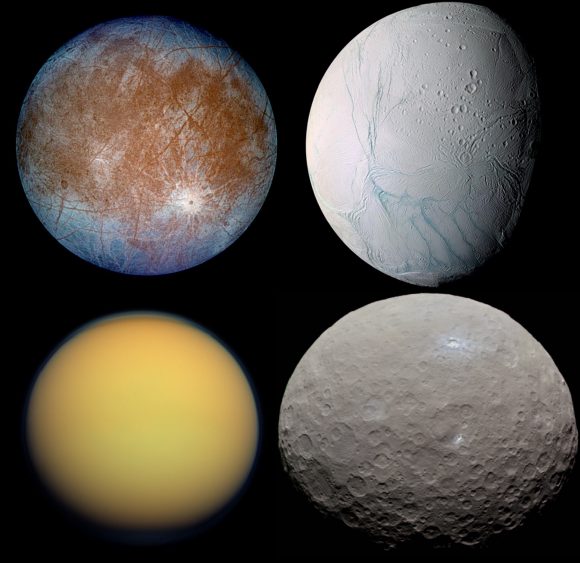
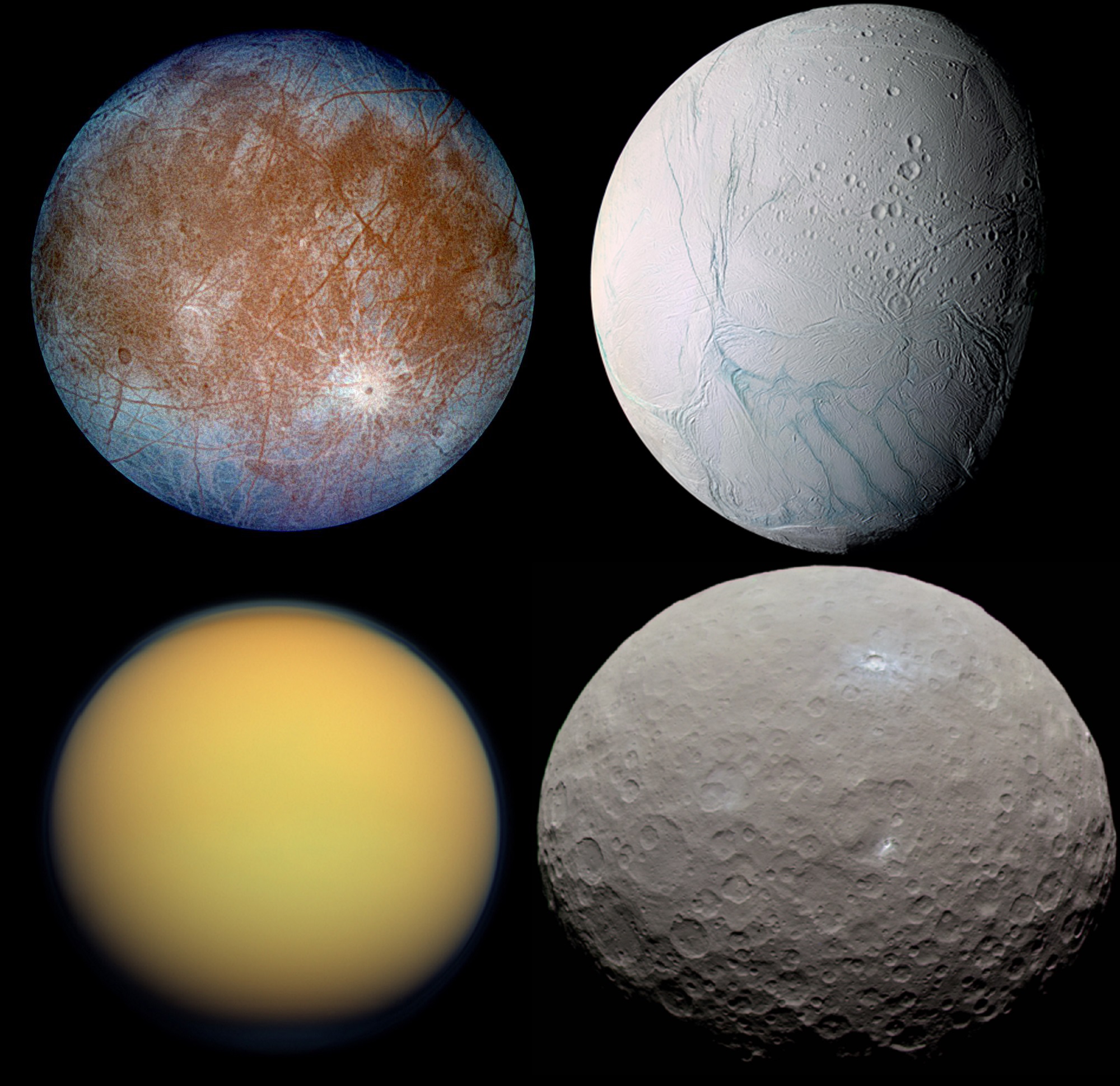
A montage of some of the "ocean worlds" in our Solar System. From top to bottom, left to right, these include Europa, Enceladus, TItan and Ceres. Credit: NASA/JPL
While such missions are already being considered for Europa, Titan is also likely to become a research destination in the coming decades. Other "ocean worlds" - like Triton, Pluto, Ceres and Dione - are likely to follow before long as well. And as Espley explained, the benefits for exploration go well beyond the Solar System:
"The magnetometers that we use to measure magnetic fields in space are relatively robust, cheap, and reliable, especially given the wide variety of science questions we can address with them. Any Solar System mission that can accommodate a magnetometer should include one. Most of exoplanet research is currently focused on remote observing of these distant worlds whereas most of Solar System magnetometry is focused on measurements in the local environment. Nonetheless as we better understand how planets in our Solar System work this is vitally important for interpreting what we see in other solar systems."
Being able to study the magnetic fields of other planets directly is certainly a long way off. But long before we can mount missions to other system and examine them up close, the study of planetary magnetic fields could help us to determine which of the many exoplanets we have discovered in recent years could be habitable. If nothing else, it might cut down on the time we spend doing follow-up investigation (like searching for radio signals).
Further Reading: USRA


 Posts
Posts