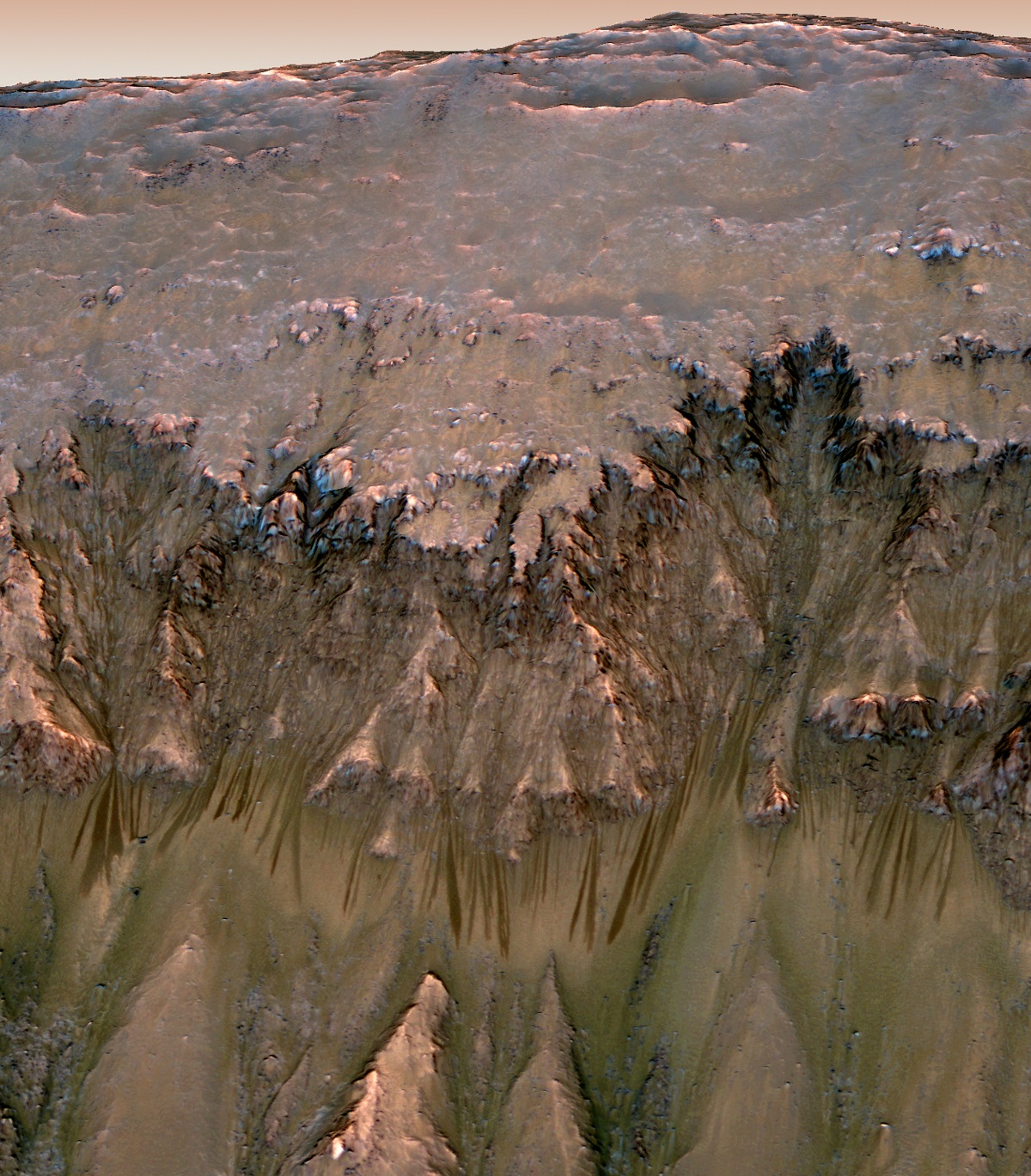
It's a well-documented fact that roughly 4 billion years ago, Mars had liquid water flowing on its surface. However, there have also been recent findings that suggest that Mars might periodically have liquid water on its surface today. One of the strongest bits of evidence comes in the form of Recurring Slope Lineae, which are ventured to be seasonal flows of salty water which occur during Mars' warmest months.
However, a new study produced by an international team of scientists has casts doubt on this theory and offered another possible explanation. Using numerical simulations, they show how a "dry" process - where rarefied gas is pumped up through the soil (due to temperature variations) - could lead to the formation of the dark streaks that have been observed on Martian slopes.
Their study, titled "Formation of recurring slope lineae on Mars by rarefied gas-triggered granular flows", appeared recently in the journal Nature Geoscience. In it, the research team - which hails from the Géosciences Paris Sud (GEOPS) laboratory in Orsay, France, and the Slovak Academy of Sciences in Bratislava- explain how the current theories about what creates RSLs fall short.
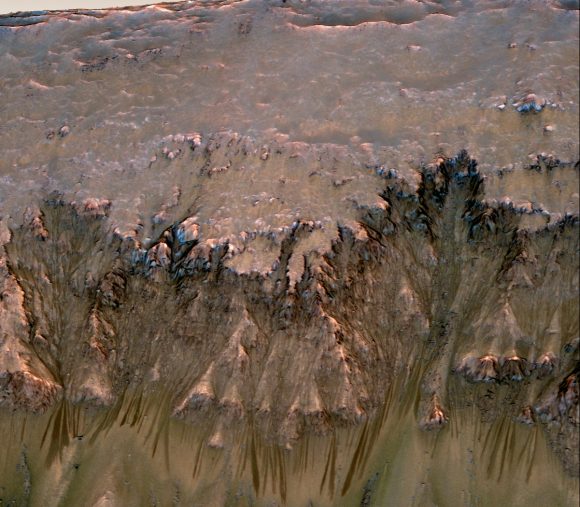
Reprojected view of warm-season flows in Newton Crater. Credit: NASA/JPL-Caltech/Univ. of Arizona
As Frédéric Schmidt, a professor from GEOPS and the lead author of the study told Universe Today via email, the current theory about RSLs is based on the morphology, composition and seasonality of lineae which in the past, seemed to suggest that liquid salt water played a role in their formation:
"They attributed the appearance to liquid water mainly because of seasonality and salt detection. The activity occurs at the maximum temperature season only, in the most favorable condition for water to be liquid. The salt permits to decrease the freezing temperature of liquid water."
This theory has met with its share of excitement, considering that the presence of water on the Martian surface would mean that the chances of finding present-day life there would be significantly greater. Unfortunately, recent studies have cast doubt on this by showing how there is insufficient water on Mars to account for the lineae that have been observed on various slopes.
"[T]here is not enough atmospheric water to fill all the dark flows and internal subsurface sources are very unlikely (Chojnacki et al., 2016)," said Dr. Schmidt. "Also, because there is no signature in the thermal range as one may have in the case of abundant liquid water. From the data, the maximum allowed water is too little (Edwards et al., 2016)."
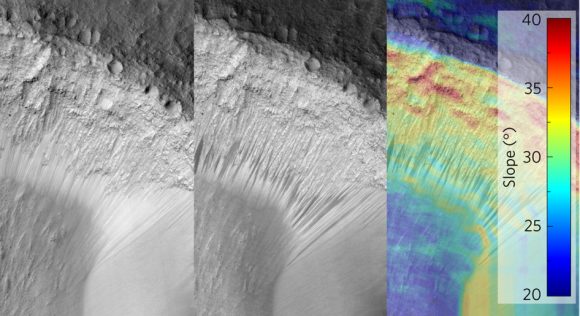
Evolution of RSL at Garni Crater, Valles Marineris, Mars. Credit: MRO, HiRISE, NASA/JPL/University of Arizona
However, Mars does have sufficient air pressure to allow for another process known as thermal creep. Also known as thermal transpiration, this process involves gas molecules drifting from the cold end of a narrow channel to the warm end. This occurs as a result of the walls of the channel experiencing temperature changes, which triggers a gas flow.
According to their study, sections of the Martian surface could be heated by solar radiation while others remained cooler because they were covered by a source of shade. When this happens, rarefied gas beneath the surface (i.e. gas with lower pressure than the atmosphere) could be pumped up through the Martian soil. Once it reached the surface, this gas would disturb patches of small particles, triggering tiny avalanches along Martian slopes.
To test this "dry" process of RSL formation, the team ran numerical simulations that took into account various locations on Mars and seasonal changes. "We tested our theory by modeling it and estimating its efficiency for different facet orientation and different seasons," said Dr. Schmidt. "We find that the observed activity is coherent with our prediction. Also we simulated it in the lab in order validate the principle.
Basically, they found that in rough and boulder-strewn terrain on Mars (where shadows are cast that can cause temperature differences in small sections of soil) this process could result in the formation of dark streaks along slopes. Not only were their results consistent with observered RSLs in some areas, but they also explained how they could form without the need for liquid water or CO² frost (dry ice) activity.
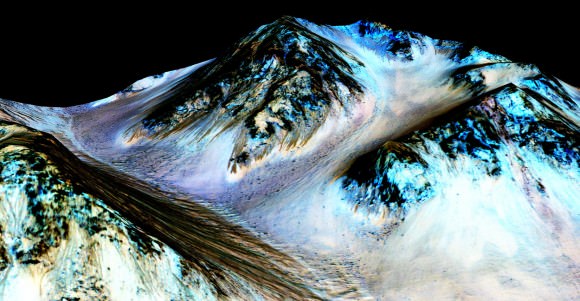
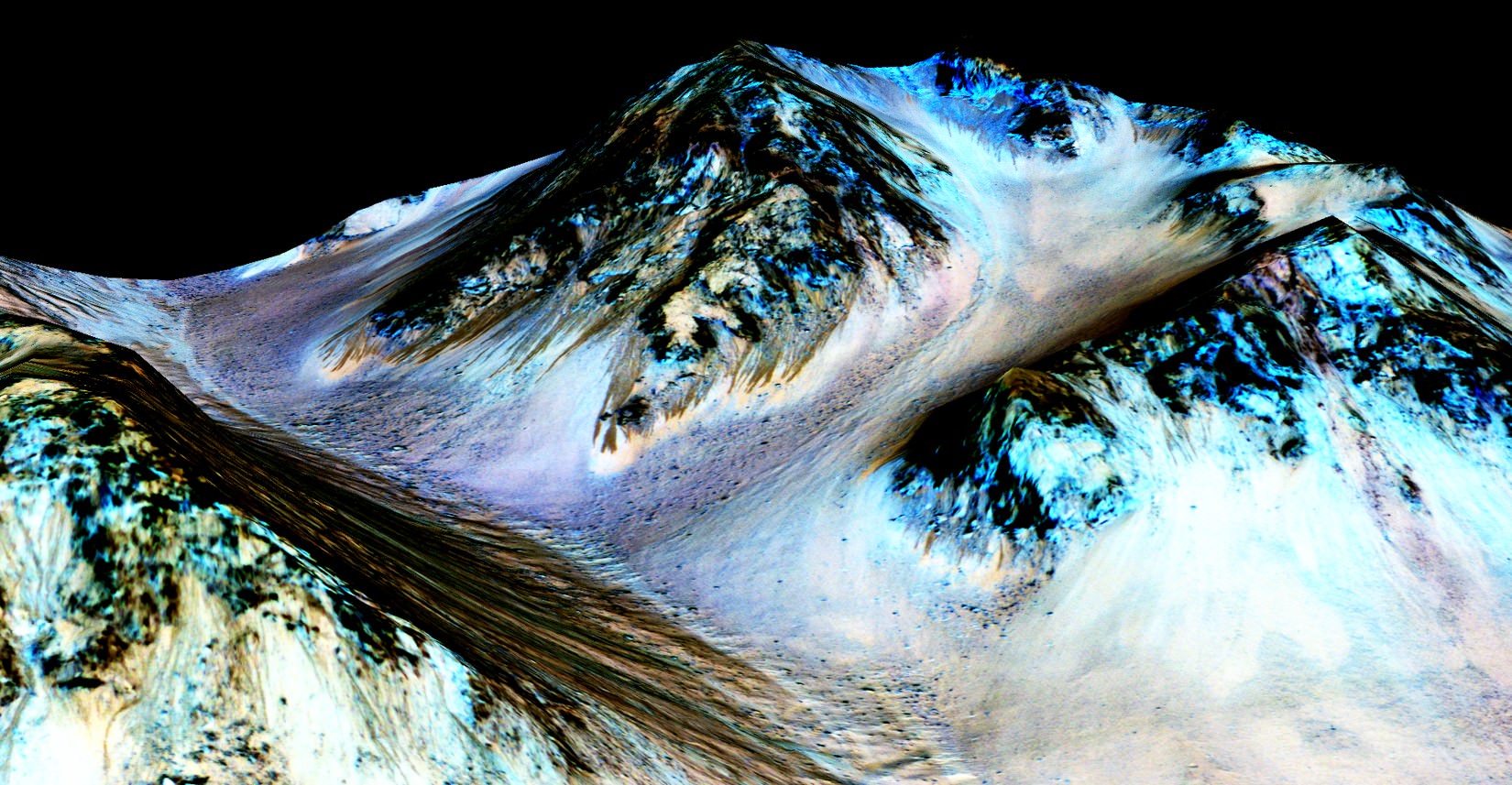
Simulation of the 100 meter-long recurring slope lineae detected on the Hale crater, produced by the High Resolution Imaging Science Experiment (University of Arizona). Credits: NASA/JPL/University of Arizona
This may sound like bad news, and it certainly is if you're planning on establishing a settlement on Mars anytime soon (Elon Musk and Bas Lansdorp might want to take heed!). And as Dr. Schmidt explained, it doesn't bode well for those who are looking to confirm that there could be present-day life on Mars either:
"Since RSL are the main features to argue about the presence of liquid water at present time on Mars, it was also the argument for possible habitability and life on Mars. If the new theory is correct, the present Mars is not as habitable as we previously thought. Liquid water was most probably present billions of years ago, but not today. These findings paint the portrait of an inhospitable world for human exploration."
So it seems that the prospect of water-procurement on Mars might be trickier than we thought. Perhaps future missions to the surface that rely on in-situ resource utilization (ISRU) will either have to drill for water, or harvest it directly from the ice caps. And as for full-blown colonization plans... well, let's hope they don't mind drilling wells or chopping ice either!
Further Reading: Nature Geoscience


 Posts
Posts