| Last week, a team from the NOC laid a mooring with Myrtle-X and a pair of acoustic modems off Gran Canaria to test remote data gathering for the RAPID array, and this week two Wavegliders were deployed in the same spot. The RAPID moorings are out in the Atlantic for up to 18 months at a time, and the Waveglider 'Sennen' will go out several times per year to harvest the data and check on the status of the mooring. Myrtle-X will release pods that transmit the data back from the more remote moorings. Unfavourable weather in the Canaries had delayed this trial deployment, but a prolonged break meant that the NOC teams from both Southampton and Liverpool could get the mooring laid, and this week the team got the two Wavegliders 'Sennen' and 'Waimea' in the water. The NOC was working with colleagues from PLOCAN based at Taliarte harbour. The mooring and Wavegliders will stay out for a further two weeks, depending on the weather. Follow live robotic vehicle deployments on our website at https://mars.noc.ac.uk/ 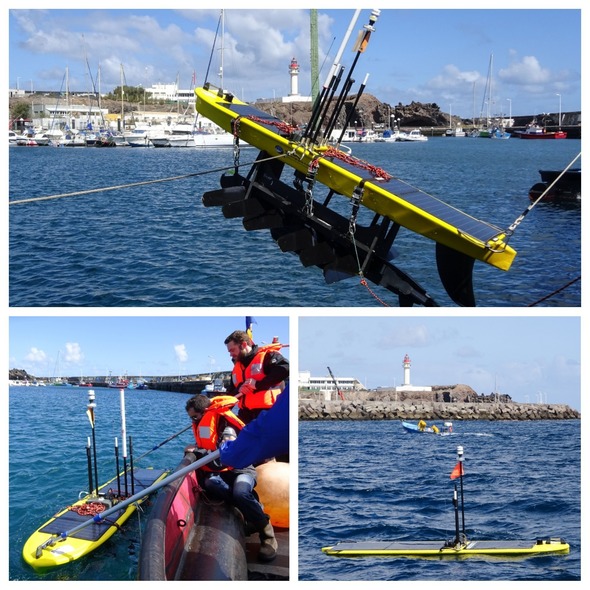 Photographs courtesy of PLOCAN 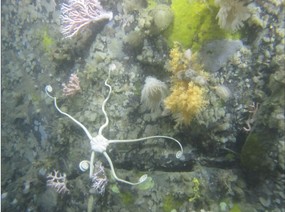 In an era where huge expanses of ocean are being designated as Marine Protected Areas (MPAs), the importance of mapping the seabed to collect baseline data and monitor change is vital. New results from an MPA around South Georgia, published this week by NOC, BAS and University of Southampton scientists, demonstrate that seabed mapping over very large areas of ocean can assist in marine planning and conservation, especially in UK Overseas Territories and other remote regions with sparse data. Read more on our website by clicking here, or click here to read the paper, published in the journal Science of the Total Environment. |
| NOC scientists working on the GOCART project this week successfully deployed submarine gliders 'Doombar' and 'Grease' in the Benguela current off of RV Mirabilis. GOCART uses autonomous marine technology to study sinking particles and carbon fluxes. Follow the team on Twitter for the all latest updates. | | 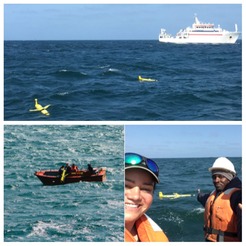 |
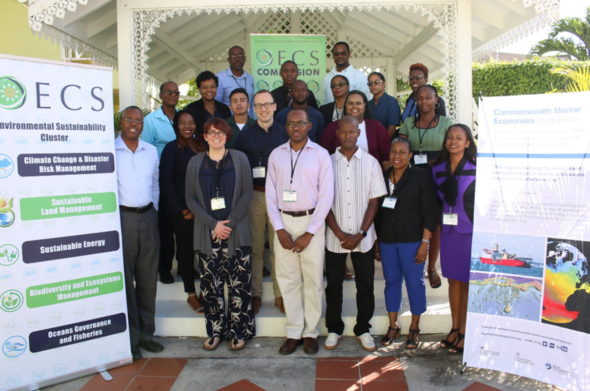 This week, marine data specialists from the NOC were in St Lucia running a Data Management Workshop for environmental organisations across the Caribbean region. Participants are now equipped to improve current data collection processes in their respective organisations and facilitate the efficient use of marine data across a range of sectors, thereby enhancing the economic return of the investment in data collection. This two-day workshop, hosted by the Organisation of Eastern Caribbean States Commission, was delivered by the Marine Environmental Data and Information Network as part of the UK Government's Commonweath Marine Economies Programme. 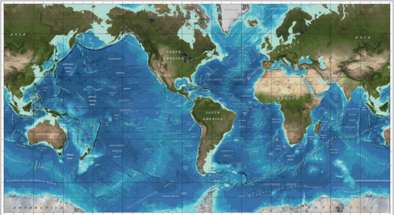 The Nippon Foundation this week announced that the Nippon Foundation-GEBCO (General Bathymetric Chart of the Oceans) Seabed 2030 project is now underway. Seabed 2030 aims to map the entirety of the ocean floor by 2030. It will compile all available and newly collected bathymetric data into a single high-quality, high-resolution digital model of the ocean floor and promote international collaborative efforts to collect new data. The NOC will serve as the Global Centre, supported by four Regional Centres, each with responsibility for mapping a region of the world's oceans. The NOC will integrate the regional grids into a global map and distribute the data to end users around the world. It will also act as the central point for the coordination of common data standards and processing tools. Image reproduced from the GEBCO world map 2014, www.gebco.net |
Last week, at the American Geophysical Union's Ocean Sciences meeting NOC scientists presented the first data from an array of instruments moored in the subpolar North Atlantic, as well as the latest results from the RAPID array at 26°N across the Atlantic. Observations from the former array, as part of the UKOSNAP project, reveal that currents east of Greenland contribute the most to strong variability in one of the world's largest systems of ocean currents, the Atlantic Meridional Overturning Circulation (AMOC). The RAPID program findings show that the AMOC has weakened by about 15% compared with its 2004-08 level. NOC scientists Dr David Smeed said: "Variability of the AMOC has many climate impacts from European weather to hurricanes to droughts in the African Sahel. So continued monitoring and understanding of these changes is very important". Read more about this in the articles written on this subject in Nature and Science: www.sciencemag.org/news/2018/02/ocean-array-alters-view-atlantic-conveyor-belt and www.nature.com/articles/d41586-018-02113-y Prof Russell Wynn represented the NOC at a Parliamentary Science and Technology Committee summit on Brexit yesterday (Thursday 22 February). A recording of the session is available on the parliament website. It was also covered in Science magazine, and the conversation continues on Twitter using the hashtag #brexitsciencesummit. The NOC has submitted formal written evidence to the inquiry, which will feed into ongoing discussions about how to mitigate risks and exploit opportunities for UK science, research and innovation after Brexit. The Committee aims to present the results at the start of the second phase of Brexit negotiations with the EU. | 


 Posts
Posts



No comments:
Post a Comment