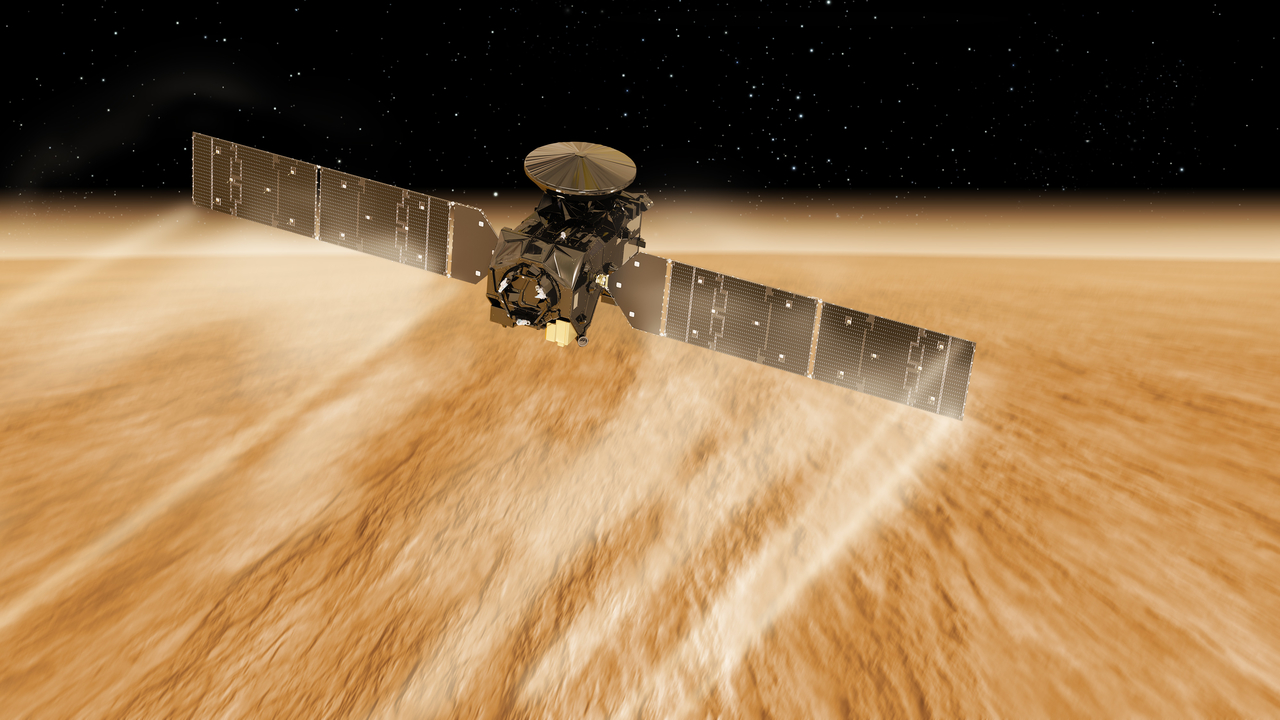
Čas od času váš počítač, tablet nebo chytrý telefon obdrží nový software, který zlepší jeho funkčnost a prodlouží životnost. Nyní takovouto „modernizací" prochází i sonda ESA Mars Express, na kterou je nový software instalovaný skrze propast 150 miliónů kilometrů vesmíru.
Der ExoMars Trace Gas Orbiter hat die ersten Bilder des Roten Planeten aus seiner neuen Umlaufbahn zurückgebracht. Der Satellit kam vor einigen Wochen in einer fast kreisrunden Umlaufbahn von 400 km Höhe an, um Gase zu finden, die mit aktiver geologischer oder biologischer Aktivität auf dem Mars in Verbindung gebracht werden können.
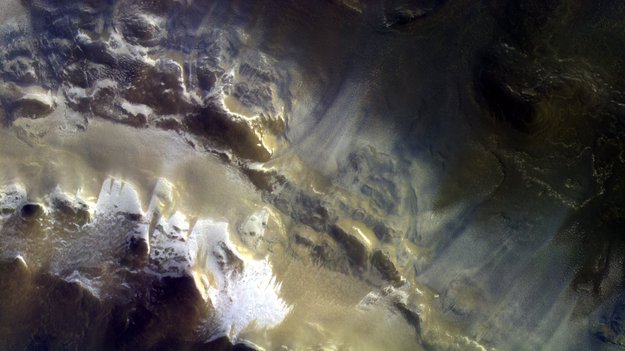
Das Colour and Stereo Surface Imaging System des Orbiters, CaSSIS, hat dieses atemberaubende Bild, das einen Teil eines Einschlagkraters zeigt, während der Testphase des Instruments aufgenommen. Die Kamera wurde am 20. März aktiviert und für den Start ihrer Hauptmission am 28. April getestet.
"Wir haben zu Beginn der Testphase neue Software auf das Gerät übertragen und nach einigen kleineren Problemen ist das Gerät in gutem Zustand und einsatzbereit", sagt der Principal Investigator der Kamera, Nicolas Thomas von der Universität Bern in der Schweiz. Das Bild zeigt einen 40 km langen Abschnitt des Korolev-Kraters hoch oben auf der Nordhalbkugel. Das helle Material am Rand des Kraters ist Eis.
"Wir waren sehr erfreut zu sehen, wie gut dieses Bild bei den Lichtverhältnissen war", sagt Antoine Pommerol, ein Mitglied des CaSSIS-Wissenschaftsteams, das an der Kalibrierung der Daten arbeitet. "Es zeigt, dass CaSSIS einen wichtigen Beitrag zur Erforschung der Kohlendioxid- und Wasserkreisläufe auf dem Mars leisten kann."
Das Bild besteht aus drei Bildern in verschiedenen Farben, die fast gleichzeitig am 15. April aufgenommen wurden. "Unser Ziel ist es, den Bildproduktionsprozess vollständig zu automatisieren", sagt Nick. "Wenn wir das erreicht haben, können wir die Daten schnell an die Wissenschaft zur Analyse verteilen."
Das Team sieht in der Zukunft weitere wissenschaftliche Veröffentlichungen vor. Die Kamera des Orbiters ist eines von vier Instrumenten des Trace Gas Orbiter, kurz TGO, in dem auch zwei Spektrometer-Suiten und ein Neutronendetektor untergebracht sind. Die Spektrometer begannen ihre wissenschaftliche Mission am 21. April mit dem ersten "Schnuppern" der Atmosphäre. In Wirklichkeit sind es die Spektrometer, die untersuchen, wie Moleküle in der Atmosphäre Sonnenlicht absorbieren: Jeder hat einen einzigartigen Fingerabdruck, der seine chemische Zusammensetzung offenbart. Eine lange Zeit der Datenerhebung wird nötig sein, um die Details herauszuarbeiten, insbesondere für besonders seltene - oder noch nicht einmal entdeckte - Inhaltsstoffe in der Atmosphäre.
Spurengase sind, wie ihr Name schon sagt, nur in sehr geringen Mengen vorhanden, d.h. weniger als ein Prozent des Volumens der Erdatmosphäre. Insbesondere wird der Orbiter nach Beweisen für Methan und andere Gase suchen, die Signaturen aktiver biologischer oder geologischer Aktivität sein könnten. Die Kamera hilft schließlich bei der Charakterisierung von Merkmalen auf der Oberfläche, die mit Spurengasquellen in Verbindung gebracht werden können.
"Wir freuen uns, mit diesem phänomenalen Raumschiff endlich damit zu beginnen, Daten auf dem Mars zu sammeln", sagt Håkan Svedhem, TGO-Projektwissenschaftler der ESA. "Die Testbilder, die wir bisher gesehen haben, legen die Messlatte hoch."
Der ExoMars Trace Gas Orbiter ist auf einer mehrjährigen Mission, um die winzigen Mengen an Methan und anderen Gasen in der Marsatmosphäre zu verstehen, die Hinweise auf mögliche biologische oder geologische Aktivitäten geben könnten. Spurengas-Orbiter auf dem Mars
Der ExoMars Trace Gas Orbiter hat die ersten Bilder des Roten Planeten aus seiner neuen Umlaufbahn zurückgebracht. Ein Vorgeschmack auf viele weitere Aufnahmen von ExoMars.
Der ExoMars Trace Gas Orbiter (TGO) wird bald mit seiner Suche nach Gasen, die auf geologische oder biologische Aktivitäten auf dem Roten Planeten hinweisen, beginnen.
La apuesta de la ESA por la exploración de Marte tiene en las misiones Mars Express y TGO de ExoMars sus mejores bazas para ofrecer observaciones científicas continuadas y complementarias de dos aspectos clave en el estudio del planeta: la presencia de metano y su climatología y ciclo del agua. Esos han sido dos de los temas tratados en el workshop científico 'De Mars Express a ExoMars' sobre ambas misiones que se ha celebrado en ESAC, y que ha reunido a más de un centenar de científicos no sólo de Europa, sino también de Rusia y la NASA.
Tras la fase de frenado paulatino surcando el borde de la atmósfera de Marte, la misión ExoMars de la ESA ha alcanzado su órbita alrededor del Planeta Rojo y ya está lista para comenzar la búsqueda de metano.
In March of 2016, the European Space Agency (ESA) launched the ExoMars (Exobiology on Mars) mission into space. A joint project between the ESA and Roscosmos, this two-part mission consisted of the Trace Gas Orbiter (TGO) and the Schiaparelli lander, both of which arrived in orbit around Mars in October of 2016. While Schiaparelli crashed while attempting to land, the TGO has gone on to accomplish some impressive feats.
For example, in March of 2017, the orbiter commenced a series of aerobraking maneuvers, where it started to lower its orbit to enter Mars' thin atmosphere and slow itself down. According to Armelle Hubault, the Spacecraft Operations Engineer on the TGO flight control team, the ExoMars mission has made tremendous progress and is well on its way to establishing its final orbit around the Red Planet.
TGO's mission has been to study the surface of Mars, characterize the distribution of water and chemicals beneath the surface, study the planet's geological evolution, identify future landing sites, and to search for possible biosignatures of past Martian life. Once it has established its final orbit around Mars - 400 km (248.5 mi) from the surface - the TGO will be ideally positioned to conduct these studies.
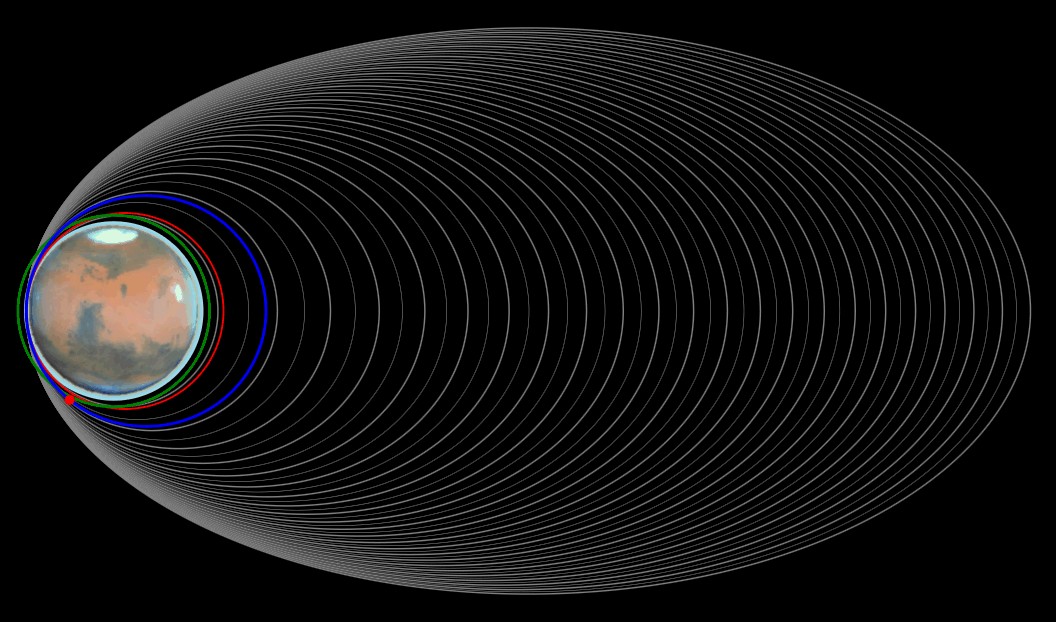
Visualization of the ExoMars mission's Trace Gas Orbiter conducting aerobraking maneuvers to March of 2018. Credit: ESA
The ESA also released a graphic (shown above) demonstrating the successive orbits the TGO has made since it began aerobraking - and will continue to make until March of 2018. Whereas the red dot indicates the orbiter (and the blue line its current orbit), the grey lines show successive reductions in the TGO's orbital period. The bold lines denote a reduction of 1 hour while the thin lines denote a reduction of 30 minutes.
Essentially, a single aerobraking maneuver consist of the orbiter passing into Mars' upper atmosphere and relying on its solar arrays to generate tiny amounts of drag. Over time, this process slows the craft down and gradually lowers its orbit around Mars. As Armelle Hubault recently posted on the ESA's rocket science blog:
"We started on the biggest orbit with an apocentre (the furthest distance from Mars during each orbit) of 33 200 km and an orbit of 24 hr in March 2017, but had to pause last summer due to Mars being in conjunction. We recommenced aerobraking in August 2017, and are on track to finish up in the final science orbit in mid-March 2018. As of today, 30 Jan 2018, we have slowed ExoMars TGO by 781.5 m/s. For comparison, this speed is more than twice as fast as the speed of a typical long-haul jet aircraft."
Earlier this week, the orbiter passed through the point where it made its closest approach to the surface in its orbit (the pericenter passage, represented by the red line). During this approach, the craft dipped well into Mars' uppermost atmosphere, which dragged the aircraft and slowed it down further. In its current elliptical orbit, it reaches a maximum distance of 2700 km (1677 mi) from Mars (it's apocenter).
Visualization of the ExoMars Trace Gas Orbiter aerobraking at Mars. Credit: ESA/ATG medialab
Despite being a decades-old practice, aerobraking remains a significant technical challenge for mission teams. Every time a spacecraft passes through a planet's atmosphere, its flight controllers need to make sure that its orientation is just right in order to slow down and ensure that the craft remains stable. If their calculations are off by even a little, the spacecraft could begin to spin out of control and veer off course. As Hubault explained:
"We have to adjust our pericentre height regularly, because on the one hand, the martian atmosphere varies in density (so sometimes we brake more and sometimes we brake less) and on the other hand, martian gravity is not the same everywhere (so sometimes the planet pulls us down and sometimes we drift out a bit). We try to stay at about 110 km altitude for optimum braking effect. To keep the spacecraft on track, we upload a new set of commands every day – so for us, for flight dynamics and for the ground station teams, it's a very demanding time!"
The next step for the flight control team is to use the spacecraft's thrusters to maneuver the spacecraft into its final orbit (represented by the green line on the diagram). At this point, the spacecraft will be in its final science and operation data relay orbit, where it will be in a roughly circular orbit about 400 km (248.5 mi) from the surface of Mars. As Hubault wrote, the process of bringing the TGO into its final orbit remains a challenging one.
"The main challenge at the moment is that, since we never know in advance how much the spacecraft is going to be slowed during each pericentre passage, we also never know exactly when it is going to reestablish contact with our ground stations after pointing back to Earth," she said. "We are working with a 20-min 'window' for acquisition of signal (AOS), when the ground station first catches TGO's signal during any given station visibility, whereas normally for interplanetary missions we have a firm AOS time programmed in advance."
Artist's impression of the ESA's Exomars 2020 rover, which is expected to land on the surface of Mars by the Spring of 2o21. Credit:ESA
With the spacecraft's orbital period now shortened to less than 3 hours, the flight control team has to go through this exercise 8 times a day now. Once the TGO has reached its final orbit (by March of 2018), the orbiter will remain there until 2022, serving as a telecommunications relay satellite for future missions. One of its tasks will be to relay data from the ESA's ExoMars 2020 mission, which will consist of a European rover and a Russian surface platform being deployed the surface of Mars in the Spring of 2021.
Along with NASA's Mars 2020 rover, this rover/lander pair will be the latest in a long line of robotic missions looking to unlock the secrets of Mars past. In addition, these missions will conduct crucial investigations that will pave the way for eventual sample return missions to Earth, not to mention crewed to the surface!
Mars modern landscape is something of a paradox. It's many surface features are very similar to those on Earth that are caused by water-borne erosion. But for the life of them, scientists cannot imagine how water could have flown on Mars' cold and desiccated surface for most of Mars' history. Whereas Mars was once a warmer, wetter place, it has had a very thin atmosphere for billions of years now, which makes water flow and erosion highly unlikely.
In fact, while the surface of Mars periodically becomes warm enough to allow for ice to thaw, liquid water would boil once exposed to the thin atmosphere. However, in a new study led by an international team of researchers from the UK, France and Switzerland, it has been determined that a different kind of transport process involving the sublimation of water ice could have led to the Martian landscape becoming what it is today.
The study, which was led Dr. Jan Raack - a Marie Sklodowska-Curie Research Fellow at The Open University - was recently published in the scientific journal Nature Communications. Titled "Water Induced Sediment Levitation Enhances Downslope Transport on Mars", this research study consisted of experiments that tested how processes on Mars' surface could allow water transport without it being in liquid form.
Reull Vallis, the river-like structure captured by the ESA's Mars Express probe, is believed to have formed when running water flowed in the distant martian past. Credit and copyright: ESA/DLR/FU Berlin (G. Neukum)
To conduct their experiments, the team used the Mars Simulation Chamber, an instrument at The Open University that is capable of simulating the atmospheric conditions on Mars. This involved lowering the atmospheric pressure inside the chamber to what is normal for Mars - about 7 mbar, compared to 1000 mbar (1 bar or 100 kilopascals) here on Earth - while also adjusting temperatures.
On Mars, temperatures range from a low of -143 °C (-255 °F) during winter at the poles to a high of 35 °C (95 °F) at the equator during midday in the summer. Having recreated these conditions, the team found that when water ice exposed to the simulated Martian atmosphere, it would not simply melt. Instead, it would become unstable and begin violently boiling off.
However, the team also found that this process would be capable of moving large amounts of sand and sediment, which would effectively "levitate" on the boiling water. This means that, compared to Earth, relatively small amounts of liquid water are capable of moving sediment across the surface of Mars. These levitating pockets of sand and debris would be capable of forming tje large dunes, gullies, recurring slope lineae, and other features observed on Mars.
In the past, scientists have indicated how these features were the result of sediment transportation down slopes, but were unclear as to the mechanisms behind them. As Dr. Jan Raack explained in a OUNews press release:
"Our research has discovered that this levitation effect caused by boiling water under low pressure enables the rapid transport of sand and sediment across the surface. This is a new geological phenomenon, which doesn't happen on Earth, and could be vital to understanding similar processes on other planetary surfaces."
Illustration of the ESA Exomars 2020 Rover, which will explore the Red Planet in search for signs of ancient life. Credit:ESA
Through these experiments, Dr. Raack and his colleagues were able to shed light on how conditions on Mars could allow for features that we tend to associate with flowing water here on Earth. In addition to helping to resolve a somewhat contentious debate concerning Mars' geological history and evolution, this study is also significant when it comes to future exploration missions.
Dr. Raack acknowledges the need for more research to confirm their study's conclusions, and indicated that the ESA's ExoMars 2020 Rover will be well-situated to conduct it once it is deployed :
"This is a controlled laboratory experiment, however, the research shows that the effects of relatively small amounts of water on Mars in forming features on the surface may have been widely underestimated. We need to carry out more research into how water levitates on Mars, and missions such as the ESA ExoMars 2020 Rover will provide vital insight to help us better understand our closest neighbour."


 Posts
Posts