Studování původu planet obíhajících hvězdy v jiných soustavách bude cílem čtvrté vědecké mise ESA střední třídy, s jejímž startem se počítá v roce 2028.
April 11, 2018 MEDIA ADVISORY M18-059 NASA Television to Air Launch of Next Planet-Hunting Mission
NASA's Transiting Exoplanet Survey Satellite (TESS) is set to launch on a SpaceX Falcon 9 rocket from Space Launch Complex 40 at Cape Canaveral Air Force Station in Florida no earlier than April 16, 2018. Once in orbit, TESS will spend about two years surveying 200,000 of the brightest stars near the sun to search for planets outside our solar system.
Credits: NASA
On a mission to detect planets outside of our solar system, NASA's Transiting Exoplanet Survey Satellite (TESS) is scheduled to launch no earlier than 6:32 p.m. EDT Monday, April 16. Prelaunch mission coverage will begin on NASA Television and the agency's website Sunday, April 15, with three live briefings.
TESS is NASA's next step in the search for planets outside of our solar system, known as exoplanets, including those that could support life. The mission is expected to catalog thousands of planet candidates and vastly increase the current number of known exoplanets. TESS will find the most promising exoplanets orbiting relatively nearby stars, giving future researchers a rich set of new targets for more comprehensive follow-up studies, including the potential to assess their capacity to harbor life.
NASA TV coverage is as follows:
Sunday, April 15
11 a.m. – NASA Social Mission Overview
Martin Still, TESS program scientist at NASA Headquarters
Tom Barclay, TESS scientist at NASA's Goddard Space Flight Center
Jenn Burt, Torres postdoctoral fellow at the Massachusetts Institute of Technology (MIT)
Zach Berta-Thompson, assistant professor at the University of Colorado, Boulder
Natalia Guerrero, TESS researcher at MIT
Robert Lockwood, TESS spacecraft program manager with Orbital ATK
Hans Koenigsmann, vice president of Build and Flight Reliability at SpaceX
Jesse Christiansen, staff scientist with the NASA Exoplanet Science Institute at Caltech
Elisa Quintana, TESS scientist at Goddard
1 p.m. – Prelaunch news conference
Sandra Connelly, deputy associate administrator of programs for NASA's Science Mission Directorate
Omar Baez, launch director for NASA's Launch Services Program
Jeff Volosin, TESS project manager at Goddard
Mike McAleenan, weather officer with the U.S. Air Force 45th Weather Squadron
Robert Lockwood
Hans Koenigsmann
3 p.m. – Science news conference
Paul Hertz, Astrophysics division director at NASA Headquarters
George Ricker, TESS principal investigator at MIT
Padi Boyd, TESS Guest Investigator Program lead at Goddard
Stephen Rinehart, TESS project scientist at Goddard
Diana Dragomir, postdoctoral fellow at MIT
Monday, April 16
10 a.m. – NASA EDGE: TESS
This half-hour live show will discuss the TESS spacecraft, the science of searching for planets outside our solar system, and the launch from Cape Canaveral.
6 p.m. – Launch coverage begins
6:32 p.m. – Launch
TESS will launch on a SpaceX Falcon 9 rocket from Space Launch Complex 40 at Cape Canaveral Air Force Station in Florida. The deadline for media accreditation for this launch has passed. For information about media accreditation, contact ksc-media-accreditat@mail.nasa.gov.
For the latest schedule of prelaunch briefings, events and NASA TV coverage, visit:
Since it's discovery was announced in August of 2016, Proxima b has been an endless source of wonder and the target of many scientific studies. As the closest extra-solar planet to our Solar System - and a terrestrial planet that orbits within Proxima Centauri's circumstellar habitable zone (aka. "Goldilocks Zone") - scientists have naturally wondered whether or not this planet could be habitable.
Unfortunately, many of these studies have emphasized the challenges that life on Proxima b would likely face, not the least of which is harmful radiation from its star. According to a recent study, a team of astronomers used the ALMA Observatory to detect a large flare emanating from Proxima Centauri. This latest findings, more than anything, raises questions about how habitable its exoplanet could be.
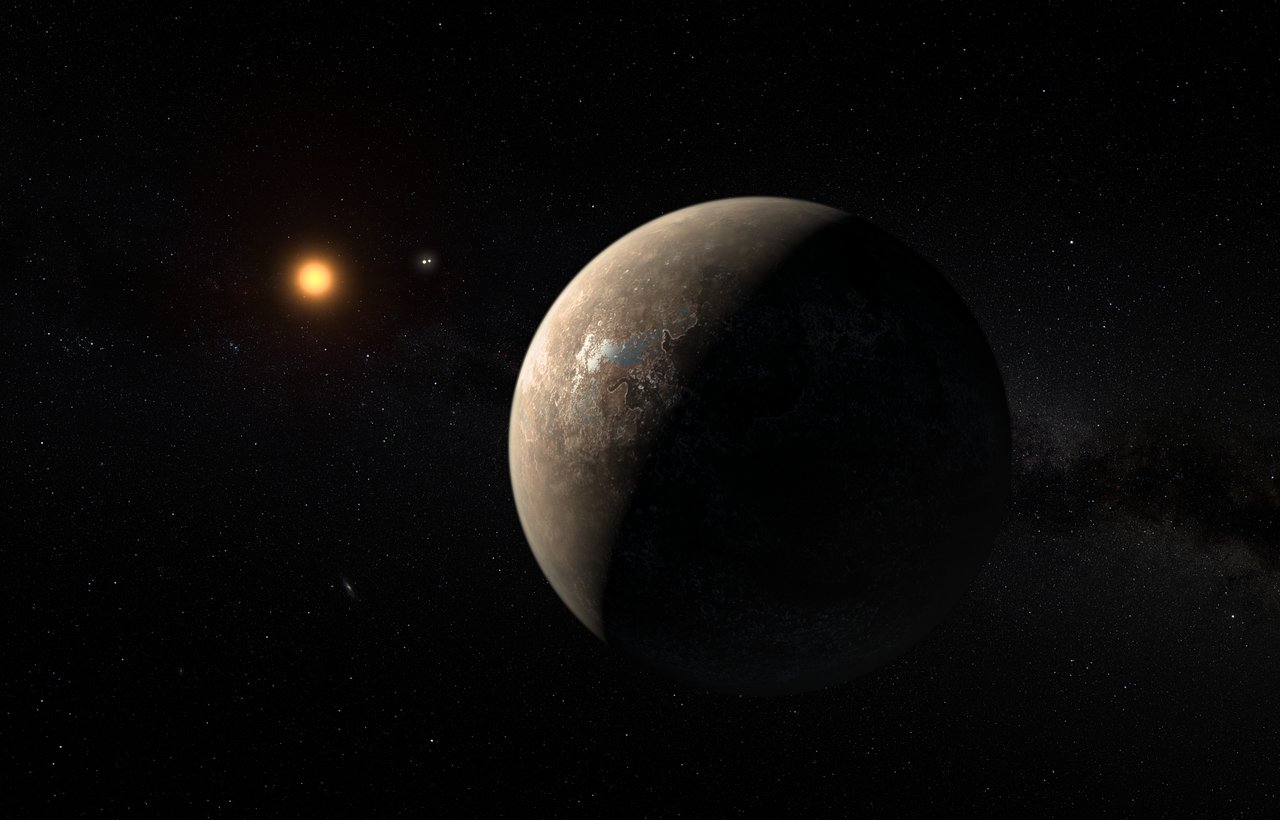
Artist's impression of Proxima b, which was discovered using the Radial Velocity method. Credit: ESO/M. Kornmesser
For the sake of their study, the team used data obtained by the Atacama Large Millimeter/submillimeter Array (ALMA) between January 21st to April 25th, 2017. This data revealed that the star underwent a significant flaring event on March 24th, where it reached a peak that was 1000 times brighter than the star's quiescent emission for a period of ten seconds.
Astronomers have known for a long time that when compared to stars like our Sun, M-type stars are variable and unstable. While they are the smallest, coolest, and dimmest stars in our Universe, they tend to flare up at a far greater rate. In this case, the flare detected by the team was ten times larger than our Sun's brightest flares at similar wavelengths.
Along with a smaller preceding flare, the entire event lasted fewer than two minutes of the 10 hours that ALMA was observing the star between January and March of last year. While it was already known that Proxima Centauri, like all M-type stars, experiences regular flare activity, this one appeared to be a rare event. However, stars like Proxima Centauri are also known to experienced regular, although smaller, X-ray flares.
All of this adds up to a bad case for habitability. As MacGregor explained in a recent NRAO press statement:
"It's likely that Proxima b was blasted by high energy radiation during this flare. Over the billions of years since Proxima b formed, flares like this one could have evaporated any atmosphere or ocean and sterilized the surface, suggesting that habitability may involve more than just being the right distance from the host star to have liquid water."
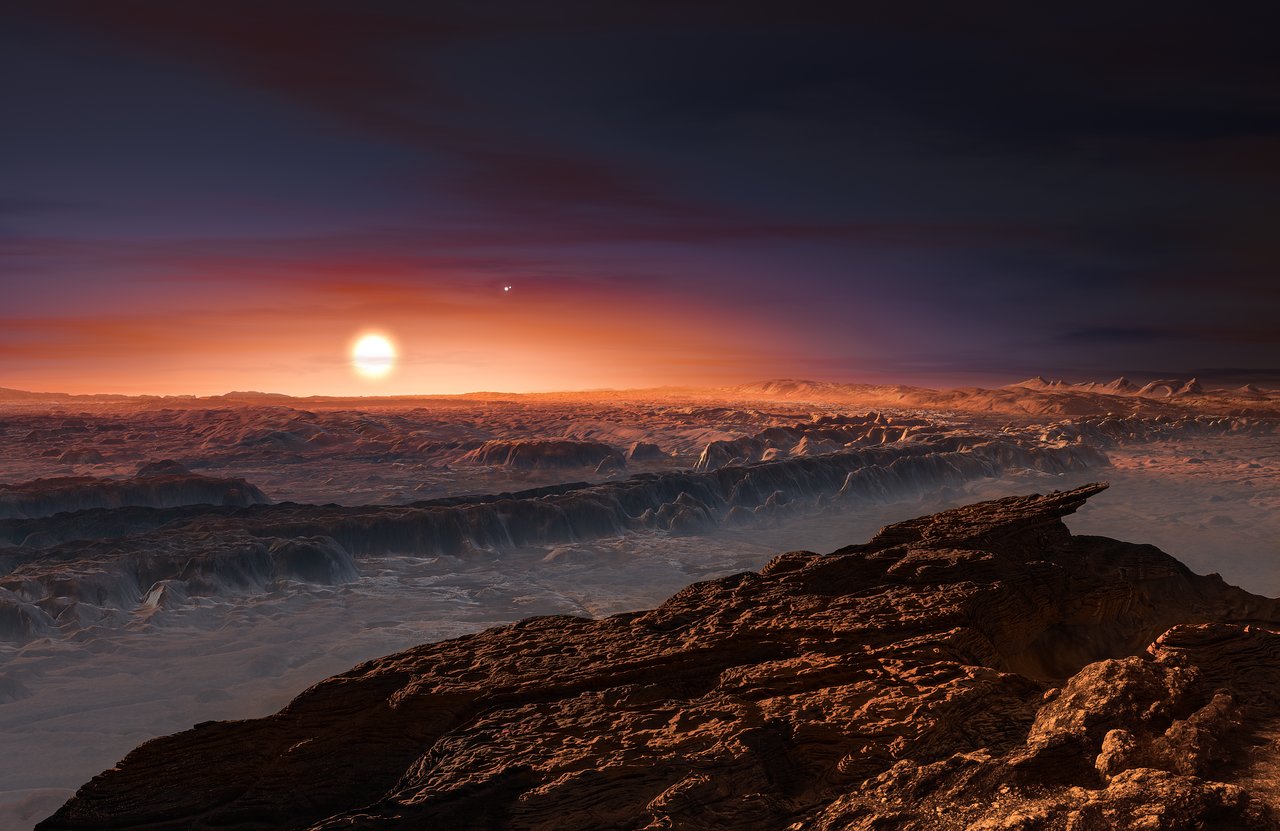
Artist's impression of the surface of the planet Proxima b orbiting the red dwarf star Proxima Centauri. The double star Alpha Centauri AB is visible to the upper right of Proxima itself. Credit: ESO
MacGregor and her colleagues also considered the possibility that Proxima Centauri is circled by several disks of dust. This was suggested by a previous study (also based on ALMA data) that indicated that the light output of both the star and flare together pointed towards the existence of debris belts around the star. However, after examining the ALMA data as a function of observing time, they were able to eliminate this as a possibility.
As Alycia J. Weinberger, also a researcher with the Carnegie Institution for Science and a co-author on the paper, explained:
"There is now no reason to think that there is a substantial amount of dust around Proxima Cen. Nor is there any information yet that indicates the star has a rich planetary system like ours."
To date, studies that have looked at possible conditions on Proxima b have come to different conclusions as to whether or not it could retain an atmosphere or liquid water on its surface. While some have found room for "transient habitability" or evidence of liquid water, others have expressed doubt based on the long-term effects that radiation and flares from its star would have on a tidally-locked planet.
In the future, the deployment of next-generation instruments like the James Webb Space Telescope are expected to provide more detailed information on this system. With precise measurements of this star and its planet, the question of whether or not life can (and does) exist in this system may finally be answered.
And be sure to enjoy this animation of Proxima Centauri in motion, courtesy of NRAO outreach:
When it comes to looking for life on extra-solar planets, scientists rely on what is known as the "low-hanging fruit" approach. In lieu of being able to observe these planets directly or up close, they are forced to look for "biosignatures" - substances that indicate that life could exist there. Given that Earth is the only planet (that we know of) that can support life, these include carbon, oxygen, nitrogen and water.
However, while the presence of these elements are a good way of gauging "habitability", they are not necessarily indications that extra-terrestrial civilizations exist. Hence why scientists engaged in the Search for Extra-Terrestrial Intelligence (SETI) also keep their eyes peeled for "technosignatures". Using data from the Kepler mission, a team of scientists recently conducted a study that examined 14 planets to look for this very thing.
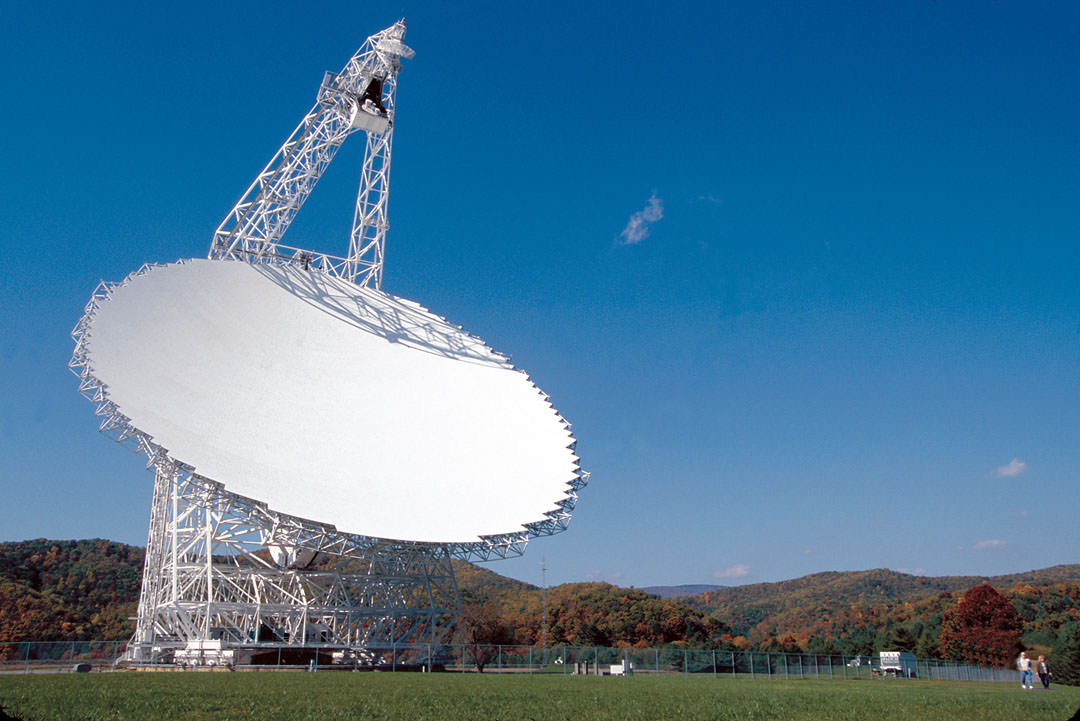
The Green Bank Telescope is the world's largest, fully-steerable telescope, which is currently being used in a new SETI (Search for Extraterrestrial Intelligence) attempt to look for possible alien radio signals from Tabby's Star. Credit: NRAO/AUI/NSF
Together, the team selected 14 systems from the Kepler catalog which showed signs of radio signals. While radio waves are a common occurrence in the cosmos, not all sources can be easily attributed to natural causes. Where and when this is the case, scientists conduct additional studies to try and rule out the possibility that they are a technosignature. As Professor Margot told Universe Today via email:
"In our article, we define a "technosignature" as any measurable property or effect that provides scientific evidence of past or present technology, by analogy with "biosignatures,'' which provide evidence of past or present life."
For the sake of their study, the team conducted an L-band radio survey of these 14 planetary systems. Specifically, they looked for signs of radio waves in the 1.15 to 1.73 gigahertz (GHz) range, which is what transmitters like the Arecibo Observatory are sensitive to within 450 light-years of Earth, and 1000 times more effective than Arecibo within 14,000 light-years of Earth.
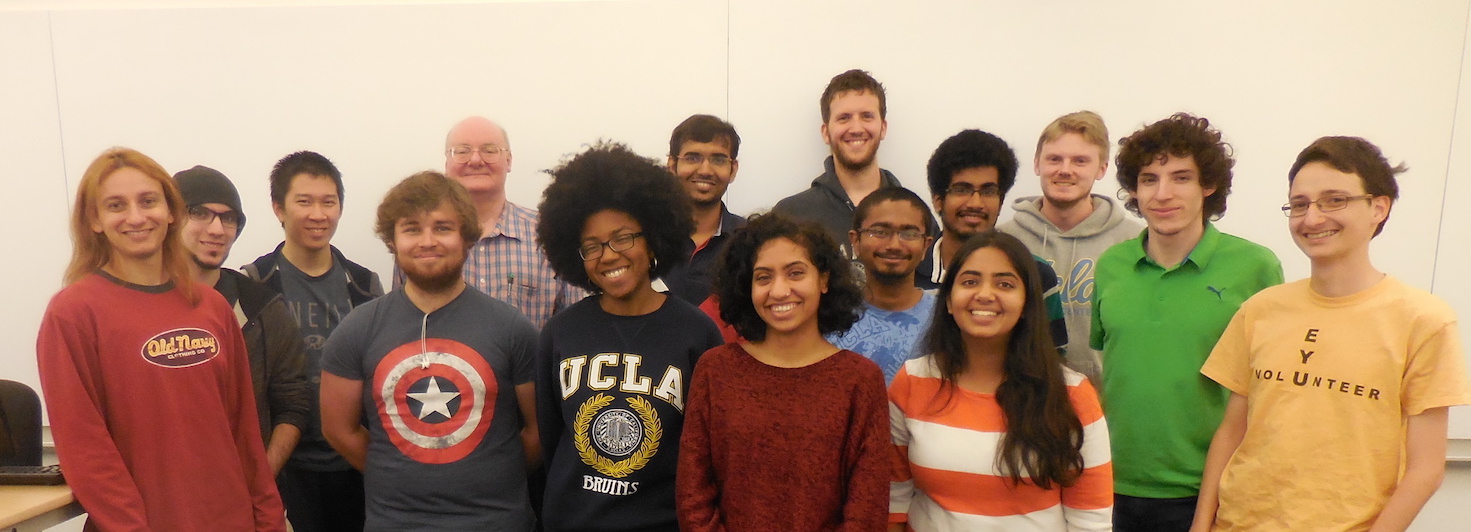
Spring 2016 UCLA SETI class with Larry Lesyna. Credit: UCLA
"We searched for signals that are narrow (< 10 Hz) in the frequency domain," said Margot. "Such signals are technosignatures because natural sources do not emit such narrowband signals... We identified approximately 850,000 candidate signals, of which 19 were of particular interest. Ultimately, none of these signals were attributable to an extraterrestrial source."
What they found was that of the 850,000 candidate signals, about 99% of them were automatically ruled out because they were quickly determine to be the result of human-generated radio-frequency interference (RFI). Of the remaining candidates, another 99% were also flagged as anthropogenic RFI because they had frequencies that overlapped with those used by GPS systems, satellite downlinks, or other common RFI sources.
The 19 candidate signals that remained were heavily scrutinized, but none could be attributed to an extraterrestrial
source. This is key when attempting to distinguish potential signs of intelligence from radio signals that come from the only intelligence we know of (i.e. us!) Hence why astronomers have historically been intrigued by strong narrowband signals (like the WOW! Signal, detected in 1977) and the Lorimer Burst detected in 2007.
In these cases, the sources appeared to be coming from the Messier 55 globular cluster and the Large Magellanic Cloud, respectively. The latter was especially fascinating since it was the first time that astronomers had observered what are now known as Fast Radio Bursts (FRBs). Such bursts, especially when they are repeating in nature, are considered one of the best candidates in the search for intelligent, technologically-advanced life.
The UCLA SETI Group banner, featuring a photo of the central region of the Milky Way Galaxy. Credit: Yuri Beletsky/Carnegie Las Campanas Observatory
Unfortunately, these sources are still being investigated and scientists cannot attribute them to unnatural causes just yet. And as Professor Margot indicated, this study (which covered only 14 of the many thousand exoplanets discovered by Kepler) was just the tip of the iceberg:
"Our study encompassed only a small fraction of the search volume. For instance, we covered less than five-millionths of the entire sky. We are eager to scale the effort to sample a larger fraction of the search volume. We are currently seeking funds to expand our search."
Between Kepler's first and second mission (K2), a total of 5,118 candidates and 2,538 confirmed exoplanets have been discovered within our galaxy alone. As of February 1st, 2018, a grand total of 3,728 exoplanets have been confirmed in 2,794 systems, with 622 systems having more than one planet. On top of that, a team of researchers from the University of Oklahoma recently made the first detection of extra-galactic planets as well!
It would therefore be no exaggeration to say that the hunt for ETI is still in its infancy, and our efforts are definitely beginning to pick up speed. There is literally a Universe of possibilities out there and to think that there are no other civilizations that are also looking for us seems downright unfathomable. To quote the late and great Carl Sagan: "The Universe is a pretty big place. If it's just us, seems like an awful waste of space."
And be sure to check out this video of the 2017 UCLA SETI Group, courtesy of the UCLA EPPS department:
When we finally find life somewhere out there beyond Earth, it'll be at the end of a long search. Life probably won't announce its presence to us, we'll have to follow a long chain of clues to find it. Like scientists keep telling us, at the start of that chain of clues is water.
The discovery of the TRAPPIST-1 system last year generated a lot of excitement. 7 planets orbiting the star TRAPPIST-1, only 40 light years from Earth. At the time, astronomers thought at least some of them were Earth-like. But now a new study shows that some of the planets could hold more water than Earth. About 250 times more.
This new study focuses on the density of the 7 TRAPPIST-1 planets. Trying to determine that density is a challenging task, and it involved some of the powerhouses in the world of telescopes. The Spitzer Space Telescope, the Kepler Space Telescope, and the SPECULOOS (Search for habitable Planets EClipsing ULtra-cOOl Stars) facility at ESO's Paranal Observatory were all used in the study.
This artist's impression shows several of the planets orbiting the ultra-cool red dwarf star TRAPPIST-1. New observations, when combined with very sophisticated analysis, have now yielded good estimates of the densities of all seven of the Earth-sized planets and suggest that they are rich in volatile materials, probably water. Image: ESO/M. Kornmesser
In this study, the observations from the three telescopes were subjected to complex computer modelling to determine the densities of the 7 TRAPPIST planets. As a result, we now know that they are all mostly made of rock, and that some of them could be 5% water by mass. (Earth is only about 0.02% water by mass.)
Finding the densities of these planets was not easy. To do so, scientists had to determine both the mass and the size. The TRAPPIST-1 planets were found using the transit method, where the light of the host star dips as the planets pass between their star and us. The transit method gives us a pretty good idea of the size of the planets, but that's it.
It's a lot harder to find the mass, because planets with different masses can have the same orbits and we can't tell them apart. But in multi-planet systems like TRAPPIST-1, there is a way.
As the planets orbit the TRAPPIST-1 star, more massive planets disturb the orbits of the other planets more than lighter ones. This changes the timing of the transits. These effects are "complicated and very subtle" according to the team, and it took a lot of observation and measurement of the transit timing—and very complex computer modelling—to determine their densities.
Lead author Simon Grimm explains how it was done: "The TRAPPIST-1 planets are so close together that they interfere with each other gravitationally, so the times when they pass in front of the star shift slightly. These shifts depend on the planets' masses, their distances and other orbital parameters. With a computer model, we simulate the planets' orbits until the calculated transits agree with the observed values, and hence derive the planetary masses."
So, what about the water?
First of all, this study didn't detect water. It detected volatile material which is probably water.
Whether or not they've confirmed the presence of water, these are still very important results. We're getting good at finding exoplanets, and the next step is to determine the properties of any atmospheres that exoplanets have.
Team member Eric Agol comments on the significance: "A goal of exoplanet studies for some time has been to probe the composition of planets that are Earth-like in size and temperature. The discovery of TRAPPIST-1 and the capabilities of ESO's facilities in Chile and the NASA Spitzer Space Telescope in orbit have made this possible — giving us our first glimpse of what Earth-sized exoplanets are made of!"
This diagram compares the sizes, masses and estimated temperatures of the TRAPPIST-1 planets with Solar System planets. The colours indicate temperatures and the black line matches the densities and composition of the terrestrial planets in the Solar System. Planets above the line are less dense and planets below are more dense. Image: EXO/S.Grimm et. al.
This study doesn't tell us if any of the TRAPPIST planets have life on them, or even if they're habitable. It's just one more step on the path to hopefully, maybe, one day, finding life somewhere. Study co-author Brice-Olivier Demory, at the University of Bern, said as much: "Densities, while important clues to the planets' compositions, do not say anything about habitability. However, our study is an important step forward as we continue to explore whether these planets could support life."
This diagram compares the masses and energy input of the seven TRAPPIST-1 planets, along with the properties of the four innermost Solar System planets. Image: NASA/JPL-Caltech
This is what the study determined about the different planets in the TRAPPIST system:
TRAPPIST 1-b and 1c are the two innermost planets and are likely to have rocky cores and be surrounded by atmospheres much thicker than Earth's.
TRAPPIST-1d is the lightest of the planets at about 30 percent the mass of Earth. We're uncertain whether it has a large atmosphere, an ocean or an ice layer.
TRAPPIST-1e is a bit of a surprise. It's the only planet in the system slightly denser than Earth. It may have a denser iron core, and it does not necessarily have a thick atmosphere, ocean or ice layer. TRAPPIST-1e is a mystery because it appears to be so much rockier than the rest of the planets. It's the most similar to Earth, in size, density and the amount of radiation it receives from its star.
TRAPPIST-1f, g and h might have frozen surfaces. If they have thin atmospheres, they would be unlikely to contain the heavy molecules that we find on Earth, such as carbon dioxide.
The TRAPPIST-1 system is going to be studied for a very long time. It promises to be one of the first targets for the James Webb Space Telescope (we hope.) It's a very intriguing system, and whether or not any of the planets are deemed habitable, studying them will teach us a lot about our search for water, habitability, and life.
The first confirmed discovery of a planet beyond our Solar System (aka. an Extrasolar Planet) was a groundbreaking event. And while the initial discoveries were made using only ground-based observatories, and were therefore few and far between, the study of exoplanets has grown considerably with the deployment of space-based telescopes like the Kepler space telescope.
As of February 1st, 2018, 3,728 planets have been confirmed in 2,794 systems, with 622 systems having more than one planet. But now, thanks to a new study by a team of astrophysicists from the University of Oklahoma, the first planets beyond our galaxy have been discovered! Using a technique predicting by Einstein's Theory of General Relativity, this team found evidence of planets in a galaxy roughly 3.8 billion light years away.
For the sake of their study, the pair used the Gravitational Microlensing technique, which relies on the gravitational force of distant objects to bend and focus light coming from a star. As a planet passes in front of the star relative to the observer (i.e. makes a transit), the light dips measurably, which can then be used to determine the presence of a planet.
In this respect, Gravitational Microlensing is a scaled-down version of Gravitational Lensing, where an intervening object (like a galaxy cluster) is used to focus light coming from a galaxy or other large object located beyond it. It also incorporates a key element of the highly-effective Transit Method, where stars are monitored for dips in brightness to indicate the presence of an exoplanet.
In addition to this method, which is the only one capable of detecting extra-solar planets at truly great distances (on the order of billions of light years), the team also used data from NASA's Chandra X-ray Observatory to study a distant quasar known as RX J1131–1231. Specifically, the team relied on the microlensing properties of the supermassive black hole (SMBH) located at the center of RX J1131–1231.
They also relied on the OU Supercomputing Center for Education and Research to calculate the microlensing models they employed. From this, they observed line energy shifts that could only be explained by the presence of of about 2000 unbound planets between the quasar's stars - which ranged from being as massive as the Moon to Jupiter - per main-sequence star.
Image of the gravitational lens RX J1131-1231 galaxy with the lens galaxy at the center and four lensed background quasars. It is estimated that there are trillions of planets in the center elliptical galaxy in this image. Credit: University of Oklahoma
As Xinyu Dai explained in a recent University of Oklahoma press release:
"We are very excited about this discovery. This is the first time anyone has discovered planets outside our galaxy. These small planets are the best candidate for the signature we observed in this study using the microlensing technique. We analyzed the high frequency of the signature by modeling the data to determine the mass."
While 53 planets have been discovered within the Milky Way galaxy using the Microlensing technique, this is the first time that planets have been observed in other galaxies. Much like the first confirmed discovery of an extra-solar planet, scientists were not even certain planets existed in other galaxies prior to this study. This discovery has therefore brought the study of planets beyond our Solar System to a whole new level!
And as Eduardo Guerras indicated, the discovery was possible thanks to improvements made in both modelling and instrumentation in recent years:
"This is an example of how powerful the techniques of analysis of extragalactic microlensing can be. This galaxy is located 3.8 billion light years away, and there is not the slightest chance of observing these planets directly, not even with the best telescope one can imagine in a science fiction scenario. However, we are able to study them, unveil their presence and even have an idea of their masses. This is very cool science."
In the future, exoplanet discoveries are likely to be made within and beyond the Milky Way Galaxy. Credit: NASA
At this juncture, the odds are good that some of these discoveries will be in neighboring galaxies. Perhaps then we can begin to determine just how common planets are in our Universe. At present, it is estimated that could be as many as 100 billion planets in the Milky Way Galaxy alone! But with an estimated 1 to 2 trillion galaxies in the Universe... well, you do the math!


 Posts
Posts