Welcome to the Guardian's weekly Brexit briefing, a summary of developments as Britain heads more or less steadily towards the EU door marked "exit". If you'd like to receive it as a weekly early morning email, please sign up here. A quick heads up: the latest episode of the Guardian's Brexit podcast, Brexit means ..., is out – the European parliament's Brexit point man, Guy Verhosfstadt, veteran MEP Richard Corbett and the Guardian's Brussels bureau chief Daniel Boffey join me to discuss the role of the parliament in Brexit. And this: producing the Guardian's independent, in-depth journalism takes a lot of time and money. We do it because we believe our perspective matters – and it may well be your perspective, too. If you value our Brexit coverage, become a Guardian Supporter and help make our future more secure. Thank you. The big picture The article 50 Brexit bill heads to the Lords this week, where a coalition of Liberal Democrat, Labour, cross-bench and some Conservative opposition peers hope to force changes – but not derail the government's timetable. Almost 200 peers are due to speak, with a vote next week. The Lords opposition leader has suggested the chamber – where the government does not have a majority – is not out to prevent article 50 being triggered by end-March. But a brace of proposed amendments on the rights of EU nationals and giving parliament a "meaningful vote" on the Brexit deal at the end of the two-year talks (and before MEPs give their verdict), may well win a majority. Despite warnings of the dire consequences for the unelected house of attempting to "ignore the will of the people", some peers may be emboldened by a high-profile – if highly controversial – call last week for a veritable "uprising" against Brexit. In his first major intervention since the referendum, the former Labour prime minister Tony Blair declared it his duty to persuade the UK to stay in the EU, calling for remainers to "rise up in defence of what we believe": The people voted without knowledge of the true terms of Brexit. As these terms become clear, it is their right to change their mind. Our mission is to persuade them to do so. Blair said it was vital to raise the alarm about what he called the "jumble of contradictions" in the government's arguments for Brexit, adding that he was setting up an institute to make the case against "Brexit at any cost": They will say the will of the people can't alter. It can. They will say leaving is inevitable. It isn't. They will say we don't represent the people. We do, many millions of them – and with determination, many millions more. Predictably, while some expressed admiration for the force of Blair's arguments and relief at the fact that at least someone was standing up to make them, for many the merits of his case did not matter: the messenger drowned the message. The view from Europe British attempts to "blackmail" and "divide and rule" EU countries ahead of the talks could lead to the UK crashing out of the bloc, a trio of European parliamentary leaders said. Manfred Weber of the powerful centre-right EPP was frank: There is only the European commission negotiator, Michel Barnier: he will be sitting next to David Davis. If you split up Europe into different interests it will not be easy to get unanimity at the European council. Britain was also accused of trying to "move the goalposts and do away with the referee" by claiming that during any transitional period it should stay in the single market but not accept the jurisdiction of the European court or allow free movement. Further leaks suggested the EU is not planning to allow the UK to "win its waters back" after Brexit as it was "difficult to see any alternative to the ... common fisheries policy", and that it is worried UK firms will violate the protected geographical status of European products like Parma ham after Brexit. Amid signs of hardening attitudes on the continent and a growing expectation that the weight of political and media pressure at home will make it very hard for the UK to compromise on the EU 27's red lines, it emerged that Theresa May will skip the EU's 60th anniversary party on 25 March. Meanwhile, back in Westminster Days away from two crucial byelections in leave-voting seats, Tony Blair's party did not take kindly to his words. While welcomed by some of the 47 Labour MPs against Brexit, senior Lib Dems and the SNP, the Labour hierarchy was unforgiving. Richard Burgon, the shadow justice secretary, said he was "wrong on this and Labour is right to disagree with him". Leader Jeremy Corbyn said Blair's remarks were "not helpful ... The referendum gave a very clear decision on this, and we have to respect that decision." Labour is in a tight battle against Ukip and the Tories to hold onto seats in Stoke-on-Trent Central and Copeland, fighting a campaign focused on trying to emphasise its support for triggering article 50 in constitutions where, respectively, 70% and 60% of referendum voters backed leave. The government and assorted leave campaigners were even harsher on the former prime minister. Boris Johnson, the foreign secretary, said the EU debate was over and Blair's speech was "insulting the intelligence of the electorate" with calls for them to think again: I respectfully say to Tony Blair, who urges the British people to rise up, I urge them to rise up and turn off the TV next time Blair comes on with his condescending campaign. The former Conservative leader Iain Duncan Smith was tougher still, dismissing Blair's intervention as arrogant and "undemocratic": The idea that you just keep on asking the British people until they give you the right answer to the question, which in his case, and some of his political elite friends is no, we don't want to leave the European Union, is arrogant really. You should also know: Read these: The Guardian's editorial on Tony Blair's speech said the controversial former prime minister made "a compelling and well-judged case for Britain in Europe, delivered with his familiar political skill" – which should be heeded despite "the debate about the integrity of the man": This is not a call to overturn the verdict of the people in last year's referendum. It is a call to those who doubted the wisdom of that verdict to raise their political game, to find new arguments and new strategies fit for the post-referendum context ... The Brexit trajectory that Britain now faces is an accident of weak leadership on both sides. Other trajectories are available. To assert that fact is not undemocratic. The deeper offence against democracy comes from those Europhobic ultras who try to stifle every murmur of dissent with demagogic nationalism – as if reasonable Brexit-scepticism is no better than treason. In the New Statesman, Stephen Bush makes much the same case, arguing that Blair was simply "spelling out the truth about Brexit" because "the essence of democracy is the right to change your mind at a later date": It's a measure of the febrile nature of British politics that an observation that is, to be frank, banal in the extreme is considered heretical or controversial ... It's not unreasonable or particularly remarkable that pro-Europeans should still retain hope of winning a second referendum. What is unreasonable and downright sinister is the insistence of a vocal section of the Brexit elite and their media allies that it is remarkable or undemocratic to ask for a second opinion. In a rousing piece for the New York Times, Tom Whyman says Brexit is "rooted in imperial nostalgia and myths of British exceptionalism", and argues that leavers' delusions are "unlikely to withstand the shock of actually leaving the European Union". Britain could be headed for post-Brexit collapse: If what the Brexiteers want is to return Britain to a utopia they have devised by splicing a few rose-tinted memories of the 1950s together with an understanding of imperial history derived largely from images on vintage biscuit tins, then all of this seems chillingly plausible, insofar as it would, in many ways, constitute the realisation of that dream. Tweet of the week Nicely done. | 


 Posts
Posts








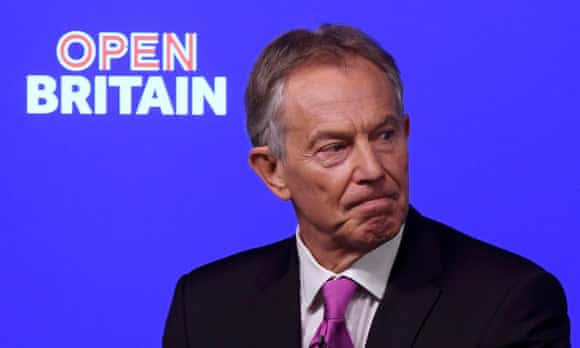
 Tony Blair said it was vital to raise the alarm about what he called the 'jumble of contradictions' in the government's arguments for Brexit. Photograph: Toby Melville/Reuters