Welcome to the Guardian's weekly Brexit briefing, a summary of developments as Britain heads more or less steadily towards the EU door marked "exit". If you'd like to receive it as a weekly early morning email, please sign up here. And this: producing the Guardian's independent, in-depth journalism takes a lot of time and money. We do it because we believe our perspective matters – and it may well be your perspective too. If you value our Brexit coverage, become a Guardian Supporter and help make our future more secure. Thank you. The big picture The joke used to go, said one presenter on BBC radio this week, that the British were so unfamiliar with a referendum that most people weren't very sure which version of the plural they should use (the Guardian is firmly on the side of referendums, rather than the slightly fussy referenda). Now, yet another referendum seems set to dominate the headlines at the precise moment ministers in London press the symbolic button to enact the result of the last one. Yes, as article 50 looms, it's time also for indyref 2. To turn first to the latter of these pieces of political jargon, the SNP's Nicola Sturgeon chose the midst of the Brexit debate to announce her intention to hold a referendum on Scottish independence, having lost one on the same issue in 2014. Scotland's first minister does not have the official power to enact a referendum, but Theresa May did not indicate she would obstruct one, while still saying Sturgeon was "playing politics with the future of our country". Sturgeon's pitch to a nation still split over the issue will be that Scotland could hold on to some sort of EU status and avoid a cliff-edge Brexit forced on the whole UK by an intransigent cabal of English ministers. May in turn will argue that Scotland will suffer even more economically alone, and should remain in the union.
Much will hinge on timing. Sturgeon wants a vote between autumn 2018 and spring 2019 – that is, before Brexit is completed. May is likely to want to delay this. Speaking of timing, numerous predictions had it that May would invoke article 50 – the process that formally begins EU exit – on Tuesday, in the wake of the expected (at time of writing) passage of the bill allowing her to do this. This has now been pushed back to the end of the month, officials have briefed. Why? In part it is to avoid potentially influencing Wednesday's Dutch election, where the far-right populist Geert Wilders hopes to capitalise on anti-EU sentiment. There is also the matter of the 60th anniversary of the Treaty of Rome, which set up the European Economic Community, forerunner of the EU, on 25 March. With May about to seek the goodwill of the 27 remaining leaders, she does not wish to poop their party by triggering article 50 until it's over.
And why not Tuesday? In the main, it seems that Sturgeon's announcement of another referendum has got in the way. These things are becoming a habit. The view from Europe Whether or not article 50 has been triggered by then, the EU plans to use its 60th anniversary celebrations in Rome on 25 March to warn that anyone who follows the UK's lead will risk being "sidelined by global dynamics". According to a leaked draft declaration, the 27 will say they are "determined to make the EU stronger and more resilient ... Unity is a necessity, not an option. Standing together is our best chance to defend our common interests and values." Be that as it may, though, the European commission president, Jean-Claude Juncker, reckons Britain will one day rejoin the EU, telling reporters that while he regretted Britain's decision to leave, he held out hope it would return: I don't like Brexit. I would like to be in the same boat as the British. The day will come when the British re-enter the boat. I hope. But all is not sweetness and light on the continent. Poland reacted furiously after the 27 voted by an overwhelming majority to re-appoint Donald Tusk as European council president, despite his home country's fierce opposition. The decision, which means Tusk will play a key role in Brexit talks, left Poland isolated – but promising to fight back. "We know now that the EU is a union under Berlin's diktat," said Poland's foreign minister, Witold Waszczykowski. Meanwhile, back in Westminster The government saw its two-line article 50 bill passed unamended, with MPs in the Commons expunging two additions made by the Lords, and peers backing down in the face of the lower house's constitutional primacy. This toing and froing between the chambers is known, even in the official guidelines, as "ping pong". If the government is not minded to back down, MPs invariably end up on the winning side. Why the fuss over the two additions, one to guarantee the rights of overseas EU citizens in the UK; the other to oblige a "meaningful" final vote in parliament on an eventual deal? It's hard to be certain, but amid talk of "not tying the prime minister's hands" and keeping the bill straightforward, it does seem a way to give ministers as much executive leeway over the process as possible. Another Brexit subject also surfaced during the weekend: what might happen if no deal proved possible, and the UK walked away to default to World Trade Organisation commerce terms? All three of May's Brexit-facing ministers, Boris Johnson, David Davis and Liam Fox, were on the weekend political talkshows, and all discussed what might happen in an event they insisted was unlikely. Johnson, the foreign secretary, even opted to argue that the UK's economy "would be perfectly OK" if it left without a deal. Ten minutes later, the head of the Confederation of British Industry was there to give a differing view. No agreement with the EU, Carolyn Fairbairn warned, would be "a recipe for chaos on a number of fronts". You should also know Read these In the Guardian, Jonathan Freedland warned that Brexit was "about to get real", but we were nowhere near ready for it. The triggering of article 50 will kickstart negotiations of mindbending complexity, and Brexiters need to step up: Leavers should be approaching this gargantuan task with a special humility, because it was they who needlessly inflicted it upon us … From this moment on, the focus must be intensely practical. No more baggy rhetoric about sovereignty and 'taking back control'. From now on, those who got us into this situation have to show they can get us out intact by March 2019. That will require a major shift among the Brexiteer ministers and in Downing Street. In the New Statesman, Stephen Bush also argues forcefully that "no deal" with the EU is most definitely not better than a bad deal, but the more we say we're prepared to walk away, the more likely it is that we will: The counterargument from most of those pushing the "no deal is better than a bad deal" line is that signalling the United Kingdom's willingness to walk away from the table increases our leverage … The difficulty is that the message that we are hoping to send is, 'We're crazy enough to walk away', but what is being heard in most European capitals is, 'It would be crazy to walk away.' The Guardian editorial ahead of the triggering of article 50 was equally forthright, arguing that no deal was not an option and that while the prime minister may pretend she is ready to crash out of the EU, such an outcome would be a catastrophe – and parliament must be allowed to prevent it: Last June's Brexit vote was a lesson in what happens when governments fail to address voters' concerns. A hard Brexit would leave the UK at the bottom of the G20. Many Brexit voters would be the first to feel the consequences. Mrs May should not pretend it is an acceptable outcome. If MPs demand a vote whatever the outcome of the negotiations, they can insist that it is not. Tweet of the week Veteran EU blogger Jon Worth pretty much sums it up: | 

 Posts
Posts








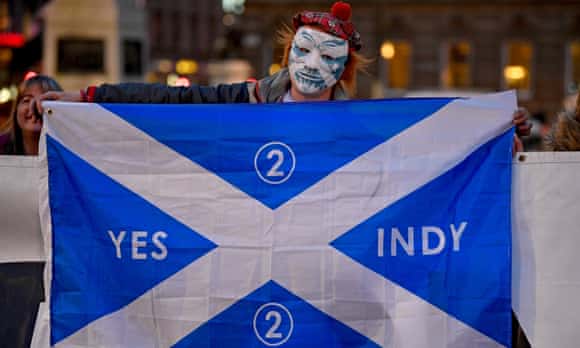
 Nicola Sturgeon's announcement of her intention to call for a second referendum on the union may have postponed the triggering of article 50. Photograph: Jeff J Mitchell/Getty Images


