Friday, April 7, 2017

Coffee roasters: Sole survivors of a long-gone era in SF

Check out this latest selection of content from The Chronicle's Food and Wine team.
If you have trouble reading this message, view it in a browser.


Food and Wine


Friday, April 7, 2017
 
 
Coffee roasters: Sole survivors of a long-gone era in SF
 
Just as the Gold Rush before it, the technology sector is fueling a coffee roasting resurgence, both through corporate sales and by creating a customer base with money to burn.


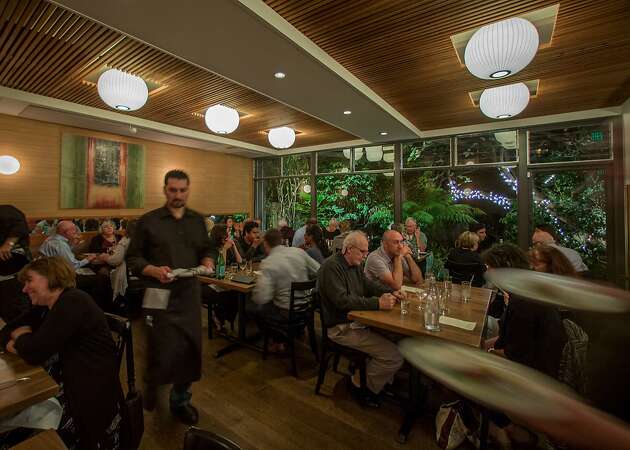
Michael Bauer: Brucker's back and all is right at Berkeley's Rivoli
  Michael Bauer: Brucker's back and all is right at Berkeley's Rivoli  
 
 
Over Proof: ABV's bar within a bar offers an intense rum experience
  Over Proof: ABV's bar within a bar offers an intense rum experience  


A Brown Kitchen: Rhubarb and cardamom kulfi
  A Brown Kitchen: Rhubarb and cardamom kulfi  
 
 
Jeremy Fox and the road back to pioneering California cuisine
  Jeremy Fox and the road back to pioneering California cuisine  


Seoul-style comfort food at Oakland's Korean drinking dens
  Seoul-style comfort food at Oakland's Korean drinking dens  
 
 
Michael Bauer: New Wolf doesn't quite break out from the pack
  Michael Bauer: New Wolf doesn't quite break out from the pack  


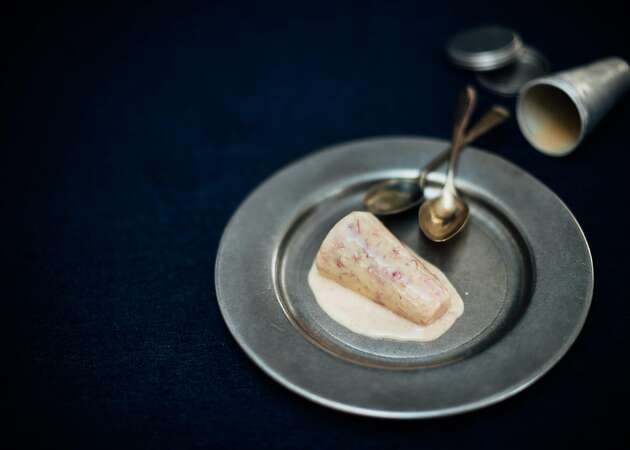
Repertoire: A sophisticated version of fish sticks
  Repertoire: A sophisticated version of fish sticks  
 
 
Warriors unveil local restaurants for SF's Chase Center arena
  Warriors unveil local restaurants for SF's Chase Center arena  


  Support authentic journalism!
Get daily insights into stories that resonate throughout the Bay Area and beyond.
Click here for San Francisco Chronicle subscription offers.


Connect     Facebook     Twitter     Pinterest     Instagram
 
About   Privacy Policy   Terms of Use


Finally! A Low Mass Super-Earth With Some Funky Atmosphere

New post on Universe Today

Finally! A Low Mass Super-Earth With Some Funky Atmosphere

by Matt Williams

In 2015, astronomers discovered an intriguing extrasolar planet located in a star system some 39 light years from Earth. Despite orbiting very close to its parent star, this "Venus-like" planet - known as GJ 1138b - appeared to still be cool enough to have an atmosphere. In short order, a debate ensued as to what kind of atmosphere it might have, whether it was a "dry Venus" or a "wet Venus".

And now, thanks to the efforts of an international team of researchers, the existence of an atmosphere has been confirmed around GJ 1138b. In addition to settling the debate about the nature of this planet, it also marks the first time that an atmosphere has been detected around a low-mass Super-Earth. On top of that, GJ 1138b is now the farthest Earth-like planet that is known to have an atmosphere.

Led by John Southworth (of Keele University) and Luigi Mancini (of the University of Rome Tor Vergata), the research team included members from the Max Planck Institute for Astronomy (MPIA), the National Institute for Astrophysics (INAF), the University of Cambridge and Stockholm University. Their study, titled "Detection of the atmosphere of the 1.6 Earth mass exoplanet GJ 1132b", recently appeared in The Astrophysical Journal.

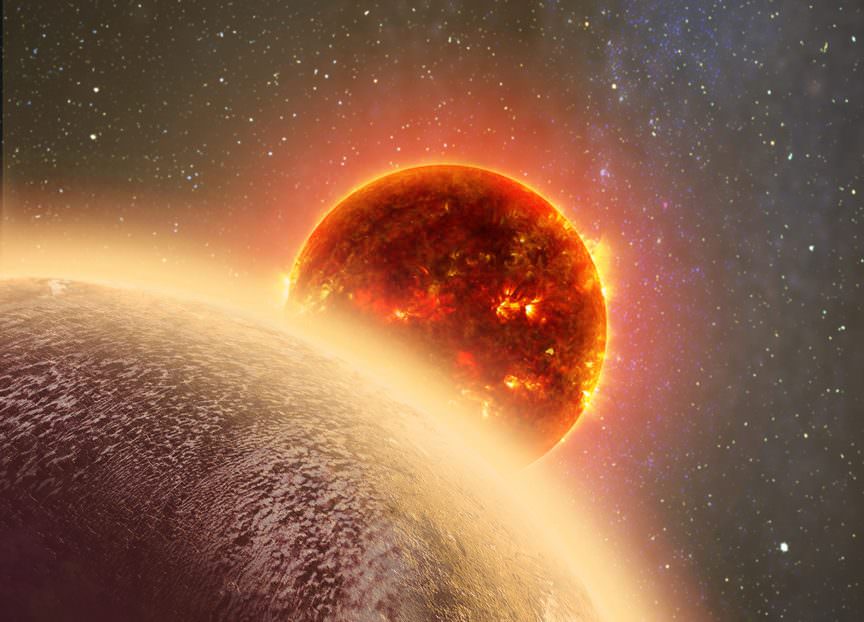
Artist's impression of the "Venus-like" exoplanet GJ 1132b. Credit: cfa.harvard.edu

Using the GROND imager on the La Silla Observatory's 2.2m ESO/MPG telescope, the team monitored GJ 1132b in seven different wavelength bands as it transited in front of its parent star. Given the planet's orbital period (1.6 days), these transits happen quite often, which presented plenty of opportunities to examine how it absorbs light from its sun.

In so doing, the team monitored the slight decreases in the star's brightness that were due to its atmosphere absorbing some of the star's light. Looking closely, they found that the planet appeared larger in the infrared wavelength than in others. From this, they deduced the presence of an atmosphere which appears opaque in infrared light (creating the illusion of it being larger) but which is transparent at all other wavelengths.

The team members from the University of Cambridge and the MPIA then conducted simulations to see what this atmosphere's composition could be. Ultimately, they concluded that it most likely has an atmosphere that is rich in water and methane - which contradicted earlier theories that the planet had a thin and tenuous atmosphere (i.e. a "dry Venus").

It was also the first time that an atmosphere has been confirmed around a planet that is not significantly greater in size and mass to Earth. In the past, astronomers have detected atmospheres around many other exoplanets. But in these cases, the planets were either gas giants or planets that were many times Earth's size and mass (aka. "Super-Earths"). GJ 1132b, however, is 1.6 times as massive as Earth, and measures 1.4 Earth radii.

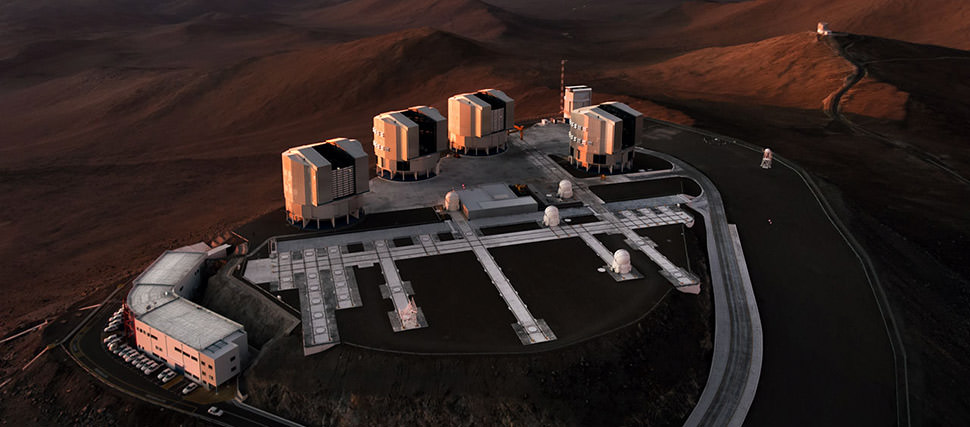
The ESO's Paranal Observatory, located in the Atacama Desert of Chile. Credit: ESO

In addition, these findings are a significant step in the search for life beyond our Solar System. At present, astronomers seek to determine the chemical composition of a planet's atmosphere to determine if it could be habitable. Where the right combination of chemical imbalances exist, the presence of living organisms is seen as a possible cause.

By being able to determine that a planet at lower end of the super-Earth scale has an atmosphere, we are one step closer to being able to determine exoplanet habitability. The detection of an atmosphere-bearing planet around an M-type (red dwarf) star is also good news in and of itself. In recent years, astronomers have detected several terrestrial planets orbiting nearby red dwarfs - including seven around a single star (TRAPPIST-1).

Recent studies have also shown that red dwarfs are not only very common in the known Universe, but they are also capable of hosting large numbers of planets. However, there have been long-standing concerns that red dwarfs are too variable and unstable for their planet's to be habitable. Due to the commonality of flare ups and particle streams, it would be difficult for any planets orbiting them to retain their atmospheres.

As such, finding a planet that is both comparable in size to Earth and has an atmosphere is highly encouraging. In the future, GJ 1132b is expected to be a high-priority target for study with the Hubble Space Telescope, the Very Large Telescope (VLT) at the Paranal Observatory in Chile, and next-generation telescopes like the James Webb Space Telescope (scheduled for launch in 2018).

I'm sure I'm not the only one who is eager to hear about what they discover when they set their sights on this nearby star system and it's Venus-like world! In the meantime, be sure to check out this video about GJ 1132b, courtesy of MIT news:

Further Reading: Max Planck Institute for Astronomy

Matt Williams | April 7, 2017 at 7:16 pm | Tags: Featured, venus-like planets | URL: http://wp.me/p1CHIY-z6r
Comment    See all comments

Trouble clicking? Copy and paste this URL into your browser: 

https://www.universetoday.com/134939/finally-low-mass-super-earth-funky-atmosphere/


JPL News - Day in Review

DAY IN REVIEW
NASA JPL latest news release
NASA Invests in 22 Visionary Exploration Concepts

A mechanical rover inspired by a Dutch artist. A weather balloon that recharges its batteries in the clouds of Venus.

These are just two of the five ideas that originated at NASA's Jet Propulsion Laboratory in Pasadena, California, and are advancing for a new round of research funded by the agency.

In total, the space agency is investing in 22 early-stage technology proposals that have the potential to transform future human and robotic exploration missions, introduce new exploration capabilities, and significantly improve current approaches to building and operating aerospace systems.

The 2017 NASA Innovative Advanced Concepts (NIAC) portfolio of Phase I concepts covers a wide range of innovations selected for their potential to revolutionize future space exploration. Phase I awards are valued at approximately $125,000, for nine months, to support initial definition and analysis of their concepts. If these basic feasibility studies are successful, awardees can apply for Phase II awards.

"The NIAC program engages researchers and innovators in the scientific and engineering communities, including agency civil servants," said Steve Jurczyk, associate administrator of NASA's Space Technology Mission Directorate. "The program gives fellows the opportunity and funding to explore visionary aerospace concepts that we appraise and potentially fold into our early stage technology portfolio."

The selected 2017 Phase I proposals are:

• A Synthetic Biology Architecture to Detoxify and Enrich Mars Soil for Agriculture, Adam Arkin, University of California, Berkeley

• A Breakthrough Propulsion Architecture for Interstellar Precursor Missions, John Brophy, NASA's Jet Propulsion Laboratory (JPL) in Pasadena, California

• Evacuated Airship for Mars Missions, John-Paul Clarke, Georgia Institute of Technology in Atlanta

• Mach Effects for In Space Propulsion: Interstellar Mission, Heidi Fearn, Space Studies Institute in Mojave, California

• Pluto Hop, Skip, and Jump, Benjamin Goldman, Global Aerospace Corporation in Irwindale, California

• Turbolift, Jason Gruber, Innovative Medical Solutions Group in Tampa, Florida

• Phobos L1 Operational Tether Experiment, Kevin Kempton, NASA's Langley Research Center in Hampton, Virginia

• Gradient Field Imploding Liner Fusion Propulsion System, Michael LaPointe, NASA's Marshall Space Flight Center in Huntsville, Alabama

• Massively Expanded NEA Accessibility via Microwave-Sintered Aerobrakes, John Lewis, Deep Space Industries, Inc., in Moffett Field, California

• Dismantling Rubble Pile Asteroids with Area-of-Effect Soft-bots, Jay McMahon, University of Colorado, Boulder

• Continuous Electrode Inertial Electrostatic Confinement Fusion, Raymond Sedwick, University of Maryland, College Park

• Sutter: Breakthrough Telescope Innovation for Asteroid Survey Missions to Start a Gold Rush in Space, Joel Sercel, TransAstra in Lake View Terrace, California

• Direct Multipixel Imaging and Spectroscopy of an Exoplanet with a Solar Gravity Lens Mission, Slava Turyshev, JPL

• Solar Surfing, Robert Youngquist, NASA's Kennedy Space Center in Florida

• A Direct Probe of Dark Energy Interactions with a Solar System Laboratory, Nan Yu, JPL

"The 2017 NIAC Phase I competition has resulted in an excellent set of studies. All of the final candidates were outstanding," said Jason Derleth, NIAC program executive. "We look forward to seeing how each new study will expand how we explore the universe."

Phase II studies allow awardees time to refine their designs and explore aspects of implementing the new technology. This year's Phase II portfolio addresses a range of leading-edge concepts, including: a Venus probe using in-situ power and propulsion to study the Venusian atmosphere, and novel orbital imaging data derived from stellar echo techniques -- measurement of the variation in a star's light caused by reflections off of distant worlds -- to detect exoplanets, which are planets outside our solar system.

Awards under Phase II of the NIAC program can be worth as much as $500,000, for two-year studies, and allow proposers to further develop Phase I concepts that successfully demonstrated initial feasibility and benefit.

The selected 2017 Phase II proposals are:

• Venus Interior Probe Using In-situ Power and Propulsion, Ratnakumar Bugga, JPL

• Remote Laser Evaporative Molecular Absorption Spectroscopy Sensor System, Gary Hughes, California Polytechnic State University in San Luis Obispo

• Brane Craft Phase II, Siegfried Janson, The Aerospace Corporation in El Segundo, California

• Stellar Echo Imaging of Exoplanets, Chris Mann, Nanohmics, Inc., Austin, Texas

• Automaton Rover for Extreme Environments, Jonathan Sauder, JPL

• Optical Mining of Asteroids, Moons, and Planets to Enable Sustainable Human Exploration and Space Industrialization, Joel Sercel, TransAstra Corp.

• Fusion-Enabled Pluto Orbiter and Lander, Stephanie Thomas, Princeton Satellite Systems, Inc., Plainsboro, New Jersey

"Phase II studies can accomplish a great deal in their two years with NIAC. It is always wonderful to see how our Fellows plan to excel," said Derleth. "The 2017 NIAC Phase II studies are exciting, and it is wonderful to be able to welcome these innovators back in to the program. Hopefully, they will all go on to do what NIAC does best -- change the possible."

NASA selected these projects through a peer-review process that evaluated innovativeness and technical viability. All projects are still in the early stages of development, most requiring 10 or more years of concept maturation and technology development before use on a NASA mission.

NIAC partners with forward-thinking scientists, engineers, and citizen inventors from across the nation to help maintain America's leadership in air and space. NIAC is funded by NASA's Space Technology Mission Directorate, which is responsible for developing the cross-cutting, pioneering, new technologies and capabilities needed by the agency to achieve its current and future missions.

For more information about NIAC and a complete list of the selected proposals, visit:

https://www.nasa.gov/niac

For more information about NASA's investments in space technology, visit:

https://www.nasa.gov/spacetech


NASA Jet Propulsion Laboratory | jplnewsroom@jpl.nasa.gov | NASA's Jet Propulsion Laboratory | 4800 Oak Grove Dr | Pasadena, CA 91109


Best Foods for Your Eyes

webmd logo Daily
Friday, April 07, 2017
Missing Images
Best Foods for Your Eyes

Dark, leafy greens. Colorful red peppers. Eggs. We share 10 foods that can help you avoid cataracts, boost your night vision, and keep your eyes sharp.
View Slideshow

New WebMD Pregnancy App

The most trusted pregnancy information is just a tap away.
Get the Free App Now
In the News
Stem Cell Therapy for Autism Shows Promise
4 in 10 U.S. Adults Under 60 Carry HPV
Debate Over 'Right to Try' Experimental Treatments
Yo-Yo Dieting May Harm the Heart
Skin's Bacterial 'Balance' May Trigger Acne
From the WebMD Network
Type 2 Diabetes Warning Signs
Vitamin and Mineral Supplements
What Is Tinea Versicolor?
Featured
What Is OCD, Exactly?
Signs of Schizophrenia
Exercises That Are Easy on Your Joints
Try This 7-Minute Workout
How to Stretch Your Hands
ADVERTISEMENT
 
ADVERTISEMENT
 
 
ADVERTISEMENT
Allergy App  
ADVERTISEMENT