When the Juno mission reached Jupiter on July 5th, 2016, it became the second mission in history to establish orbit around the Solar System's largest planet. And in the course of it conducting its many orbits, it has revealed some interesting things about Jupiter. This has included information about its atmosphere, meteorological phenomena, gravity, and its powerful magnetic fields.
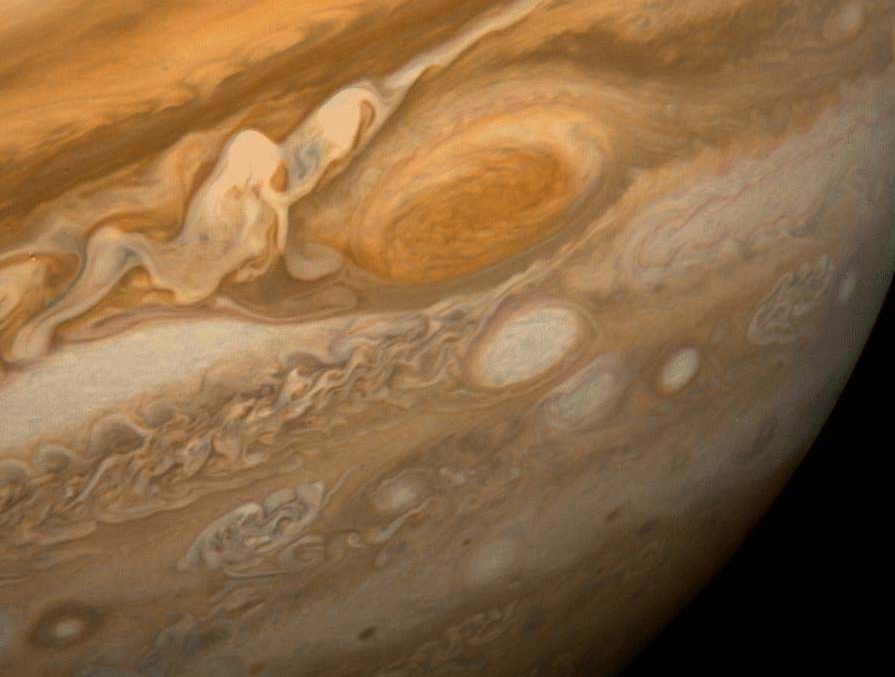
And today - on Monday, July 10th at 7:06 p.m. PDT (11:06 p.m. EDT) - just days after the probe celebrated its first year of orbiting the planet, the Juno mission passed directly over Jupiter's most famous feature - the Great Red Spot. This massive anticyclonic storm has been a focal point for centuries, and Juno's scheduled flyby was the closest any mission has ever come to it.
Jupiter's Great Red Spot was first observed during the late 17th century, either by Robert Hooke or Giovanni Cassini. By 1830, astronomers began monitoring this anticyclonic storm, and have noted periodic expansions and regressions in its size ever since. Today, it is 16,000 kilometers (10,000 miles) in diameter and reaches wind speeds of 120 meters per second (432 km/h; 286 mph) at the edges.

The Juno spacecraft isn't the first one to visit Jupiter. Galileo went there in the mid 90's, and Voyager 1 snapped a nice picture of the clouds on its mission. Credit: NASA
As part of its sixth orbit of Jupiter's turbulent cloud tops, Juno passed close to Jupiter's center (aka. perijove), which took place at 6:55 p.m. PDT (9:55 p.m. EDT). Eleven minutes later - at 7:06 p.m. PDT (10:06 p.m. EDT) - the probe flew over the Great Red Spot. In the process, Juno was at a distance of just 9,000 km (5,600 miles) from the anticyclonic storm, which is the closest any spacecraft has ever flown to it.
During the flyby, Juno had all eight of its scientific instruments (as well its imager, the JunoCam) trained directly on the storm. With such an array aimed at this feature, NASA expects to learn more about what has been powering this storm for at least the past three and a half centuries. As Scott Bolton, the principal investigator of Juno at the Southwest Research Institute (SwRI), said prior to the event in a NASA press release:
"Jupiter's mysterious Great Red Spot is probably the best-known feature of Jupiter. This monumental storm has raged on the Solar System's biggest planet for centuries. Now, Juno and her cloud-penetrating science instruments will dive in to see how deep the roots of this storm go, and help us understand how this giant storm works and what makes it so special."
This perijove and flyby of the Giant Red Spot also comes just days after Juno celebrated its first anniversary around Jupiter. This took place on July 4th at 7:30 p.m. PDT (10:30 p.m. EDT), at which point, Juno had been in orbit around the Jovian planet for exactly one year. By this time, the spacecraft had covered a distance of 114.5 million km (71 million mi) while orbiting around the planet.
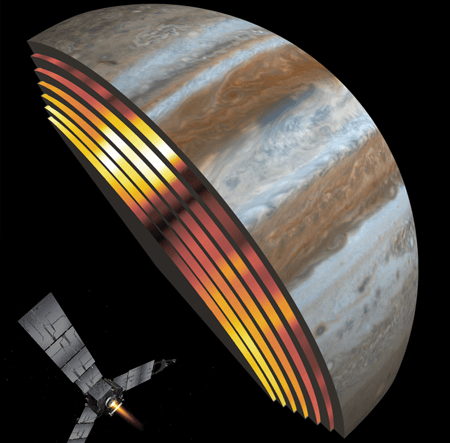
This artist's illustration shows Juno's Microwave Radiometer observing deep into Jupiter's atmosphere. The image shows real data from the 6 MWR channels, arranged by wavelength. Credit: NASA/SwRI/JPL
The information that Juno has collected in that time with its advanced suite of instruments has already provided fresh insights into Jupiter's interior and the history of its formation. And this information, it is hoped, will help astronomers to learn more about the Solar System's own history of formation. And in the course of making its orbits, the probe has been put through its paces, absorbing radiation from Jupiter's powerful magnetic field.
As Rick Nybakken, the project manager for Juno at NASA's Jet Propulsion Laboratory, put it:
"The success of science collection at Jupiter is a testament to the dedication, creativity and technical abilities of the NASA-Juno team. Each new orbit brings us closer to the heart of Jupiter's radiation belt, but so far the spacecraft has weathered the storm of electrons surrounding Jupiter better than we could have ever imagined."
The Juno mission is set to conclude this coming February, after completing 6 more orbits of Jupiter. At this point, and barring any mission extensions, the probe will be de-orbited to burn up in Jupiter's outer atmosphere. As with the Galileo spacecraft, this is meant to avoid any possibility of impact and biological contamination with one of Jupiter's moons.
Further Reading: NASA


 Posts
Posts