Showing posts with label Ceres. Show all posts

Tuesday, December 12, 2017

JPL News - Day in Review

DAY IN REVIEW
NASA JPL latest news release
Bright Areas on Ceres Suggest Geologic Activity

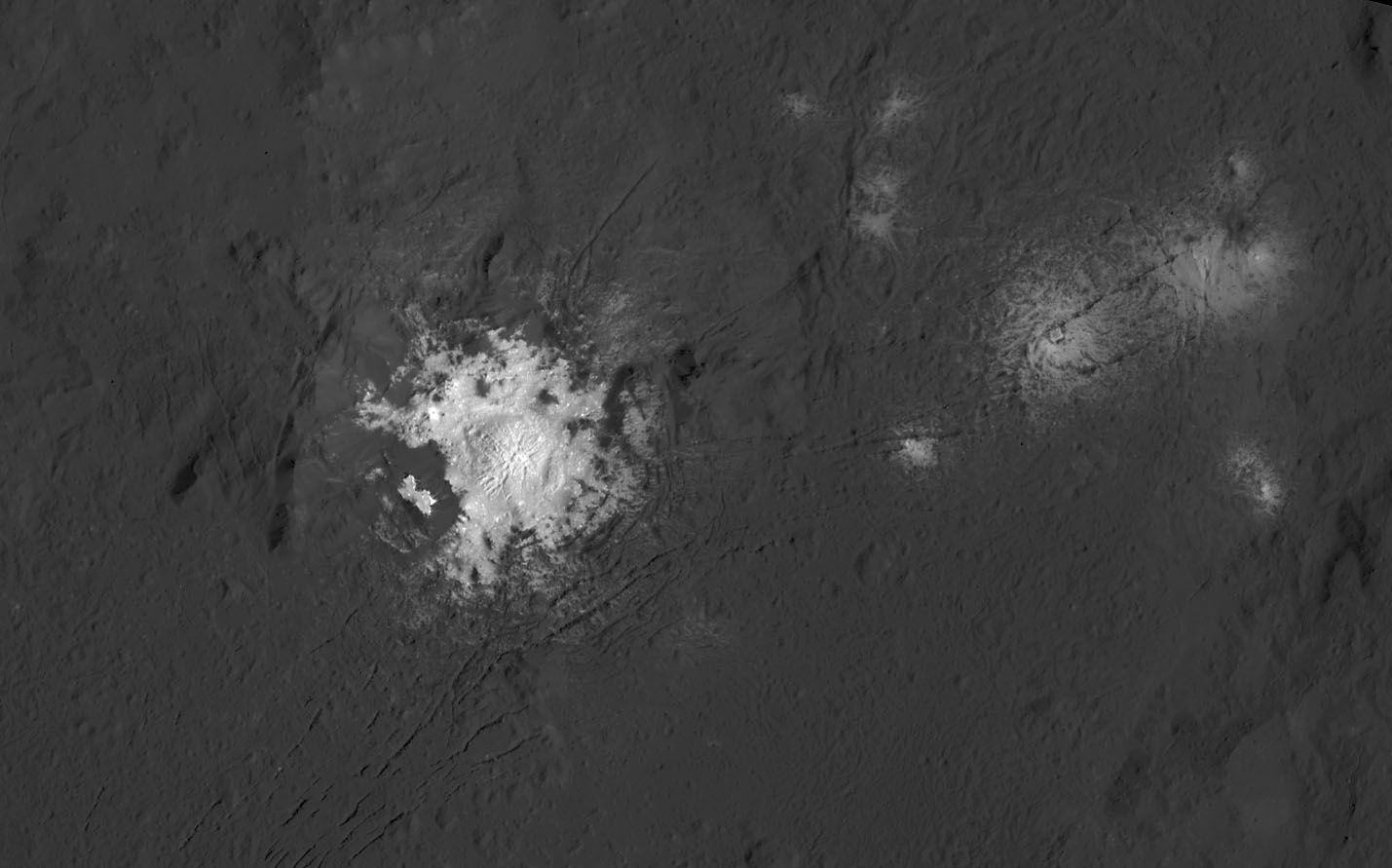
If you could fly aboard NASA's Dawn spacecraft, the surface of dwarf planet Ceres would generally look quite dark, but with notable exceptions. These exceptions are the hundreds of bright areas that stand out in images Dawn has returned. Now, scientists have a better sense of how these reflective areas formed and changed over time -- processes indicative of an active, evolving world.

"The mysterious bright spots on Ceres, which have captivated both the Dawn science team and the public, reveal evidence of Ceres' past subsurface ocean, and indicate that, far from being a dead world, Ceres is surprisingly active. Geological processes created these bright areas and may still be changing the face of Ceres today," said Carol Raymond, deputy principal investigator of the Dawn mission, based at NASA's Jet Propulsion Laboratory in Pasadena, California. Raymond and colleagues presented the latest results about the bright areas at the American Geophysical Union meeting in New Orleans on Tuesday, Dec. 12.

Different Kinds of Bright Areas

Since Dawn arrived in orbit at Ceres in March 2015, scientists have located more than 300 bright areas on Ceres. A new study in the journal Icarus, led by Nathan Stein, a doctoral researcher at Caltech in Pasadena, California, divides Ceres' features into four categories.

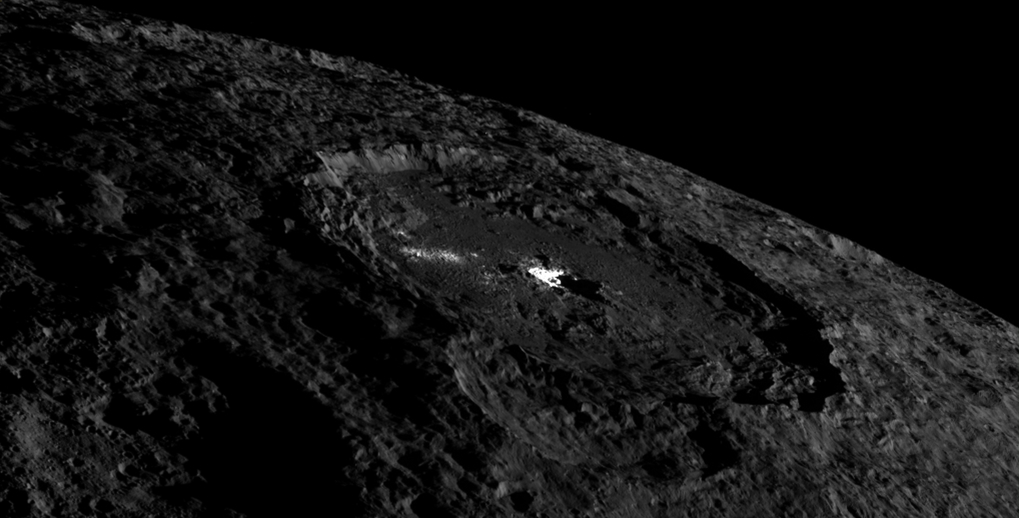
The first group of bright spots contains the most reflective material on Ceres, which is found on crater floors. The most iconic examples are in Occator Crater, which hosts two prominent bright areas. Cerealia Facula, in the center of the crater, consists of bright material covering a 6-mile-wide (10-kilometer-wide) pit, within which sits a small dome. East of the center is a collection of slightly less reflective and more diffuse features called Vinalia Faculae. All the bright material in Occator Crater is made of salt-rich material, which was likely once mixed in water. Although Cerealia Facula is the brightest area on all of Ceres, it would resemble dirty snow to the human eye.

› DOWNLOAD VIDEO The Bright Stuff: New NASA Dawn Findings at Ceres

More commonly, in the second category, bright material is found on the rims of craters, streaking down toward the floors. Impacting bodies likely exposed bright material that was already in the subsurface or had formed in a previous impact event.

Separately, in the third category, bright material can be found in the material ejected when craters were formed.

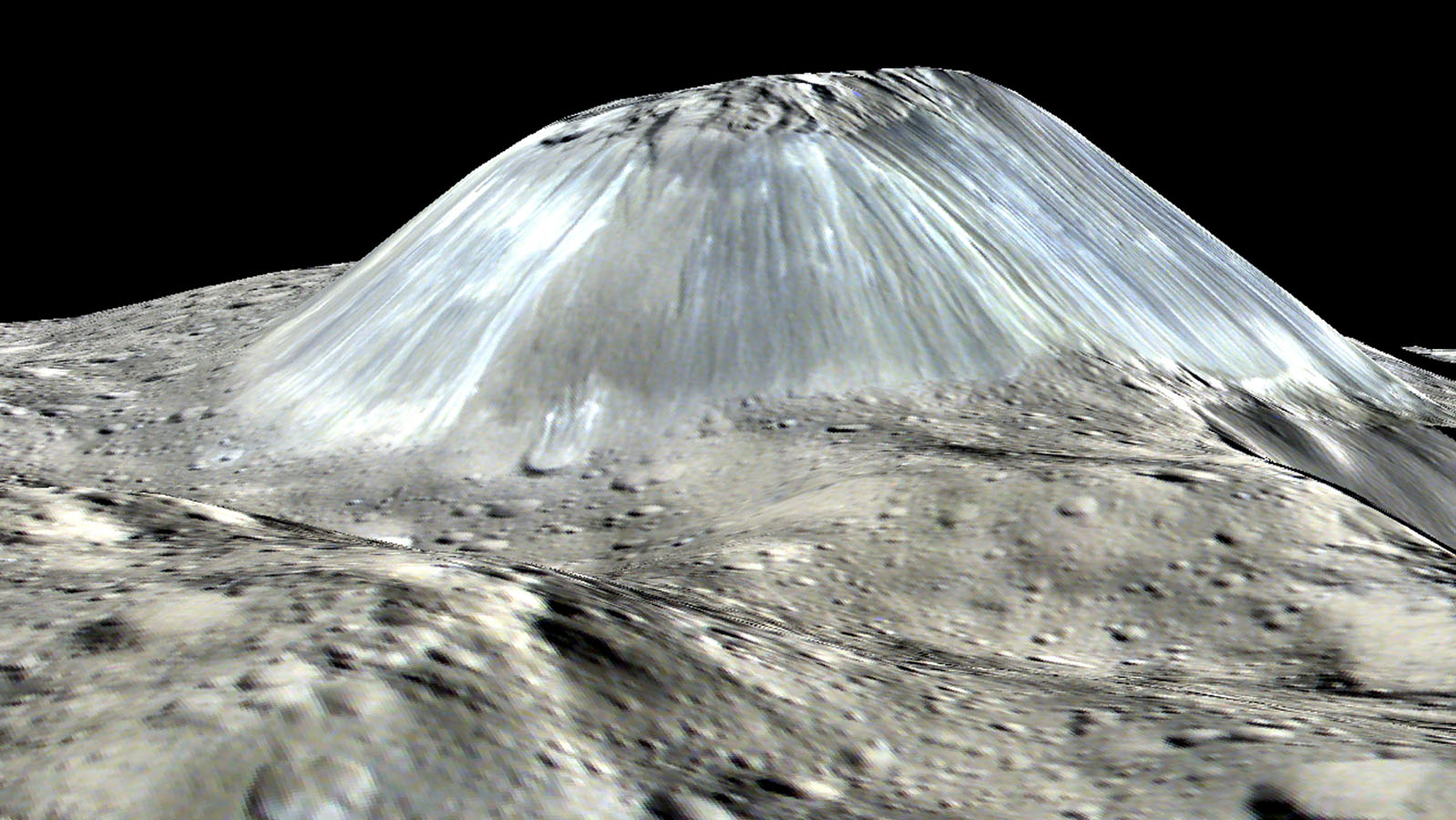
The mountain Ahuna Mons gets its own fourth category -- the one instance on Ceres where bright material is unaffiliated with any impact crater. This likely cryovolcano, a volcano formed bythe gradual accumulation of thick, slowly flowing icy materials, has prominent bright streaks on its flanks.

Over hundreds of millions of years, bright material has mixed with the dark material that forms the bulk of Ceres' surface, as well as debris ejected during impacts. That means billions of years ago, when Ceres experienced more impacts, the dwarf planet's surface likely would have been peppered with thousands of bright areas.

"Previous research has shown that the bright material is made of salts, and we think subsurface fluid activity transported it to the surface to form some of the bright spots," Stein said.

The Case of Occator

Why do the different bright areas of Occator seem so distinct from one another? Lynnae Quick, a planetary geologist at the Smithsonian Institution in Washington, has been delving into this question.

The leading explanation for what happened at Occator is that it could have had, at least in the recent past, a reservoir of salty water beneath it. Vinalia Faculae, the diffuse bright regions to the northeast of the crater's central dome, could have formed from a fluid driven to the surface by a small amount of gas, similar to champagne surging out of its bottle when the cork is removed.

In the case of the Vinalia Faculae, the dissolved gas could have been a volatile substance such as water vapor, carbon dioxide, methane or ammonia. Volatile-rich salty water could have been brought close to Ceres' surface through fractures that connected to the briny reservoir beneath Occator. The lower pressure at Ceres' surface would have caused the fluid to boil off as a vapor. Where fractures reached the surface, this vapor could escape energetically, carrying with it ice and salt particles and depositing them on the surface.

Cerealia Facula must have formed in a somewhat different process, given that it is more elevated and brighter than Vinalia Faculae. The material at Cerealia may have been more like an icy lava, seeping up through the fractures and swelling into a dome. Intermittent phases of boiling, similar to what happened when Vinalia Faculae formed, may have occurred during this process, littering the surface with ice and salt particles that formed the Cerealia bright spot.

Quick's analyses do not depend on the initial impact that formed Occator. However, the current thinking among Dawn scientists is that when a large body slammed into Ceres, excavating the 57-mile-wide (92-kilometer-wide) crater, the impact may have also created fractures through which liquid later emerged.

"We also see fractures on other solar system bodies, such as Jupiter's icy moon Europa," Quick said. "The fractures on Europa are more widespread than the fractures we see at Occator. However, processes related to liquid reservoirs that might exist beneath Europa's cracks today could be used as a comparison for what may have happened at Occator in the past."

As Dawn continues the final phase of its mission, in which it will descend to lower altitudes than ever before, scientists will continue learning about the origins of the bright material on Ceres and what gave rise to the enigmatic features in Occator.

The Dawn mission is managed by JPL for NASA's Science Mission Directorate in Washington. Dawn is a project of the directorate's Discovery Program, managed by NASA's Marshall Space Flight Center in Huntsville, Alabama. UCLA is responsible for overall Dawn mission science. Orbital ATK Inc., in Dulles, Virginia, designed and built the spacecraft. The German Aerospace Center, Max Planck Institute for Solar System Research, Italian Space Agency and Italian National Astrophysical Institute are international partners on the mission team. For a complete list of mission participants, visit:

https://dawn.jpl.nasa.gov/mission

More information about Dawn is available at the following sites:

https://www.nasa.gov/dawn

https://dawn.jpl.nasa.gov


NASA Jet Propulsion Laboratory
NASA's Jet Propulsion Laboratory
4800 Oak Grove Dr
Pasadena, CA 91109

Sunday, October 29, 2017

EarthSky News - Oct 29 - Did Ceres Once Have an Ocean?

October 29
Did Ceres Once Have an Ocean?
Like us on Facebook
Follow us on Twitter
Instagram
Website
imp?s=127510&layout=marquee&li=c643945d79&e=mantiskhiralla@gmail.com&p=8cb296e66b
imp?s=127511&sz=1x1&li=c643945d79&e=mantiskhiralla@gmail.com&p=8cb296e66b imp?s=127512&sz=1x1&li=c643945d79&e=mantiskhiralla@gmail.com&p=8cb296e66b
imp?s=127513&sz=116x15&li=c643945d79&e=mantiskhiralla@gmail.com&p=8cb296e66b imp?s=127514&sz=69x15&li=c643945d79&e=mantiskhiralla@gmail.com&p=8cb296e66b
Did Ceres once have an ocean?
If it existed, what happened to it? And could Ceres still have liquid water today?
Tonight … Perseus the Hero and a Demon Star
Algol means head of the demon. Point out this star to your friends this Halloween.
Fornax Galaxy Cluster reveals its secrets
This new 2.3-gigapixel image of the Fornax Galaxy Cluster - one of the largest images ever released by European Southern Observatory - might make you feel small.
How do human genes act in space?
"Looking at gene expression ... we really see an explosion, like fireworks taking off, as soon as the human body gets into space."
imp?s=49920&sz=300x250&li=c643945d79&e=mantiskhiralla@gmail.com&p=8cb296e66b
imp?s=49921&sz=1x1&li=c643945d79&e=mantiskhiralla@gmail.com&p=8cb296e66b imp?s=49922&sz=1x1&li=c643945d79&e=mantiskhiralla@gmail.com&p=8cb296e66b
imp?s=49911&sz=116x15&li=c643945d79&e=mantiskhiralla@gmail.com&p=8cb296e66b imp?s=96408&sz=69x15&li=c643945d79&e=mantiskhiralla@gmail.com&p=8cb296e66b
Donate to EarthSky

Help us keep presenting your world, and cosmos, to you.

Tonight … Perseus the Hero and a Demon Star
Algol isn't Perseus' brightest star, but it's probably its best known star. Algol is easy to spot in a dark-enough sky.
imp?s=167941&sz=300x250&li=c643945d79&e=mantiskhiralla@gmail.com&p=8cb296e66b
imp?s=167942&sz=1x1&li=c643945d79&e=mantiskhiralla@gmail.com&p=8cb296e66b imp?s=167943&sz=1x1&li=c643945d79&e=mantiskhiralla@gmail.com&p=8cb296e66b
imp?s=49911&sz=116x15&li=c643945d79&e=mantiskhiralla@gmail.com&p=8cb296e66b imp?s=96408&sz=69x15&li=c643945d79&e=mantiskhiralla@gmail.com&p=8cb296e66b

Photos: Observe the Moon Night

Last night was International Observe the Moon Night, and EarthSky community members from around the world sent photos, reminding us that we all see the same moon. This shot is from Talha Zia of Karachi, Pakistan.


Submit your photo to EarthSky here!
Like us on Facebook
Follow us on Twitter
Instagram
Website
imp?s=160248&layout=marquee&li=c643945d79&e=mantiskhiralla@gmail.com&p=8cb296e66b
imp?s=160249&sz=1x1&li=c643945d79&e=mantiskhiralla@gmail.com&p=8cb296e66b imp?s=160250&sz=1x1&li=c643945d79&e=mantiskhiralla@gmail.com&p=8cb296e66b
imp?s=160251&sz=116x15&li=c643945d79&e=mantiskhiralla@gmail.com&p=8cb296e66b

Tuesday, April 18, 2017

Ceres Prank Lands Bart Simpson In Detention For Eternity

New post on Universe Today

Ceres Prank Lands Bart Simpson In Detention For Eternity

by Evan Gough

Human-kind has a long history of looking up at the stars and seeing figures and faces. In fact, there's a word for recognizing faces in natural objects: pareidolia. But this must be the first time someone has recognized Bart Simpson's face on an object in space.

Researchers studying landslides on the dwarf planet Ceres noticed a pattern that resembles the cartoon character. The researchers, from the Georgia Institute of Technology, are studying massive landslides that occur on the surface of the icy dwarf. Their findings are reinforcing the idea that Ceres has significant quantities of frozen water.

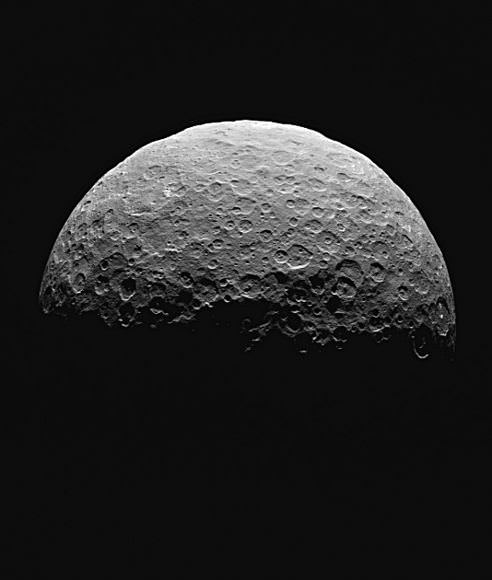
Dwarf planet Ceres is the largest object in the asteroid belt between Mars and Jupiter. Credit: NASA/JPL-Caltech/UCLA/MPS/DLR/IDA, taken by Dawn Framing Camera

Dwarf planet Ceres is the largest object in the asteroid belt between Mars and Jupiter. Credit: NASA/JPL-Caltech/UCLA/MPS/DLR/IDA, taken by Dawn Framing Camera

In a new paper in the journal Nature Geoscience, the team of scientists, led by Georgia Tech Assistant Professor and Dawn Science Team Associate Britney Schmidt, examined the surface of Ceres looking for morphologies that resemble landslides here on Earth.

Research shows us that Ceres probably has a subsurface shell that is rich with water-ice. That shell is covered by a layer of silicates. Close examination of the type, and distribution, of landslides at different latitudes adds more evidence to the sub-surface ice theory.

Ceres is pretty big. At 945 km in diameter, it's the largest object in the asteroid belt between Mars and Jupiter. It's big enough to be rounded by its own gravity, and it actually comprises about one third of the mass of the entire asteroid belt.

Credit: NASA/JPL-Caltech/UCLA/MPS/DLR/IDA, taken by Dawn Framing Camera

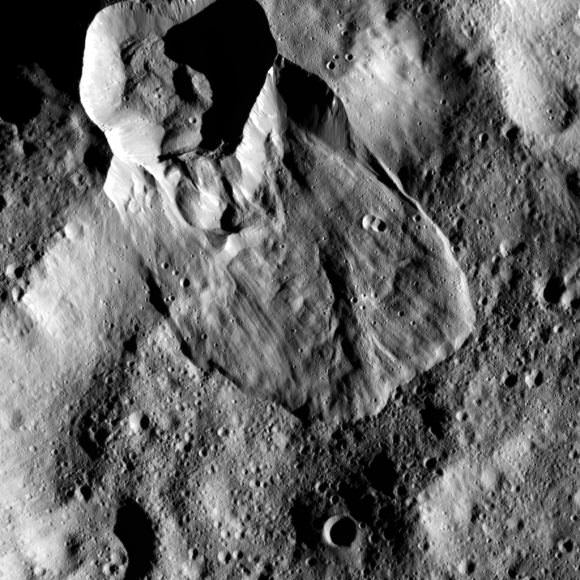
Type 1 landslides on Ceres are large and occur at higher latitudes. Image: Credit: NASA/JPL-Caltech/UCLA/MPS/DLR/IDA, taken by Dawn Framing Camera

The team used observations from the Dawn Framing Camera to identify three types of landslides on Ceres' surface:

  • Type 1 are large, rounded features similar to glacier features in the Earth's Arctic region. These are found mostly at high latitudes on Ceres, which is where most of the ice probably is.
  • Type 2 are the most common. They are thinner and longer than Type 1, and look like terrestrial avalanche deposits. They're found mostly at mid-latitudes on Ceres. The researchers behind the study thought one of them looked like Bart Simpson's face.
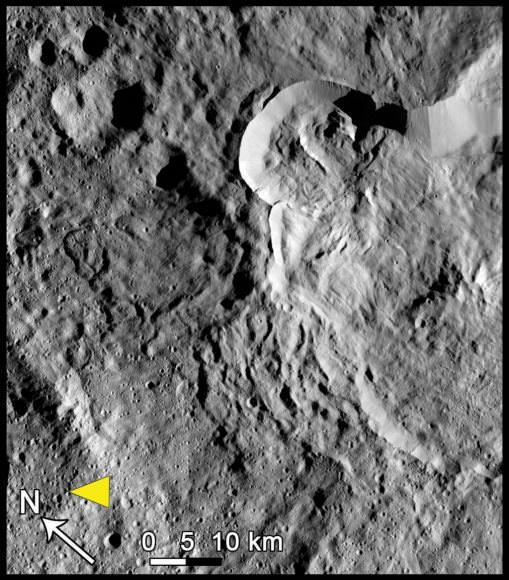
  • Type 3 occur mostly at low latitudes near Ceres' equator. These are always found coming from large impact craters, and probably formed when impacts melted the sub-surface ice.
Type 3 landslides on Ceres occur at low latitudes at large craters, and form when ice is melted by impacts. Credit: NASA/JPL-Caltech/UCLA/MPS/DLR/IDA, taken by Dawn Framing Camera

Type 3 landslides on Ceres occur at low latitudes at large craters, and form when ice is melted by impacts. Credit: NASA/JPL-Caltech/UCLA/MPS/DLR/IDA, taken by Dawn Framing Camera

The authors of the study say that finding larger landslides further away from the equator is significant, because that's where most of the ice is.

"Landslides cover more area in the poles than at the equator, but most surface processes generally don't care about latitude," said Schmidt, a faculty member in the School of Earth and Atmospheric Sciences. "That's one reason why we think it's ice affecting the flow processes. There's no other good way to explain why the poles have huge, thick landslides; mid-latitudes have a mixture of sheeted and thick landslides; and low latitudes have just a few."  

Key to understanding these results is the fact that these types of processes have only been observed before on Earth and Mars. Earth, obviously, has water and ice in great abundance, and Mars has large quantities of sub-surface ice as well. "It's just kind of fun that we see features on this small planet that remind us of those on the big planets, like Earth and Mars," Schmidt said. "It seems more and more that Ceres is our innermost icy world."

"These landslides offer us the opportunity to understand what's happening in the upper few kilometers of Ceres," said Georgia Tech Ph.D. student Heather Chilton, a co-author on the paper. "That's a sweet spot between information about the upper meter or so provided by the GRaND (Gamma Ray and Neutron Detector) and VIR (Visible and Infrared Spectrometer) instrument data, and the tens of kilometers-deep structure elucidated by crater studies."

It's not just the presence of these landslides, but the frequency of them, that upholds the icy-mantle idea on Ceres. The study showed that 20% to 30% of craters on Ceres larger than 10 km have some type of landslide. The researchers say that upper layers of Ceres' could be up to 50% ice by volume.

Comment    See all comments

Trouble clicking? Copy and paste this URL into your browser: 

https://www.universetoday.com/135068/ceres-prank-lands-bart-simpson-detention-eternity/


Thursday, April 6, 2017

Confirmed: Ceres Has a Transient Atmosphere

New post on Universe Today

Confirmed: Ceres Has a Transient Atmosphere

by Nancy Atkinson

Sometimes they see it, sometimes they don't. That's why scientists have never been completely sure if Ceres has an atmosphere or not. But now data from the Dawn spacecraft -- in orbit of Ceres -- confirms the dwarf planet really does have a very weak atmosphere, but it comes and goes. The on-again-off-again nature of Ceres' atmosphere appears to be linked to solar activity. When energetic particles from the Sun hit exposed ice within the craters on Ceres, the ice can sublimate and create an "exosphere" that lasts for a week or so.

Michaela Villarreal from UCLA, lead author of the new study, and her team wrote in their paper that the "atmosphere appeared shortly after the passage of a large enhancement in the local flux of high-energy solar protons," and explained that when energetic particles from the Sun hit exposed ice and ice near the surface of the dwarf planet, it transfers energy to the water molecules as they collide. This frees the water molecules from the ground, allowing them to escape and create a tenuous atmosphere.

NASA's Dawn spacecraft determined the hydrogen content of the upper yard, or meter, of Ceres' surface. Blue indicates where hydrogen content is higher, near the poles, while red indicates lower content at lower latitudes. Image credit: NASA/JPL-Caltech/UCLA/MPS/DLR/IDA/PSI

A process like this could also be taking place on the Moon, and is likely similar to the process similar to what takes place on comets.

"Our results also have implications for other airless, water-rich bodies of the solar system, including the polar regions of the moon and some asteroids," said Chris Russell, principal investigator of the Dawn mission, also at UCLA. "Atmospheric releases might be expected from their surfaces, too, when solar activity erupts."

There have been hints of an atmosphere at Ceres since the early 1990's. In 1991, the International Ultraviolet Explorer satellite detected hydroxyl emission from Ceres, but not in 1990. Then, in 2007, the European Southern Observatory's Very Large Telescope searched for a hydroxide emission, but came up empty. The European Space Agency's Herschel Space Observatory detected water vapor as a possible weak atmosphere, on three occasions, but did not on a fourth attempt.

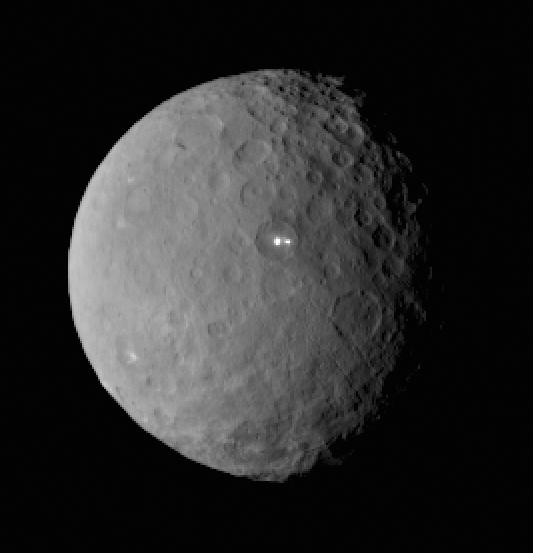
This image was taken by NASA's Dawn spacecraft of dwarf planet Ceres on Feb. 19 from a distance of nearly 29,000 miles (46,000 kilometers). It shows that the brightest spot on Ceres has a dimmer companion, which apparently lies in the same basin. Image Credit: NASA/JPL-Caltech/UCLA/MPS/DLR/IDA

The Dawn spacecraft itself saw evidence of a transient atmosphere when it arrived at Ceres in March 2015, with data from its Gamma Ray and Neutron Detector instrument. It also has found ample evidence for water in the form of ice, found just underground at higher latitudes, where temperatures are lower. Ice has been detected directly at the small bright crater called Oxo and in at least one of the craters that are persistently in shadow in the northern hemisphere. Other research has suggested that persistently shadowed craters are likely to harbor ice. Additionally, the shapes of craters and other features are consistent with significant water-ice content in the crust.

The team's research shows the atmosphere doesn't necessarily show up when Ceres is close to the Sun or when sunlight hits the ice directly, but from energetic particles released by the Sun when its activity level is high. For example, the best detections of Ceres' atmosphere did not occur at its closest approach to the Sun.

Also, the times where no atmosphere was detected coincided with lower solar activity, so the researchers say this this suggests that solar activity, rather than Ceres' proximity to the Sun, is a more important factor in generating an exosphere.

Ceres actually is now getting closer to the Sun. However, since the Sun appears to be in a very quiet period, Villarreal, Russell and team predict an atmosphere won't show up that the dwarf planet will have little to no atmosphere for some time. However, they said both Dawn and other observatories should keep an eye on what's happening at Ceres.

Paper: The Dependence of the Cerean Exosphere on Solar Energetic Particle Events

JPL press release

Nancy Atkinson | April 6, 2017 at 7:19 pm | URL: http://wp.me/p1CHIY-z6a
Comment    See all comments

Trouble clicking? Copy and paste this URL into your browser: 

https://www.universetoday.com/134922/confirmed-ceres-transient-atmosphere/


Tuesday, March 7, 2017

Brightest ‘Spot’ on Ceres is Likely a Cryovolcano

New post on Universe Today

Brightest 'Spot' on Ceres is Likely a Cryovolcano

by Nancy Atkinson

The bright regions on the dwarf planet Ceres have been some of the most talked about features in planetary science in recent years. While data from the Dawn spacecraft has shown these bright areas are salt deposits (alas, not lights of an alien city), the question remained of where these salts came from.

Researchers with the Dawn mission say they have now thoroughly investigated the complex geological structures in Occator crater, the region with the brightest regions on Ceres. The scientists conclude that a bright dome-like feature called Cerealia Facula is the remnant of a cryovolcano -- an ice volcano -- that repeatedly and relatively recently spewed salty ice on the surface of Ceres.

"The age and appearance of the material surrounding the bright dome indicate that Cerealia Facula was formed by a recurring, eruptive process, which also hurled material into more outward regions of the central pit," said Andreas Nathues, a Dawn scientist from the Max Planck Institute for Solar System Research. "A single eruptive event is rather unlikely."

The bright central spots near the center of Occator Crater are shown in enhanced color in this view from NASA's Dawn spacecraft. The view was produced by combining the highest resolution images taken in February 2016 (at image scales 115 feet (35 meters) per pixel of 35 meters with color images obtained in September 2015 at a lower resolution. Click for a highest-res view. Credit: NASA/JPL-Caltech/UCLA/MPS/DLR/IDA/PSI

Occator crater located in the northern hemisphere of Ceres measures 92 kilometers (57 miles) in diameter. In its center is a pit with a diameter of about 11 kilometers (7 miles). On some parts of its edges, jagged mountains and steep slopes rise up to 750 meters (820 yards) high. Within the pit a bright dome formed. It has a diameter of 3 km (1.8 miles), is 400 meters (437 yards) high, with prominent fractures.

In analyzing images from Dawn's Framing Camera, Nathues and his team deduced that the central pit is a remnant of a former central mountain, formed from the impact that created Occator Crater about 34 million years ago. But with a method for estimating the age of a planet's surface – called crater counting -- the science team could determine the dome of bright material is only about four million years old.

This suggests, the team said, that Occator crater has been the scene of eruptive outbursts of subsurface brine over a long period and until almost recently.

Jupiter's moons Callisto and Ganymede show similar types of domes, and researchers interpret them as signs of cryovolcanism. While Ceres is too far from the Sun to be warm enough for regular volcanic activity, it very likely has harbored cryovolcanic activity, and it may even be active today.

This 3d-anaglyph for the first time shows a part of Occator crater in a combination of anaglyphe and false-color image. Credit: NASA/JPL-Caltech/UCLA/MPS/DLR/IDA

Images from the Hubble Space Telescope taken more than a decade ago hinted at the bright spots in Occator Crater, but as the Dawn spacecraft approached Ceres in 2015, new images showed the bright areas almost shining like "cosmic beacons, like interplanetary lighthouses drawing us forth," as described by Marc Rayman, the chief engineer and mission director for Dawn, in an interview with me last year.

Dawn scientist had previously determined the bright areas were salts left over from subsurface briny water that had made its way to the surface, and in the vacuum of space, the water sublimated away, leaving behind the dissolved salts. These salts were determined to be sodium carbonate and ammonium chloride.

This view of the whole Occator crater shows the brightly colored pit in its center and the cryovolcanic dome. The jagged mountains on the edge of the pit throw their shadows on parts of the pit. This image was taken from a distance of 1478 kilometers above the surface and has a resolution of 158 meters per pixel. Credit: NASA/JPL-Caltech/UCLA/MPS/DLR/IDA

But don't call these bright areas "spots," said Rayman. "Some of these bright areas are miles across," he said, "and just as if you were standing on salt flats on Earth that were several thousand acres, you wouldn't say, 'I'm standing on a spot.' You are standing on a big area. But just to see the distribution of this material in the Dawn images shows there is something complex going on there."

It is currently unknown if the region in Occator Crater is active, but there are hints it is, at least at a low level.

In 2014 the Herschel spacecraft detected water vapor above Occator, and images from Dawn's cameras of the crater show a 'haze' when imaged at certain angles, and this has been explained as the sublimation of water.

Dawn scientists are also studying the large volcanic feature on Ceres, Ahuna Mons, to determine if it could be a cryovolcano.

Ceres' lonely mountain, Ahuna Mons, is seen in this simulated perspective view. The elevation has been exaggerated by a factor of two. Image Credit: NASA/JPL-Caltech/UCLA/MPS/DLR/IDA/PSI

Further Reading: Max Planck Institute for Solar System Research

Nancy Atkinson | March 7, 2017 at 5:02 pm | Tags: Featured, Occator crater, Thailand | Categories: Ceres | URL: http://wp.me/p1CHIY-yTi
Comment    See all comments

Trouble clicking? Copy and paste this URL into your browser: 

http://www.universetoday.com/134124/brightest-spot-ceres-likely-cryovolcano/