For decades, ever since the Pioneer and Voyager missions passed through the outer Solar System, scientists have speculated that life might exist within icy bodies like Jupiter's moon Europa. However, thanks the Cassinimission, scientists now believe that other moons in the outer Solar System - such as Saturn's moon Enceladus - could possibly harbor life as well.
For instance, Cassini observed plume activity coming from Enceladus' southern polar region that indicated the presence of hydrothermal activity inside. What's more, these plumes contained organic molecules and hydrated minerals, which are potential indications of life. To see if life could thrive inside this moon, a team of scientists conducted a test where strains of Earth bacteria were subjected to conditions similar to what is found inside Enceladus.
The study which details their findings recently appeared in the journal Nature Communications under the title "Biological methane production under putative Enceladus-like conditions". The study was led by Ruth-Sophie Taubner from the University of Vienna, and included members from the Johannes Kepler University Linz, Ecotechnology Austria, the University of Bremen, and the University of Hamburg.
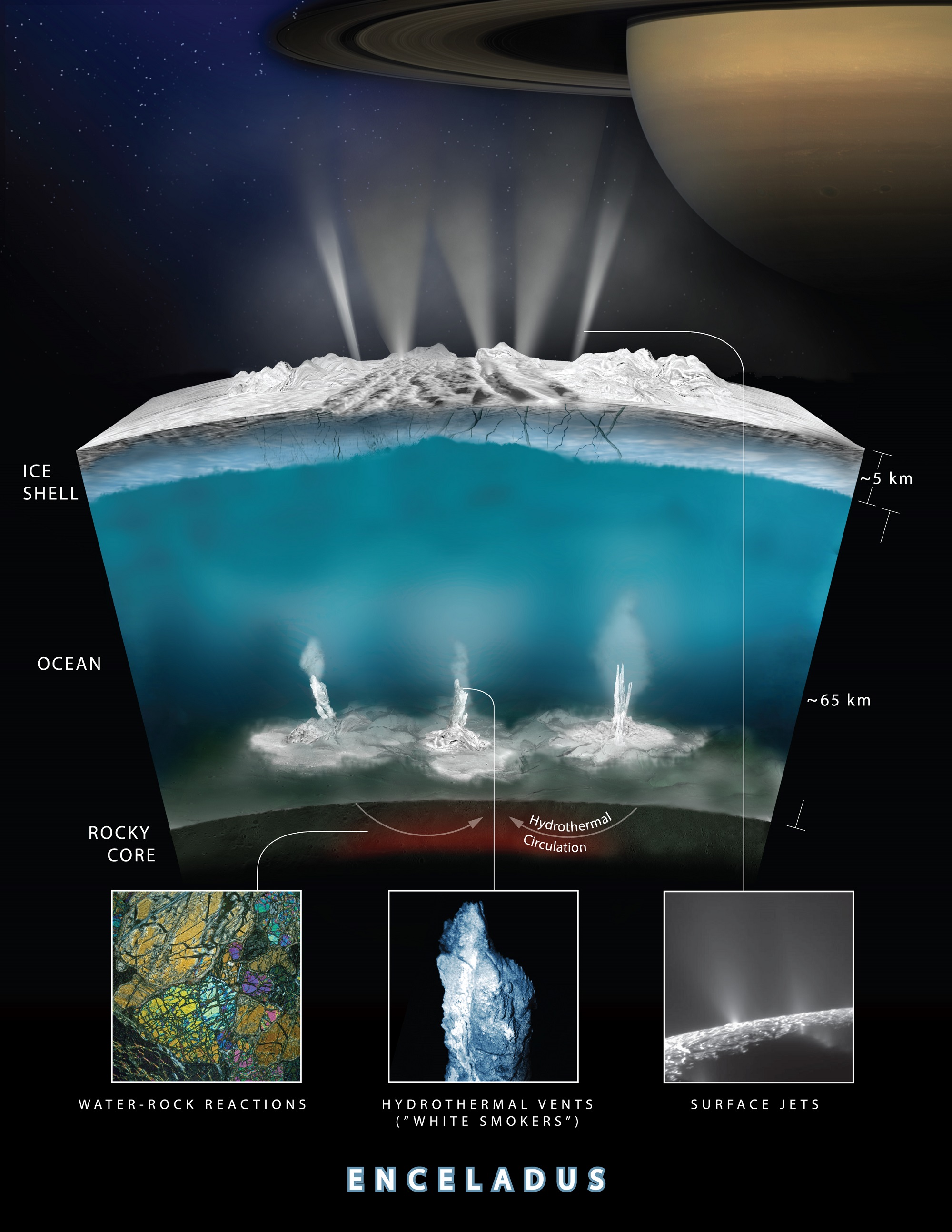
Artist's rendering of possible hydrothermal activity that may be taking place on and under the seafloor of Enceladus. Credit: NASA/JPL
For the sake of their study, the team chose to work with three strains of methanogenic archaea known as methanothermococcus okinawensis. This type of microorganism thrives in low-oxygen environments and consumes chemical products known to exist on Enceladus - such as methane (CH4), carbon dioxide (CO2) and molecular hydrogen (H2) - and emit methane as a metabolic byproduct. As they state:
"To investigate growth of methanogens under Enceladus-like conditions, three thermophilic and methanogenic strains, Methanothermococcus okinawensis (65 °C), Methanothermobacter marburgensis (65 °C), and Methanococcus villosus (80 °C), all able to fix carbon and gain energy through the reduction of CO2 with H2 to form CH4, were investigated regarding growth and biological CH4 production under different headspace gas compositions..."
These strains were selected because of their ability to grow in a temperature range that is characteristic of the vicinity around hydrothermal vents, in a chemically defined medium, and at low partial pressures of molecular hydrogen. This is consistent with what has been observed in Enceladus' plumes and what is believed to exist within the moon's interior.
These types of archaea can still be found on Earth today, lingering in deep-see fissures and around hydrothermal vents. In particular, the strain of M. okinawensis has been determined to exist in only one location around the deep-sea hydrothermal vent field at Iheya Ridge in the Okinawa Trough near Japan. Since this vent is located at a depth of 972 m (3189 ft) below sea level, this suggests that this strain has a tolerance toward high pressure.
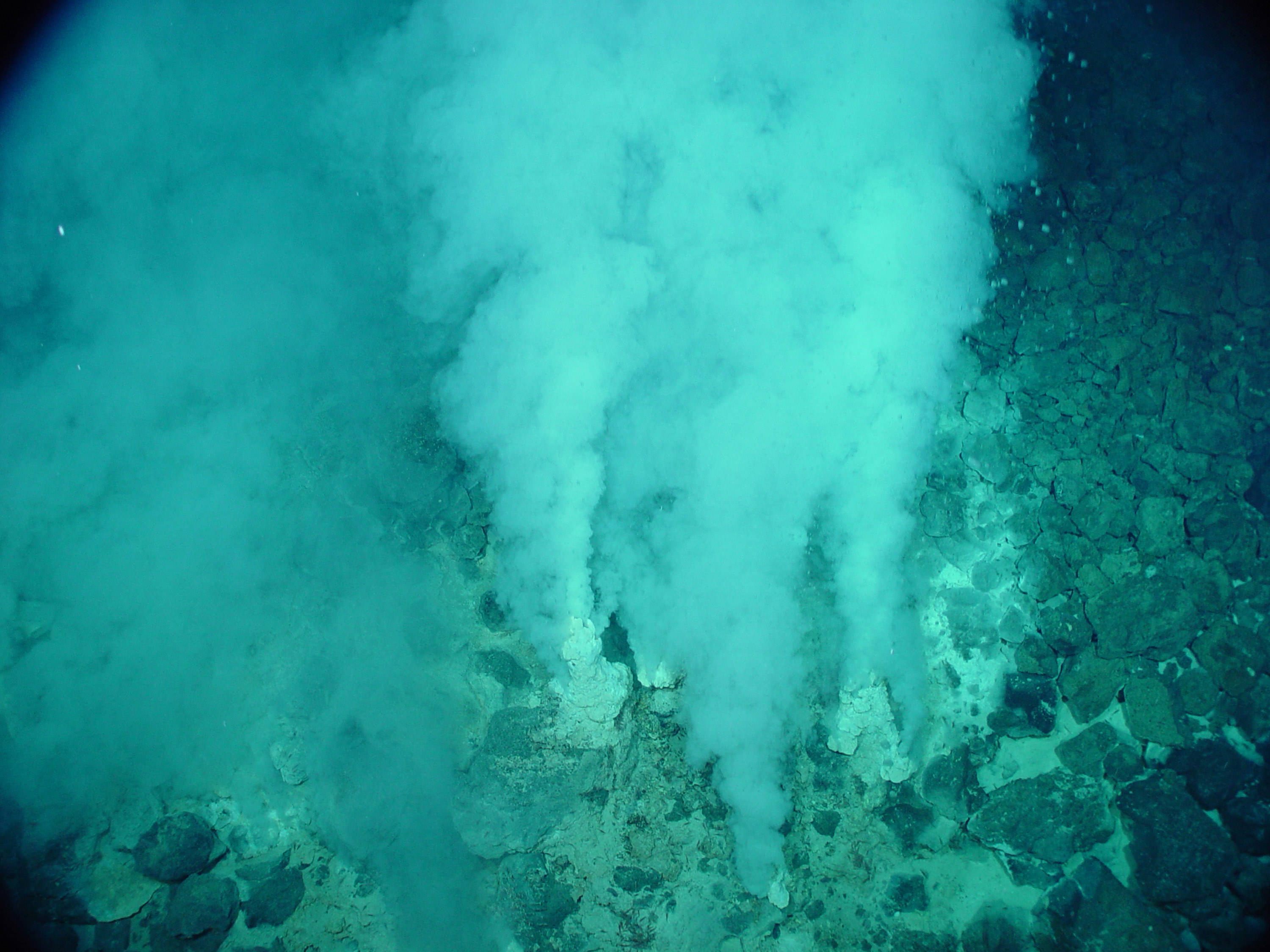
Hydrothermal vents on Earth's ocean floor. Credit: NOAA
For many years, scientists have suspected that Earth's hydrothermal vents played a vital role in the emergence of life, and that similar vents could exist within the interior of moons like Europa, Ganymede, Titan, Enceladus, and other bodies in the outer Solar System. As a result, the research team believed that methanogenic archaea could also exist within these bodies.
After subjecting the strains to Enceladus-like temperature, pressure and chemical conditions in a laboratory environment, they found that one of the three strains was able to flourish and produce methane. The strain even managed to survive after the team introduced harsh chemicals that are present on Enceladus, and which are known to inhibit the growth of microbes. As they conclude in their study:
"In this study, we show that the methanogenic strain M. okinawensis is able to propagate and/or to produce CH4 under putative Enceladus-like conditions. M. okinawensis was cultivated under high-pressure (up to 50 bar) conditions in defined growth medium and gas phase, including several potential inhibitors that were detected in Enceladus' plume."
From this, they determined that some of the methane found in Enceladus' plumes were likely produced by the presence of methanogenic microbes. As Simon Rittmann, a microbiologist at the University of Vienna and lead author of the study, explained in an interview with The Verge. "It's likely this organism could be living on other planetary bodies," he said. "And it could be really interesting to investigate in future missions."
Artist impression of an interior cross-section of the crust of Enceladus, which shows how hydrothermal activity may be causing the plumes of water at the moon's surface. Credits: NASA-GSFC/SVS, NASA/JPL-Caltech/Southwest Research Institute
In the coming decades, NASA and other space agencies plan to send multiple mission to the Jupiter and Saturn systems to investigate their "ocean worlds" for potential signs of life. In the case of Enceladus, this will most likely involve a lander that will set down around the southern polar region and collect samples from the surface to determine the presence of biosignatures.
Alternately, an orbiter mission may be developed that will fly through Enceladus' plumes and collect bioreadings directly from the moon's ejecta, thus picking up where Cassini left off. Whatever form the mission takes, the discoveries are expected to be a major breakthrough. At long last, we may finally have proof that Earth is not the only place in the Solar System where live can exist.
The ESA's Mars Express probe has been studying Mars and its Moons for many years. While there are several missions currently in orbit around Mars, Mars Express's near-polar elliptical orbit gives it some advantages over the others. For one, its orbital path takes it closer to Phobos than any other spacecraft, which allows it to periodically observe the moon from distances of around 150 km (93 mi).
Because of this, the probe is in an ideal position to study Mars' moons and capture images of them. On occasion, this allows for some interesting photo opportunities. For example, in November of 2017, while taking pictures of Phobos and Deimos, the probe spotted Saturn in the background. This fortuitous event led to the creation of some beautiful images, which were put together to produce a video.
Since 2003, Mars Express has been studying Phobos and Deimos in the hopes of learning more about these mysterious objects. While it has learned much about their size, appearance and position, much remains unknown about their composition, how and where they formed, and what their surface conditions are like. To answer these questions, the probe has been conducting regular flybys of these moons and taking pictures of them.
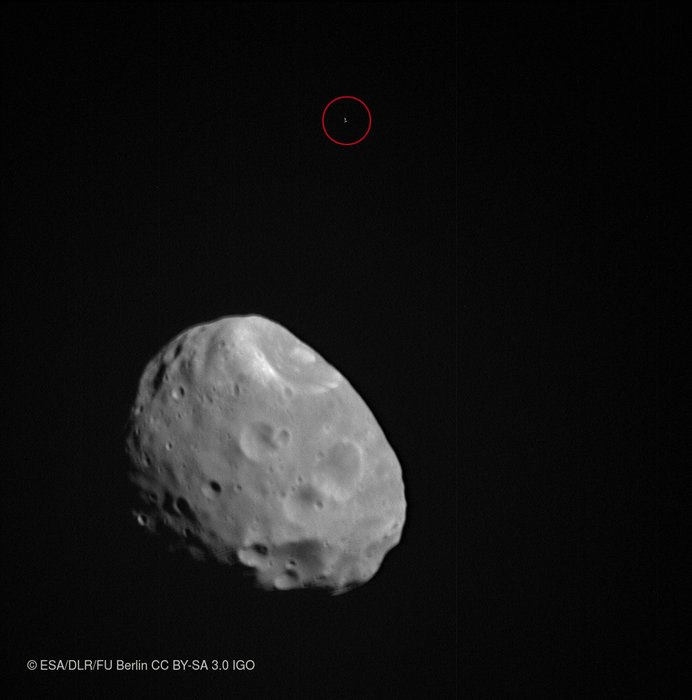
Phobos and background star (circled in red). Credit: ESA/DLR/FU Berlin
The video that was recently released by the ESA combines 30 such images which show Phobos passing through the frame. In the background, Saturn is visible as a small ringed dot, despite being roughly 1 billion km away. The images that were used to create this video were taken by the probes High Resolution Stereo Camera on November 26th, 2016, while the probe was traveling at a speed of about 3 km/s.
This photobomb was not unexpected, since the Mars Express repeatedly uses background reference stars and other bodies in the Solar System to confirm positions of the moons in the sky. In so doing, the probe is able to calculate the position of Phobos and Deimos with an accuracy of up to a few kilometers. The probes ideal position for capturing detailed images has also helped scientists to learn more about the surface features and structure of the two moons.
For instance, the pictures taken during the probe's close flybys of Phobos showed its bumpy, irregular and dimpled surface in detail.The moon's largest impact crater - the Stickney Crater - is also visible in one of the frames. Measuring 9 km ( mi) in diameter, this crater accounts for a third of the moon's diameter, making it one the largest impact craters relative to body size in the Solar System.
In another image, taken on January 15th, 2018, Deimos is visible as an irregular and partially shadowed body in the foreground, while the delicate rings of Saturn are just visible encircling the small dot in the background (see below). In addition, Mars Express also obtained images of Phobos set against a reference star on January 8th, 2018 (see above) and close-up images of Phobos' pockmarked surface on September 12th, 2017.
This image of Deimos and Saturn was taken by the Super Resolution Channel of Mars Express' High Resolution Stereo Camera. Credit: ESA/DLR/FU Berlin
In the future, the Mars Express probe is expected to reveal a great deal more about Mars' system of moons. In addition to the enduring questions of their origins, formation and composition, there are also questions about where future missions could land in order to study the surface directly. In particular, Phobos has been considered for a possible landing and sample-return mission.
Because of its nearness to Mars and the fact that one side is always facing towards the planet, the moon could make for an ideal location for a permanent observation post. This post would allow for the long-term study of the Martian surface and atmosphere, could act as a communications relay for other spacecraft, and could even serve as a base for future missions to the surface.
If and when such a mission to Phobos becomes a reality, it is the Mars Express probe that will determine where the ideal landing site would be. In essence, by studying the Martian moons to learning more about them, Mars Express is helping to prepare future missions to the Red Planet.
Be sure to check out the time-lapse video of Phobos and Saturn, courtesy of the ESA:
As tempestades de Saturno são uma visão a ser comtemplada. Ao contrário de outros planetas no Sistema Solar, o planeta anelado parece armazenar enormes quantidades de energia em várias décadas da Terra e, em seguida, libertá-la de uma só vez sob a forma de uma tempestade caótica de relâmpagos.
Las tormentas saturnianas son dignas de contemplar. A diferencia de otros planetas del Sistema Solar, Saturno parece acumular enormes cantidades de energía a lo largo de varias décadas terrestres para luego liberarlas de una sola vez en forma de turbulentas y caóticas tormentas eléctricas.
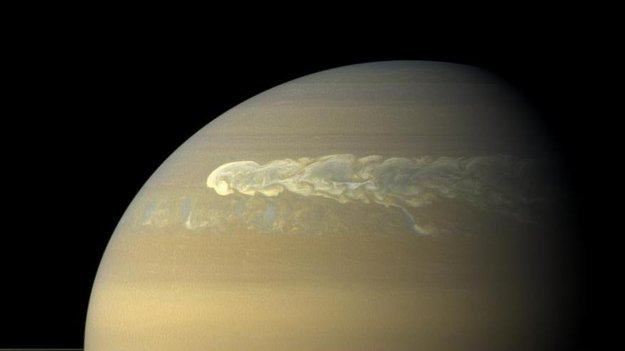
Space Science Image of the Week: Saturn's storms are a sight to behold, as Cassini discovered when it saw this behemoth of a storm encircling the planet in 2011
In 2003, Mars was closer and brighter in our sky than in nearly 60,000 years. In 2018, Mars will be at its brightest since then! Start watching Mars now.
At a very steady rate, unstable carbon-14 gradually decays to carbon-12. The ratio of these carbon isotopes reveals the ages of some of Earth's oldest inhabitants.
Stefan Nilsson took this photo last Sunday. He told us, "I try to shoot this tree once every year during this season ... The tree is on the beach where I live in Åhus, in the southeast part of Sweden."


 Posts
Posts